
Events & Personalities
Gandhi preferred Ahmedabad
When Mahatma Gandhi was invited to a lavish dinner in his honor at Sir Jehangir Petit’s mansion in Bombay, he felt out of place amid the bejeweled, elegantly dressed English speaking high society of the city. Bombay had less charm for him than his native Gujarat and Ahmedabad in particular. The man of peace who spearheaded India’s independence movement preferred to be a big fish in a smaller pond (Ahmedabad) instead of being a big fish in a big pond (Bombay). So related historian and Temple University professor, Howard Spodek delivering the sixth Prof (Dr) Mani Kamerkar Endowment Lecture titled, "Ahmedabad and Bombay: Divergent urban personalities” under the auspices of The Asiatic Society of Bombay (ASB) on February 24, 2012 at the Homi J. H. Taleyarkhan Hall.
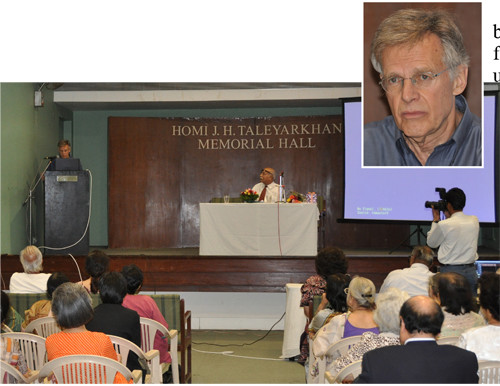
Prof Howard Spodek speaking at the sixth Prof (Dr) Mani Kamerkar Endowment Lecture
It was in Bombay that Gandhi had failed as a lawyer, unable to verbalize his arguments for a client, said Spodek. "He left disgraced.” Gandhi applied for a job as a teacher and though selected was not offered the opening as he was not suitably qualified. "I didn’t like Bombay very much… I see all the shortcomings of London without the benefits,” the historian quoted Gandhi as saying. He went to South Africa and joined a law firm there.
In Bombay civil disobedience took the form of processions, gatherings, speeches, etc. Occasionally violence also erupted as on November 17, 1921 when riots occurred during the visit of the Prince of Wales. The headgear of Parsi men was knocked off and "Parsi women were molested,” said the professor. Earlier, in the riots following opposition to the Rowlatt Act in March and April of 1919 more people died and were injured and killed in Bombay than in Ahmedabad. Gandhi went on a fast in Bombay to restore peace. Three days later normalcy returned. The Act empowered the government to imprison up to two years without trial any person suspected of fomenting violence against the state. The Jallianwala Bagh massacre took place following protests against the draconian legislation the same year. The Act was repealed three years later.
The two cities are 300 miles apart, with Bombay being much larger and having a population of around 20 million to Ahmedabad’s five or six, observed Spodek. Ahmedabad was not as much influenced by outside forces, especially the British, as were other cities built by the colonizers such as Delhi, Calcutta and Madras. "Bombay spoke with multiple voices. Ahmedabad with one dominant voice,” said the professor. "The Gujaratis were more accepting of Gandhi’s style.”
Chairing the meeting, Prof J. V. Naik, trustee of the ASB and former head of the Bombay University’s department of history, said Gandhi "had no fascination for cities. India lives in the villages,” the Mahatma believed.
◆ ◆ ◆
From the archive