
Politics and Policy
Ground realities
Protecting community properties is a challenge for anjumans beset with dwindling resources and members
"Why don’t you talk of other defunct anjumans?” questioned West Zone B retiring vice president Areez Khambatta who believed that Sorab Katpitia who handles the defunct anjumans portfolio on behalf of the Federation of Parsi Zoroastrian Anjumans of India (FPZAI) was only referring to those in Gujarat instead of "concentrating on all India work.” Insisting that there is no progress in the last five years, at the executive council meeting in Bombay on February 11, 2012 Khambatta demanded why Katpitia made no reference to areas like Sahranpur, Aligarh, Mathura, Simla, Amritsar.
Whilst Katpitia tried to explain, "I work without any prejudice… You are sadly mistaken,” it was West Zone A co-opted member Farrokh Rustomji who being a former resident of Delhi explained how the areas cited by Khambatta have only community graveyards which are being maintained by non-Parsis and "no property…of any value.” Partially placated, Khambatta insisted, "This answer should have come from Katpitia… Khoti motai karvané badlé (instead of trying to show off).”
To retrieve defunct anjuman properties, 80 percent of the work is legal, 10 percent concerns revenue and 10 percent is administrative, summed up Katpitia who has now been assigned a trainee to assist him in these onerous tasks.
In Neemuch, when the promised documents did not come from the anjuman, Katpitia managed to access government records. Even though he had engaged a lawyer to object to community property being disposed of, within a month he learnt that three properties had been sold off. He sought the Federation’s consent to declare the sales as illegal and file a criminal case against those who have liquidated community assets. Tehmton Anklesaria, vice president of the north zone felt that after getting each property valuated, it may be better to "try and find a midway” instead of taking legal recourse.
For the Dharwar land, the offer of two crore rupees has to be finalized. The proceeds will be distributed such that neighboring Hubli gets 25 percent of the income plus costs they have borne on protecting the burial land. As conveyed by Maki Kapadia of Belgaum, the father-son duo of Ervads Hoshang and Jehangir Dalal are insistent that the graves should not be touched and a pathway should be provided to access the graves. Since the corpus amount will vest with the all India body, Federation president Dinshaw Mehta announced that they should stipulate the amount required for maintenance of the agiary or dakhma and "we will give it to them.”
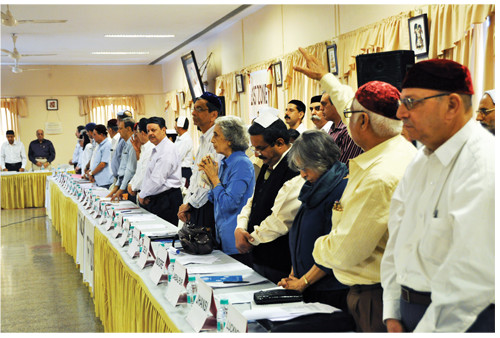
Delegates praying at the start of the first day's deliberations
Efforts are being made to save the property in Rajkot but there appeared to be some confusion over the modalities. According to Khambatta, "We had selected persons — those who can be on the spot and help us. The BPP suo moto decided their own four/five trustees will handle (this matter).” When Mehta told Khambatta, "File was given by you to (BPP trustee) Muncherji Cama,” Khambatta instantly shot back, "I have not given; you have given. A small file does not take a month to read.” When he was asked to follow up with Cama, Khambatta’s rejoinder was, "Why should I? I understand you are the president.”
As explained by Cama most of the letters are in Gujarati and "since I am the only BPP trustee who is fluent in Gujarati” he was asked to peruse the file. He maintained that he had returned the file and barring a description of the properties, the papers made no reference to the Federation having appointed five-seven trustees to negotiate on this matter. Rajkot resident Khushman Tamboli declared that he spends hours at the police station in Rajkot to ensure that this community property is not lost. "Nothing can go wrong while I am there,” he added. When Mehta tried to halt his tirade, Tamboli protested, "I have come all these kilometers. Let me speak…”
The strength of Parsis having "whittled down” in Sholapur and Meeraj the Federation has sought to help them protect their property being "eyed by wicked politicians and bureaucrats who say ‘you surrender your land because being so few you don’t need so much,’” reported Katpitia. Supplemented Mehta, "The Sholapur collector wanted to take over the land and hand it over for use as waqf property.” With the intervention of the National Minorities Commission, the community is "hopeful the (alleged) builder/government lobby will not succeed.” In Bhusaval, an application has been filed and the first hearing was due in February 2012.
In his attempt to compile a list of anjumans likely to be defunct in the near future, Katpitia has issued letters seeking to ascertain the properties being managed by the anjuman, considering that there are some instances of properties being sold off. "When anjumans do not cooperate, the Federation must proceed” and take necessary action before property is lost from the hands of the community, asserted Katpitia.
An agitated Pervez Khergamwalla reproached Katpitia, "You have done nothing… I am a commoner. I have spent lakhs on my anjuman, the dadgah…” Clarified Bombay resident Tannaz Parakh who usually represents Khergam at the Federation meetings, "Khergam is paying the price for allowing me to come to this meeting.”
When Poona resident Adi Engineer representing Kanpur sought to ascertain the definition of "defunct” he was told that when the population in an area comes down to 15-20, "it is time to be vigilant” before the community assets are lost.
"What about selling off of properties by anjumans that are not defunct?” demanded Noshir Dordee of Surat representing Nargol. But at the end of the first day’s proceedings no one was interested in revisiting any controversial topics.
In areas where fire temples are languishing for want of priests or devotees anjumans can avail of the services offered by Naval Surti (mob: 09821926507) with his colleague Marazban Wadia who has been trained at the Cama Athornan Institute thanks to the initiative of Ervad Cyrus Dastoor and efforts of Ervad Homi Govadia. The presence of laymen willing to undertake occasional priestly duties would indicate that community properties are not totally neglected in those areas, they explained their rationale.
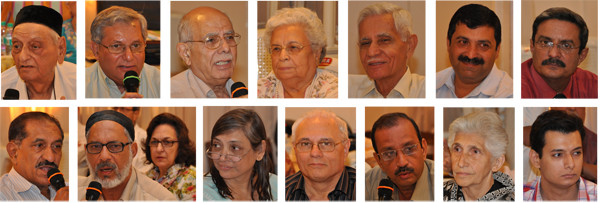
From left (1st row): Sorab Katpitia, Cawas Panthaki, Dadiba Dalal, Mani Clubwala, Marzban Dhanbhoora, Sam Chothia, Kerman Batliwalla; (2nd row) Pervez Bhesania, Sarosh and Pilloo Ginwalla, Pervin Jehangir, Khurshed Pastakia, Marazban Baria, Maki Kapadia, Khushman Tamboli
Restoring resources
Ankleshwar has an agiary over 500 years old with open space around. "We need donations to prevent encroachment from Hindus,” stated Sarosh Bhurana. Bardoli too would be happy to receive donations towards the maintenance of their 125-year-old agiary, mentioned Homi Pithawalla. Daman-Vapi would welcome donations towards the maintenance of their dadgah and dakhma, noted Sharukh Todiwala. Bhatha has a dadgah serving the needs of 25 individuals from 10 families, reported Hushang Vakil. Gandevi’s assets include an adarian, dharamshala and dakhma. They would appreciate financial help for their dakhma wall, conveyed Phiroze Gandevia. In Chikhli they manage a dadgah, a community hall which requires renovation at a cost of Rs 4,00,000, a dharamshala and a dakhma, reminded Parvez Italia. They have no mobed for the last three years but fortunately the three sons of the managing trustee come by rotation to do boi for the dadgah.
Vyara-Songadh, with its population of 125 Zoroastrians has a dadgah, community hall, dharamshala and dakhma. They are now raising funds to build a bungli, mentioned Persi Buhariwala. Badnera-Amravati is the only anjuman that has taken advantage of the Federation’s Agiary Repairs Scheme to repair its dadgah. It is now seeking funds to build mobed quarters, declared Bombay resident Anahita Desai.
In Bharuch the punchayet is completing a wall to protect acres of land around its dakhma. Faced with a dwindling population, they are left with agiaries in areas where no Parsis remain. There are approximately 140 Zoroastrians in Bharuch although not all may be residents, reported Sarosh Ginwalla.
Bilimora has a 113-year-old adarian that is maintained from a fund that draws an annual interest of Rs 3,36,000 and a 184-year-old dadgah managed from a fund that earns a surplus income of Rs 26,000 each year. One of their youngsters serves as a full-time priest and when necessary shares responsibilities of the priest in Gandevi. "We have to give incentives, only then will young mobeds come forward,” stated Marazban Baria. The total income of their anjuman being Rs 53 lakhs this year, they spent Rs 8,66,000 on distribution of foodgrains twice a year, as also 10 meters of mulmul and a frying pan. As per documentary records their land admeasures 1,40,000 sq ft and has a market value of over three crore rupees. "If anyone needs help for their dadgah, adarian or dakhma, we are willing to help.” Another anjuman that is "financially very sound” is Jabalpur that donates funds for scholarships and has spent Rs 4.5 lakhs to build its aramgah wall, stated Kerman Batliwalla. .
Davier has an agiary built in 1855 as also a dharamshala. Their library has been given on rent to a non-Parsi, mentioned Marazban Wadia. To handle their affairs they envisaged they would need help from Nargol/Valsad and also Katpitia.
Godhra has 42-43 Parsis, most of whom are not well educated and unable to manage their assets, said Baroda resident Eruch Lalkaka who has "taken charge.” They have four acres of land originally used as an aramgah that is severely encroached. Worth about five crores of rupees, they have handed over matters to Katpitia.
Federation’s new member, Chhatisgarh, has a membership of 30-35 people with an aramgah in Raipur, said Khurshid Buhariwala. There are 14 Parsis remaining in Kanpur and 13 in Lucknow. Community properties in Kanpur include an agiary, an aramgah and accommodation for the poor, conveyed Adi Engineer.
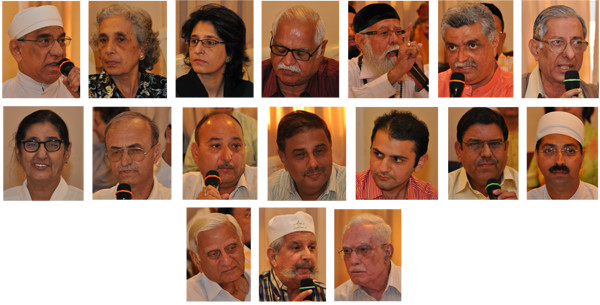
From left (1st row): Ervad Yezdi Panthaki, Thrity Wadia, Khurshid Buhariwala, Ronny Dick,
Marazban Wadia, Sharukh Todiwala, Pervez Khergamwalla; (2nd row) Soonu Vesuna, Eruch Lalkaka, Sarosh Bhurana, Darab Bajina, Arshad Contractor, Parvez Italia, Ervad Kurush Sidhwa; (3rd row) Phiroze Gandevia, Naval Surti and Noshir Dordee
Illav has barely 18-20 Zoroastrian residents including those who only come over the weekends. Their anjuman is not registered but they have an agiary that is about 150 years old, some dakhma land, a dining hall, a gahanbar fund with the BPP. Although their expenses are within 85 percent of their income and they do not need donations, they require assistance in translating Gujarati documents and constitutional guidance on managing a trust, conveyed Bombay resident Pervin Jehangir.
Khergam has only four Zoroastrian households managing an old agiary, dakhma and some prime property in the heart of Khergam where one philanthropic Parsi has offered to finance the cost of fencing the property and planting bawal trees, stated Khergamwalla. Whilst they would like to build a wedding hall and use the revenue to maintain their other assets, Mehta kept enquiring whether they would like the Federation to step in as custodians.
There are two Parsi founded schools in Nargol but not a single Parsi student. As against a population of two-and-a-half thousand in its heydays, the community strength has dwindled to barely 45, "all dosas (elderly).” They have three dadgahs, a dakhma and 23 acres of land in their custody on which they grow grass that yields a monthly income of around Rs 20,000, revealed Farroakh Govadia.
Rajkot has a strength of 20-25 Parsis and four community properties including agiary and graveyard for kids that they have inherited, stated Khushman Tamboli.
When community property in Saronda was encroached upon two years ago the residents contributed money and built mobed’s quarters and a lodging facility for tourists, mentioned Yezdi Panthaki. According to Valsad president Marzban Dhanbhoora, they have two agiaries and a dakhma serving 650 Parsis who are quite comfortable. Vesu has 20 families, noted Soonu Vesuna and they continue to help the needy.
Navsari’s Bamji Chawl, it is feared, is about to fall. The possibility of encroachment too has not been ruled out, revealed Viraf Chiniwala.
Belgaum’s 70 Zoroastrian residents have in their midst an agiary, a dharamshala and manager’s quarters that need periodic repairs, and an aramgah where the wall had to be built after land had to be surrendered to the Cantonment Board for road widening, conveyed Kapadia.
The major source of income for the Madras Anjuman is the rentals they earn from hiring out their airconditioned hall. They number 270 with the age profile being skewed in favor of the elderly. The peaceful and harmonious community meets on the last Saturday of each month and additionally for jashans organized on hamkaras and gahanbars, said Madras Anjuman president Dadiba Dalal.
The community in Ratlam, numbering 30-35 is like a family and they get together for social functions and for two jashans that are held in the year, said Ratlam Anjuman secretary Arshad Contractor. For the North Zone, the highlight during the year was the trip to Udvada made by a group of 60 Zoroastrians aged between 11-85. Mhow was finally able to resolve the legal issue and held elections after two years, reported president Cyrus Mancherji. Its population of around 50 is declining at a rapid rate. Although they have considerable community property, they regret that some of it is locked by those paying a paltry rent of Rs 50-80. They have 11 acres of land around their dakhma. The first anjuman to enter into a custodian agreement with the Federation, they are secure with that arrangement. As pointed out Anklesaria, "The community must have lost crores of property in India. When the Federation can work as a fire tender, my humble request to all the anjumans is to accept the custodianship of the Federation.” Even though there is only one Zoroastrian remaining in Bhopal where there is aramgah land, Federation custodianship has been refused.
On the maintenance of the Jhansi dharamshala they expended one lakh rupees and they also maintain their 120-year-old aramgah that has 350 graves in good condition, revealed Ronny Dick.
Thana has a Zoroastrian population of 1,100 of whom 589 are members of the anjuman, declared Pervez Bhesania. Besides the 232-year-old agiary and 312-year-old dakhma managed by separate trusts there are three buildings where Parsis reside and more will be constructed for the community. Last year the Anjuman published a directory of the Thana residents.
Sixty-nine acres of Doongerwadi land in Poona that were vulnerable in the past have now been made secure with the construction of a wall thanks to a generous donation from Dr Cyrus Poonawalla in memory of his wife Villoo, acknowledged Farokh Irani. Panchgani has a population of 17 Zoroastrian families, 60 being permanent residents and around 40, constituting a floating population, mentioned Darab Bajina. The agiary is going in a loss but was renovated in 2011 thanks to Bomi Mistry and his volunteers who worked from 7 am to midnight. The Batha sanatorium and school has large property running into crores but the octogenarian trustee being bedridden he has entrusted the affairs in the hands of a Maharashtrian family.
The Iranian Zoroastrian Anjuman expended Rs 35,14,000 in 2011 to assist the community: Rs 2,13,300 was expended on educational grants for 66 schoolchildren; Rs 5,84,400 on 133 college students; Rs 2,00,000 on overseas studies; Rs 16,48,200 on medical aid; and Rs 5,40,400 on relief of poverty, announced Mehrwan Irani. Whilst the IZA raises funds by growing grass on its lands in Palghar, Pervez Irani also referred to forest lands being available for cultivation of bawal in the districts of Palghar/Jawahar/Dahanu/Talasari at a nominal rent of one rupee on the understanding that the produce will be divided between the nongovernmental organization and the government.
The Borivli and Suburban Zoroastrian Anjuman that was dormant for two years has resumed its activities and newsletter, mentioned Khurshed Pastakia. They own no real estate.
More than its assets the Surat Parsi Panchayat (SPP) takes pride that 35 newly wedded couples who were assigned residential accommodation by the Panchayat have "made the community richer by adding new infants.” Besides housing their mobeds and managing the infirmary to keep their elderly in a physically fit condition, they are utilizing the vacant land around the dakhma by planting 7,000 bawal trees that will be able to provide the community kathi within eight to 10 years. The Panchayat spends over 14 lakh rupees on poverty amelioration, over 15 lakh on medical assistance and over 18 lakh on educational grants, SPP president and vice president of Federation West Zone B, Darayas Master gave an overview.
The BPP has spent Rs 8.25 crores in the year ending March 2011 of which 1,48,00,000 was on education, 1,58,00,000 on medical relief, 1,53,00,000 on relief of poverty, 1,69,00,000 on religion, stated BPP’s Cawas Panthaki. There are 130 children who are availing of the BPP’s monthly assistance promised to the third child until he/she completes 18 years of age. The fertility assistance introduced by the BPP has seen 222 babies born in Bombay until 2010.
The final report on the Federation meeting will appear in the April 21 issue of Parsiana.
◆ ◆ ◆
From the archive