
In Memoriam
The blessed bard
Died: Kaikhushru Dhunjibhoy Sethna (rechristened Amal Kiran, meaning ‘the clear ray’ by Sri Aurobindo), 106, mystic poet and author of over 50 books and pamphlets on subjects ranging from literature and Indian history to spirituality and philosophy, on June 29, 2011 at Sri Aurobindo Ashram Nursing Home, Pondicherry.
Ever the yogi, Sethna was indifferent to worldly life, fame and success and as he had once written, "Who cares for what the world says when those great wide eyes, deeper than oceans, fell on these poems and accepted them as fit offerings to His divinity? The Lord’s look, the Lord’s smile — that is what I have lived for.” The grace of Sri Aurobindo and the Mother, sustained Sethna in his intellectual-scholarly pursuits and his commitment to Integral Yoga and the life of the Spirit. Two years before his passing away in 1950, Sri Aurobindo wrote to Sethna, "Amal, I have gone through your manuscript of poems and I propose that they should be immediately published without further delay.”
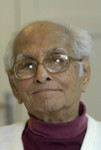
Kaikhushru Sethna: fervent author
Sethna’s favorite poem was This Errant Life (see pg 40) that he had penned in 1931, reveal Esther and Minna Paladino who were his close associates until the end. As was his wont, Sethna had sent his verses to Aurobindo for his critical appraisal and the master did not just comment on his disciple’s poems but answered the queries raised in his quest for perfection. Not once, but two, three and even four times had Sethna sought Aurobindo’s feedback to eliminate superfluous imagery or repetitive words.
"A number of aspects of Sethna’s life seem to share uncanny parallels with that of his Master Sri Aurobindo: both had studied in elite institutions… been exposed to western languages and literature... had experienced a bout of atheism… shared an equal interest in literature and philosophy… turned in later life to the pivotal question of Indian history: the problem of the Aryan invasion. Both were attracted to spiritual and mystical poetry…” remarks Sachidananda Mohanty in his introduction, "Celebrating a Genius — K. D. Sethna: The Man and His Work.” This treatise was included in the centenary volume published to mark the completion of Sethna’s "100 years of his earthly life.”
The literary output, autobiographical sketches, diary notes, newspaper clippings and correspondence of the "freelance Aurobindonian,” as he liked to describe himself, were all scrupulously documented and preserved by the author and his admirers over the years. "He wrote on a myriad of subjects with felicity and fervor: poetry, criticism, history, comparative literature, yoga, spirituality, science, philosophy, international relations, journalism, archeology, mythology, art history and future studies,” appreciates Mohanty who compares "the often dense style… of his scholarly works” to the "extremely lucid style” that characterizes his books on Ashram life and spirituality.
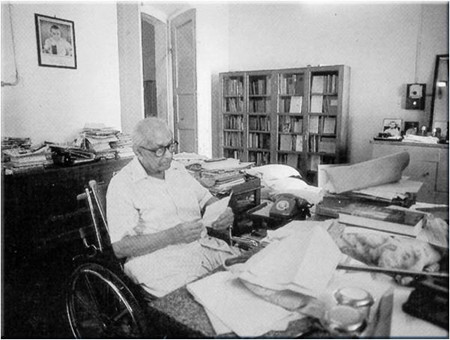
Sethna at his study cum bedroom
"His magnum opus was surely an 800-page volume, The Secret Splendour: Collected Poems,” mentions Veera Dastoor who remembers interacting with him during her visits to the Pondicherry Ashram. "His kindly face, radiant with the mischief of a child, belied his genius,” she added. He was confined to a wheelchair after a fall in 1999 broke the neck of his right femur bone and the doctors decided against operating on him at the age of 95. From the Ashram Nursing Home he would be wheeled to Sri Aurobindo and Mother’s samadhi at 4.30 in the evening where he would go into deep meditation.
He had engaged in free and frank exchange of views with international celebrities like Aldous Huxley, Albert Einstein, Kathleen Raine and Paul Brunton as also lesser known readers and admirers. For nearly 50 years Sethna edited Mother India, regarded as one of the best cultural monthlies of the country, known for its high standards and professionalism.
Born in a highly respected Parsi family of Bombay, his father Dhunjibhoy was a noted ophthalmic surgeon, intellectually gifted, stern yet considerate but the young boy was emotionally drawn to his mother Bhikaiji. In one of his recollections he relates: "The moment I was born the big lamp in our drawing room flared up. My father had to answer the frightened servant’s cry and run from my mother’s side to prevent a fire. The English lady doctor in attendance on my mother took the flaring lamp as an omen and said ‘This boy will be a great man.’ It seems to me that she went beyond her data and should have confined herself to saying ‘This boy will be a fiery fellow!’ I displayed from the beginning a very hot temper and the fury with which I, as a baby, yelled and grew red in the face was worthy of a Reza Shah Pahlavi. And it is quite on the cards that I might have become a soldier or at least a man of action if misfortune had not dogged my steps in my third year. In the literal sense my steps were dogged by misfortune for a severe form of infantile paralysis attacked my legs.” Despite surgery in the UK, he needed a walking stick for the rest of his life.
Weekends and holidays were frequently spent in Matheran where the family owned a bungalow. Pastime usually involved playing the "Grand Inquisitor” with "ugly looking insects.”
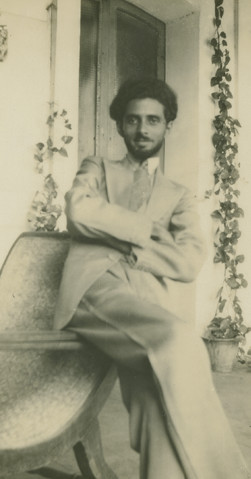
Kaikhushru Sethna during a holiday in Matheran
Kaikhushru, or Kekoo as he was lovingly known in the family, was educated at St Xavier’s School and College with Latin as his second language. In the Intermediate Arts he earned the Selby Scholarship for logic and the Hughlings Prize in English. Graduating with honors in philosophy, he won the Ellis Prize in English which is normally won by a student of literature. During College days he regularly contributed essays to the St Xavier’s College magazine. He took to writing verses only to outdo his cousin who was composing poems on a girl called Katie, Sethna had revealed. His other compositions included the lives of Shivaji and Napoleon in verse form, a few plays, 26 novelettes, each with an interesting alliterative title.
Providing to young Sethna the necessary creative stimulus were members of Bombay’s literary circles that included A. S. Wadia, Simon Pereira, Frank Moraes, D. F. Karaka, R. K. Karanjia and Nissim Ezekiel.
As he acknowledged, an "early preoccupation with religious studies” had predisposed him towards "questions of metaphysics” and issues like "good and evil, justice, charity and equanimity.” The influence of a Jesuit teacher with a scientific bent of mind and the exposure he received to the world of playwright Bernard Shaw made him disdain "cheap religionism as well as cheap materialism…” There was a phase when he "became an atheist” leading to a confrontation with his father until the latter passed away a year after Kekoo’s matriculation. The father’s death however led to a gradual recovery of faith.
The first time he heard about Sri Aurobindo’s cosmic consciousness was from a South Indian Theosophist who was also an art critic. Later he chanced upon an account of "The Ashram of Sri Aurobindo Ghose” from a newspaper wrapper that held the shoes he had purchased from a shop at Crawford Market. His feet being providentially guided to a new destination, he approached the Ashram authorities and made his first trip to Pondicherry with his then wife Daulat shortly after his 23rd birthday in 1927. It was in 1954 that Sethna’s "second coming home” took place. By then he had divorced Daulat and was married to Sehra. They were given a flat to reside in the vicinity of the Ashram. Besides being a lecturer in English literature and poetry at the Sri Aurobindo International Centre of Education he was also invited to speak on Indian history and culture.
Nirodbaran, a doctor turned poet and yet another centenarian in the Ashram was quoted in Manoj Das’ tribute in The Hindu of August 7, 2011. Referring to Sethna’s cheerfulness despite his physical handicap he notes, "He had no regrets. Rather he considers this God’s blessing to him for it has enabled him to plunge into the oceans of the mind and thus acquire a vast body of knowledge at an early age — so much so that Sri Aurobindo jokingly remarked: ‘He has learnt too much. He must start unlearning now.’”
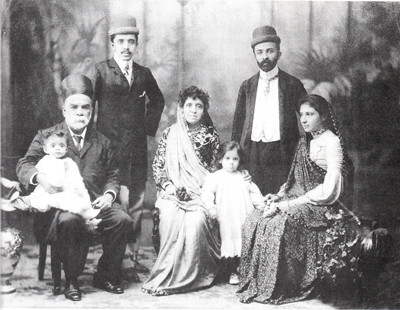
From left: Kaikhushru seated on his grandfather Pestonji’s lap, uncle Perojshah, grandmother Hamabai, sister Manekbai, and parents Dhunjibhoy and Bhikaiji Sethna
Although encomiums and praise little mattered to Sethna, in 1994 he earned the Devavrata Bhisma Award from The International Institute of Indian Studies "for his contribution to world peace and order on the basis of universal Vedantic values.” 1994 being the 90th year of his life, he was gifted a festschrift entitled Amal-Kiran: Poet and Critic edited by Nirodbaran and R. Y. Deshpande. At the 125th birth anniversary of Sri Aurobindo in 1998 he was presented the Sri Aurobindo Puraskar by the celebration committee in Calcutta as also a memento from the Government of Pondicherry. Over a decade later he was conferred a merit certificate by the Government of Pondicherry for having "excelled in the field of literature.” Last year he received the Auro Ratna Award from the Overman Foundation in Calcutta. More than any of these honors he recalled that in his mid-life when he desperately needed Rs 500 "to settle a few matters and pay for a thorough migration (to Pondicherry) with my wife and dog,” he managed to raise the amount by writing an article on Sri Aurobindo for a special India supplement of the Atlantic Monthly, an article that never got published!
As commented Das, "What is remarkable, whoever came in contact with him went back imbibing a ray of his ever-shining wit and humor.”
◆ ◆ ◆
From the archive