
Zoroastrians Abroad
Mission mobedyar
Currently there are 193 mobeds in North America (NA), 65 in Canada and 128 in USA, as reported in FEZANA (Federation of Zoroastrian Associations of North America) Journal, Spring 2010. Within Canada, Ontario showed the highest count, 52, and Alberta, the lowest figure of one. In USA, the maximum number, 31, were in Texas followed by 24 in California. Those areas served by a lone priest are Colorado, Kentucky, New Hampshire, Oklahoma and South Carolina.
Witnessing a shortage of mobeds in certain areas the North American Mobeds Council (NAMC) introduced the mobedyar program in 1995. Over the years it has trained around half a dozen members of the laity to officiate as paramobeds and perform outer liturgical ceremonies in the absence of ordained priests. With the eligibility criteria amended in 2008 to permit even ladies as mobedyars, they currently have one lady in training. The motivation and reflection of these well educated mobedyars who had a spiritual urge to undergo the training were gleaned by Parsiana from the Spring 2010 issue of FEZANA Journal.
Co-chair of the FEZANA Welfare and Critical Assistance Committee and past president of the Zoroastrian Association of Pennsylvania, Hutoxi Contractor who is currently under training looks forward "to the day I will officially become a member of NAMC as a mobedyar.” In her reflections she writes, "I am excited for what this new policy will mean for communities throughout the US. I have lived in Pittsburgh, PA for the past 30 years where we have a small but wonderfully cohesive Zoroastrian community. One thing that we lack however is a mobed within our community…”
Choosing to educate herself on Zoroastrianism by reading and interacting with community and academic scholars, she was soon confident of conducting "religious classes for our Zarathushti youth in Pittsburgh. Over the years I have also become more involved in teaching people of different faiths about Zarathushtra’s beautiful message. Mahatma Gandhi himself used to recite verses from the Gathas… Now as a mobedyar-in-training I look forward to taking my religious education to a new level… I encourage others within our community to take advantage of this wonderful initiative so that we can together increase knowledge of Zarathushtra’s teachings throughout North America and celebrate our beautiful faith.”
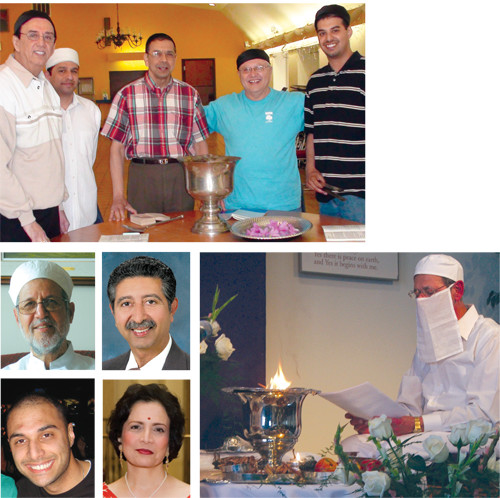
(Above): Bomi Damkevala (center) with mentors (from left): Ervads Neriosang Karanjia, Jamshed Ravji, Pesi Vazifdar, Jamshed Antia; (alongside, clockwise from right): Rumi Engineer at prayer, Hutoxi Contractor, Jamshid Mistry, Khushroo Mirza and Maneck Bhujwala Photos courtesy FEZANA Journal Spring 2010
"Becoming a mobedyar should not be construed as being in competition with any of the mobeds in my Chicago Zarathushti community or elsewhere,” declared Bomi Damkevala. "My desire to become a mobedyar is entirely based on personal interest in the language and teachings of Zoroastrianism, my faith and gratitude to my community…” wrote the former president of the Zoroastrian Association of Metropolitan Chicago (ZAC). "During my training the most surprising element was the physical effort required to project and eloquently recite our prayers, hour after hour, and at the same time tending the fire. I also found that our priests demonstrate an amazing amount of self-discipline in preparing for religious ceremonies and events. As I finish my mobedyar training I look forward to serving the NA Zoroastrian community with gratitude, faith and knowledge.
"I hope that my story may inspire the next generation of Zarathushtis to actively pursue religious education,” states Damkevala, a graduate of the Indian Institute of Technology who did his masters from the Illinois Institute of Technology and has lived in Chicago for the last 40 years. His mobedyar ordainment ceremony on April 4 this year coincided with the NAMC annual general meeting hosted by ZAC and hence there were 14 mobeds from across USA and Canada with around 85 people in the audience who witnessed Damkevala lead the jashan as a zaotar, reports the ZAC newsletter of May 2010.
Serving the spiritual and ritualistic needs of the small Zoroastrian community in Colorado is Rumi Engineer. "Since I have become a mobedyar I have found there is a great deal of interest in understanding the basis of the jashan ceremony, its meaning and significance from non-Zoroastrians,” related Engineer. "I feel strongly that allowing participants of other (or no) faiths is a wonderful way of spreading knowledge of the Zarathushti religion. This in no way implies that it will attract people to convert or there is any intention of converting… To some people I am a heretic and, therefore, not acceptable as a mobedyar. Therefore there have been few calls to perform a jashan. Fortunately none for geh sarna prayers,” indicated the erstwhile president of the Rocky Mountain Zoroastrian Association who is an immigration lawyer in Denver adding, "I believe personal animosities, prejudices and a misplaced sense of conservatism has hindered a full blown acceptance of the idea of a lay priest performing any type of formal religious ceremony.”
"Shortage of practicing priests is a reality and opening priesthood to behdins is a timely step to save our traditions,” believes Maneck Bhujwala, a trained mobedyar who is called upon to perform jashans and funeral prayers in the California area. He recalls though the initial hostile reception when the "local priests objected to my practice with public e-mail postings, phone calls, starting prayers before scheduled time, etc.” One of the leading pillars of the Zoroastrian Association of California and the Zarthushti Anjuman of Northern California, Bhujwala was a design automation engineer by profession and after retirement has been working as a realtor.
For Khushroo Mirza, his practice as a mobedyar has been very rewarding, being regularly invited to participate in jashans as raspi or zaotar, and even at navjotes and weddings. "As I observed our purely voluntary mobeds performing jashan ceremonies I began to wish I had undergone the navar initiation in my younger days so that I too could do my part… Judging from the enthusiastic support I have received from our community I feel convinced that there is a very real place for mobedyars in North America,” states Mirza. Former president of the Zoroastrian Association of Quebec, Mirza was involved in the shipping industry until his retirement last year.
The youngest mobedyar is 28-year-old Jamshid Mistry who was the first individual to be ordained as a mobedyar in North America in 1997. His two-year training program began in his sophomore year in high school. "From sitting in navjotes to praying in funerals, my experience has been extremely enriching. I have given talks and lectures to associations with over 300 members (and done) a jashan in a state with only five Zarathushtis. Each experience has given me the great opportunity to build on my own knowledge base and further my skills as a religious servant,” states the Seattle based Mistry who has been accepted as a neurosurgery pre-residency fellow at the Riverside County Regional Medical Center.
"This volunteer class of mobeds... was the best way to serve the community in the past and at the present. But I am afraid this system of volunteers may not be viable in the future,” conveyed Ervad Kobad Zarolia, the founder president of NAMC and also its current president. He felt Zoroastrian communities should sponsor a full-time mobed as is being done by the Chicago Zoroastrians. Referring to the purpose of founding NAMC in 1990, Zarolia was reminded of the advice he had earlier received from Dastur (Dr) Hormazdyar Mirza: "In North America you have navo (new) ball and a navi (game) so you should start thinking for yourselves and not rely on dasturjis in India to... solve your problems.”
The NAMC provides a forum for "open discussions between mobeds who respect each other’s opinions and are therefore able to discuss all matters important to the community, whether they are controversial or not, without any disruption, as well as learning from each other’s experience and knowledge,” sums up Ervad Nozer Kotwal who was the founder treasurer of this organization.
After a few years the Iranian mobeds chose to form a parallel organization, the Council of Iranian Mobeds in North America (CIMNA). There are 11 Iranian mobeds and mobedyars in NA, most of whom reside in California where there is a large Iranian Zarathushti population, writes Mobed (Dr) Rostam Vahidi who is in charge of the California Dar-e-Mehr.
The two-year mobed training course in Orange County Dar-e-Mehr presently has four students learning Zoroastrian history, philosophy, civilization, customs and practices¸ with sessions on prayer recitation and religious ceremonies. The candidate has to pass two exams and present a paper in front of a jury of mobeds and seniors. The accepted candidate is then ordained as a mobed, mobedyar or hirbod (religious teacher), mentions Vahidi.
The mobed organization in Iran known as Kankash-e-Mobedan was established in 1915. According to Vahidi there are 60 mobeds and mobedyars in Iran, of whom 20 each are in Tehran and Yazd. In cities like Shiraz and Esfahan which see many tourists at fire temples, there were old mobeds who performed ceremonies but were unable to explain the religion to the visitors. Well-trained, eager, young mobedyars were thus inducted to give an overview of the Zarathushti religion. "Presently we have some 40 mobedyars in Iran... well respected spiritual persons who provide excellent service to the community,” adds Vahidi.
◆ ◆ ◆
From the archive