
Science
Black holes and new goals
Dr Spenta Wadia’s outstanding contribution to the field of high energy physics earned him international recognition
"Over the past 20 years, his vision and knowledge have attracted some of India’s most gifted physicists to Bombay and his group is recognized as one of the world’s strongest in the field of high energy physics, and is certainly regarded as the strongest in Asia.” This recognition for Dr Spenta Wadia accompanied the announcement from the Academy of Sciences of the Developing World (formerly known as the Third World Academy of Sciences —TWAS) naming eight scientists from developing countries who have made outstanding contributions to the advancement of sciences for the 2004 TWAS prize. "One of the nice things about receiving this award,” conveys the self effacing Wadia is to be in the company of "past recipients who are distinguished people, well known in their branch of science.”
The first Parsi recipient of the TWAS prize which includes a cash gift of US $ 10,000 accompanied by a plaque inscribed with the awardee’s major contributions will receive the honor in November 2005. Senior professor, Department of Theoretical Physics at the Tata Institute of Fundamental Research (TIFR), Wadia states, "There are so few Parsis working in basic sciences. With the size of the community being so small, the sample in this field is naturally smaller. The urge to really go out and do new things seems to be diminishing.”
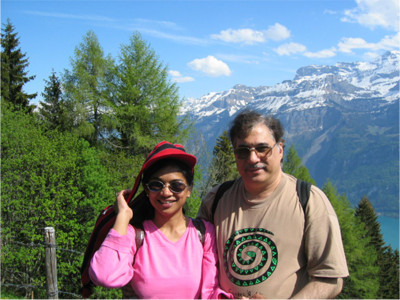
Leena and Spenta Wadia: respecting each others’ values
The prize recognizes his work "in a wide spectrum of areas in physics, including quantum field theory, string theory, statistical mechanics and disordered systems.” When asked to elaborate on his work the scientist refers to "black holes physics; to the theory of elementary particles and other fundamental matters...” He alludes to "string theory, a paradigm for high energy physics and gravitation, as offering a framework to ask some very important questions in physics related to phenomena like black holes and the origin and fate of the universe.” We understand a few terms, the rest remain in the realm of the abstract. The teacher in him takes over: There are two important pillars in modern physics, each of which is applicable in its own domain – Einstein’s General Theory of Relativity, a theory of gravitation, is applicable to large scale phenomena in the universe, and Quantum Mechanics, discovered in the early 20th century, governs nature at very small scales. For example, all electronic devices work on the principles of quantum mechanics. However quantum mechanics applied to gravitation leads to inconsistencies. But physicists like Wadia are pursuing string theory which reconciles gravity with quantum mechanics.
"As we become more knowledgeable we realize how ignorant we are. It’s a peculiar frightening thought which gives a queasy feeling,” admits the senior faculty member recalling how in the mid 1980s he felt "the time was ripe to begin exploring many of these issues whose answers would be soon in coming.” The decade prior to that he had spent in the USA, earning his doctorate from the City College of the City University of New York and gaining work experience at the Enrico Fermi Institute of the University of Chicago. "I always felt I should come back and do something here. Fortunately there was a place – TIFR – to come back to,” states Wadia who has grown with the Institute since 1982, working as a researcher, teacher, mentor, and has developed a team rated as among the best in the world.
Barring reference tomes and books on the subject there are few distractions in his spartan office at the TIFR building in the high security Navy Nagar end of south Bombay. A white board though does dominate one of his walls: "As theoreticians we use mathematical tools – geometry, topology, calculus, analysis all the time,” he explains. A Fellow of the Indian Academy of Sciences, the Indian National Science Academy and the New York Academy of Sciences, Wadia was awarded the Abdus Salam International Centre for Theoretical Physics prize in 1995. With scores of research articles and over a dozen publications to his credit, the theoretician also serves as editor of two prestigious journals — International Journal of Modern Physics A and Modern Physics Letters A.
"These are very exciting times but one has to be very careful. There is so much information that it’s hard to distill knowledge,” he points out. He still remembers being gifted with The Golden Book of Science by his father Rustom when he was 10 years old which had "a very profound impact on me. I still treasure it,” appreciates Spenta comparing it to the scenario today where his daughter Neha who studies at the J. B. Petit School and son Varun who is at Cathedral and John Connon have "so many books and so many opportunities with an entire gateway to knowledge open to them.” Although educational institutions in India are now slowly waking up he finds that most "are not training children to think. They are killing creative thinking.” Creative education leads to a richer society. The study of science and technology in colleges and universities contributes to the creation of wealth which in turn fosters good education, Wadia explains the continuity of the cycle.
His own love for learning Wadia attributes to his "very progressive parents Rustom and Nergish to whom education was very important, and chance encounters with good teachers who inspire you to excel.” Until Std IX Wadia says his grades were low in all subjects making him doubt whether he was academically inclined. Suddenly in Std X and XI he scored well in mathematics. "This confidence was very important,” he says in retrospect. Once at St Xavier’s College he "spent an incredible amount of time in the library there.” His next halt was at the prestigious Indian Institute of Technology, Kanpur from where he obtained his MSc before proceeding to the United States.
From the time he was in high school Wadia was interested in philosophy and religion. In his quest to "explore the meaning of the world around,” Wadia turned to science hoping that "a pragmatic approach (would lead) to an understanding of the origin of life, the origin of the universe…It is easy to believe that there is a God there who looks after us, who wants us to live a good life. But these are all ideas that evolved in the last 40,000 years” in part to create a harmonious society. Wadia knows lots of ‘religious’ people who find comfort in the notion of God and his supremacy but flounder when other seekers start questioning certain religious premises.
"Religious bigotry is a dangerous thing in society and for the Parsi community it reinforces isolation from the mainstream. I am proud of my origins, how I grew up (in Nowroz Baug), my values. But other people also have good values,” states the physicist who is married to Leena Chandran, a computer scientist whom he met at the International Centre for Theoretical Physics in Italy. "Boundaries should dissolve and people should live together,” he recommends, convinced that we should not be "a closed community.” Referring to his own family he mentions, "We don’t function to the exclusion of any culture.” Very fond of "the ancient ceremonies of Parsis, the rituals associated with weddings and navjotes,” Wadia would like "people to continue with their traditions which reflect a diversity in human thinking…”
Neha and Varun Wadia raised on an all embracing culture
The controversy surrounding the dakhmenashini mode of disposing the dead in the absence of vultures makes Wadia comment, "Once the brain has collapsed and there is just organic matter left, the body can be disposed of in any respectable way.” He knows that the four days he spent at the Doongerwadi following his father’s demise, "cut off from the rest of the world” brought him "peace and undoubtedly comfort to mourn in the serenity of the environment.”
Not able to understand "this gender differentiation” which denies rights to outmarried women whilst permitting all liberties to their male counterparts, Wadia views it as "so absurd. If we have a more easy policy it would be very nice for the community. What we need to ensure is continuity of values, good business practices…” He has also been observing "the Parsi divide,” as he terms it, "with very few channels of communication between an elite class, the leaders of industry, ingrained with western culture, and the less privileged class. Why is there such a sharp divide in such a small community? Why is there no percolation of attitude? Of wealth? Whilst many have migrated for better opportunities, the residue that is left are in a difficult situation. The community leadership should be active in uplifting the educational levels of Parsis.”
When free from his scientific pursuits, Wadia finds solace in fine arts – painting which was his hobby, and music, both Indian and western classical. "I think music is one of the great creations of the human mind,” notes Wadia, happy that Neha plays the piano and Varun, the classical guitar. Trekking in the outdoors too is popular with their family. Reading on various aspects of history is also a passion with Wadia for he finds biology and evolution fascinating. To understand the diversity and complexity of life, the scientist is convinced, "physics is the basic tool that will answer most questions.”
◆ ◆ ◆
From the archive