
History
Madras musings – II
Many notable Zoroastrians made up the mosaic of the minuscule community in this southern city
The first instalment of "Madras musings” (Parsiana, September 7, 2010) gave an overview of the early settlers in this area and the formation of the Madras Parsi Zarthosti Anjuman and other community facilities.
Besides the individuals who took a keen interest in the activities of the Madras Parsi Zarthosti Anjuman, there were other community members too who had made a mark on Madras.
Dhun Building on Mount Road, one of the first high-rise constructions, was built by Jehanbux H. Tarapore in memory of his wife. He graduated as a civil engineer from the Guindy Engineering College. His spectacular career spanning over 60 years began in 1926. He set up the firm Tarapore and Company in partnership with Loganathan Mudaliar. The company was involved in the construction of dams like the Tungabhadra, Sharavati, Hirakud and Farraka barrage. Numerous factory complexes in the steel, cement, copper, aluminium and textile industries helped India’s growth in these sectors. Tarapore faced a major tragedy when five of his family members died in a car accident. A charitable trust set up in 1979, the J. H. Tarapore Foundation, annually distributes its corpus earnings to various educational and health care institutions. Many physically and economically challenged persons have also benefited from this trust. Tarapore was a humble, kindly and benevolent figure. Tarapore and Company stood for quality and integrity. Another famous landmark, Abbotsbury, was donated to the Sathya Sri Sai Baba Trust. Tarapore was appointed sheriff in 1963.
Dorab "Dolly” Burjor Madan left Calcutta for personal reasons. He started from scratch in Madras city, riding a lady’s bicycle to work. Beginning in 1945 as Tata’s agent for distribution of mild steels, years later he became a director in one of the Tata companies. Within 20 years, he turned D. B. Madan and Company into one of the leading shipping agencies in Madras harbor and amassed a fortune for DSR Lines of East Germany and for his Russian principals, the Black Sea and Fesco companies. For his yeoman services, the Russian government awarded him the highest civilian maritime honor. His resources were always available for the community’s needs.
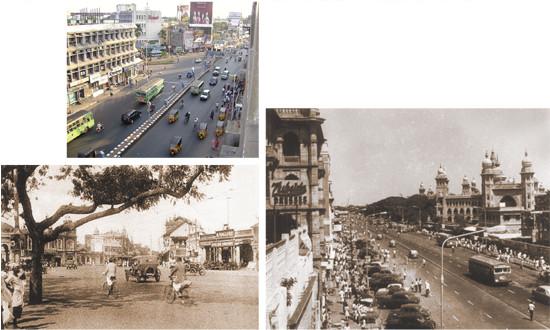
Mount Road over the years
Minoo K. Belgamvala was a well-known figure in the world of motor sports and horse racing. He came to Madras in 1939 as regional manager of Asbestos Cement Limited and was later instrumental in starting their factory in Coimbatore in 1951. Basically an audio and radio electronics engineer, he was one of the founders of the Madras Motor Sports Club and served as its president for 18 years (which incidentally is a record). Belgamvala put the village of Sholavaram on the map of motor sports racing in India.
A keen horse rider, he was a race day official at the Madras Race Club for nearly 50 years, serving as chief judge for the last 25 years of his tenure. As chairman of the Automobile Association of Southern India for 20 years, he represented India at various international conferences. He was president of the Madras Anjuman for 25 years. Above all, he was loved for his extremely affable nature, calm temperament and fair judgment — the quintessential gentleman.
Aspy Litho Works, a familiar sight on General Patters Road, was founded by Arjasp Taraporwala, a graduate in philosophy from Madras Christian College. Pre-independence, his father’s firm was a well-known dealer in luxury motor cars. When the firm’s fortunes took a reversal during the war, Arjasp took up military contracts and in 1948 founded the litho press (later progressing to offset) to print cinema posters. Arjasp was founder member of the Madras Printers’ and Lithographers’ Association and was its president for some years. In 1974, he joined the Guild of Service and later became its vice-chairman and patron. He served the community in various positions for 50 years. Such was his reticence and humility that he embodied the adage that the left hand did not know what the right hand was giving.
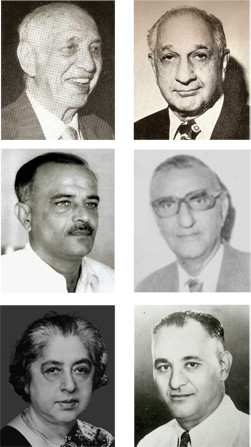
Clockwisefrom far left: Dorab Madan, Minoo Belgamvala, Dr Meherji Cooper, Rustam Mazda, Mary Clubwala-Jadhav and Ardeshir Irani
Cinema in Tamil Nadu has always had a huge fan following from around the turn of the 20th century and two Iranis contributed their skills to this mighty industry. The first was the legendary Adi Merwan Irani who started his career in The Imperial Film Company of Bombay and by 1929 was a respected figure in Bollywood. He had many firsts to his credit — first newsreel, aerial and underwater shots, trick photography and the favorite "double role” technique. He was always fine-tuning his art and filmed India’s first talkie Alam Ara. He moved to Madras in 1939 and worked on S. S. Vasan’s movies like Kamadhenu and Bala Nagamma. He then moved to Coimbatore to capture the mythological classic Haridass which ran for a record three years!
From 1949 Irani worked for Vauhini Studios and Nagi Reddy Studios. He shot the famous Malleswari (the first crane shot in South India) and Prince and Pauper. Many directors were made because of his instinct as a cinematographer and he was held in great respect by starts like Gemini Ganesan, M. R. Radha and N. T. Rama Rao. He passed on his art to his son Mehli Irani who went on to become an award-winning cinematographer in the Malayalam film industry. The developing stages of Indian cinema were embellished by Irani’s sense of visual wonder and artistry.
This next is a rags to riches story of true grit and determination. Dinshaw Tehrani was an unhappy young Zoroastrian in Iran who boarded a ship as a stowaway and landed in Madras empty-handed. He was working as a coolie at Central Station when some Parsis attached to Connemara Hotel spotted him and decided to help. He was presumably sent to one of the film studios to work at odd jobs. Speaking only his native Dari language, one wonders how Tehrani managed to pick up the basics of sound engineering. So proficient did he become at his job that he was soon working for big studios and eventually started Newtone Studios in Kilpauk, as a partnership firm. Tehrani produced Pall Kudam under his Manijeh Cine Arts banner and recorded S. P. Balasubramaniam’s famous song Malligai Poo Vaanghi Vandhen. He also recorded Bhanumathi’s famous song O! Paavuramma in the film Swarga Seema with a huge metallic bell hung over the mike to give the song its dreamy, silken tone!
Newtone Studios was famous for producing many Tamil, Telugu and Malayalam films. The interior shots of Meera, the well-known M. S. Subbulakshmi film were taken here. Tehrani worked on the audiography of this movie as well. It was directed by the famous Ellis R. Dungan. At one time Tehrani was the top sound engineer of the South. The Bharatiya Vidya Bhavan School on Kilpauk Garden Road now occupies the site of this once-famous studio.
The Madras Medical College started around 1853. The oldest building in the complex, built in red brick, in typical Indo-Saracenic style, was called Red Fort because it housed the anatomy department, a subject very difficult to master. Dr Meherji M. Cooper was one of the most outstanding anatomists of Madras during the last century. Starting his teaching career in 1946, simplifying this difficult subject for the thousands of students who passed out during his tenure was his passion. With his ever-ready wit and explicit diagrams, he made lecture sessions unforgettable. Cooper taught not just second but even third generation students. When he retired in 1979, he was director, Institute of Anatomy and vice principal of the College. Almost a legendary figure, Cooper was elected Fellow of the Madras Medical College.
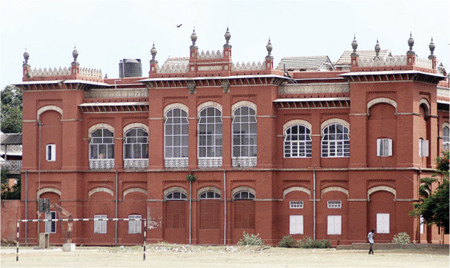
The Madras Medical College (above)
Cooper published and read numerous papers during his career. He was one of the founding members of the Anatomical Association of Tamil Nadu. He was also appointed professor emeritus of Stanley Medical College. Cooper served the Parsi community in various positions for 23 years. Even today, leading doctors in the city have fond recollections of this dedicated and brilliant teacher.
The redoubtable social worker Mary Clubwala was the daughter-in-law of businessman-philanthropist Phiroj M. Clubwala who had donated the fire temple to the community in memory of his son Jal. His other son Nogi, Mary’s husband died suddenly in 1935, when he went to Europe to recover from ill health. Instead of retiring into a shell the grief-stricken wife with her four-year-old son Khushro (Phil) decided to occupy her time meaningfully.
She joined the Guild of Service in 1935 and soon became the live-wire of the organization, being appointed its honorary secretary two years later.
In 1935, Clubwala was appointed honorary presidency magistrate and holds a record for continuously sitting at the Juvenile Court. It is through her persistent efforts that lady magistrates were appointed to preside over the Juvenile Courts and almost entirely manage them. She was the founder and honorary general secretary of the Juvenile Guidance Bureau.
In 1942, at a time when few amenities were provided for the Indian soldier, Clubwala founded the Indian Hospitality Committee with helpers drawn mostly from the Guild of Service. Called "the darling of the army” by General K. M. Cariappa she persuaded volunteers to organize mobile canteens, hospital visits, diversional therapy and entertainment programs and after the war by helping ex-servicemen and their families reinstate themselves. The victorious 14th Army presented Clubwala a Japanese sword in appreciation of her tremendous efforts.
Clubwala’s concern for destitute children was responsible for starting the Seva Samajam Boys’ Home and Seva Samajam Girls’ Home in Adyar in 1950. In 1954, she helped launch the Bala Vihar in Kilpauk, a school for mentally challenged children, through the joint efforts of the Guild and the Madras Rotary Club.
Perhaps Clubwala’s most significant contribution was establishing the Madras School of Social Work in 1952, the oldest in the country, after Bombay’s Tata Institute of Social Sciences.
In 1953, Clubwala married Major Chandrakanth K. Jadhav, an officer of the Indian Army who supported her in all her social service activities. Though she was in close touch with high-ranking politicians and well-known personalities, she was totally apolitical and was respected by all for this. Clubwala-Jadhav’s widespread activities gained international attention. She was the first Indian lady voluntary social worker to be invited to the United States under the Leader Specialists’ Programme. She gave numerous lectures on social service activities in that country. By 1957, she was appointed as the UN (United Nations) correspondent in India for prevention of crime and treatment of offenders.
The first lady sheriff of Madras, Clubwala-Jadhav was involved with 150 social service organizations in the city. The government of India conferred on her the Padma Vibhushan, its second highest civilian award.
Before her death in 1975, she suffered the untimely demise of her beloved son Phil. Today the Phil and Mary Clubwala Jadhav Trust disburses aid to many worthy causes which were dear to her heart. Concluded
◆ ◆ ◆
From the archive