
Cinema
Grandchildren reminisce
Film pioneer Ardeshir Irani’s descendants share memories of their grandfather
"In my early childhood I remember going to the Majestic Cinema with him (film pioneer Ardeshir Irani) on a regular basis, and because he carried a walking stick, I wanted one. So, I have vague recollections of the servants giving me my ‘walking stick,’ which was a small cane, before we left the house.” USA based physician/pathologist Dr Mehraboon Irani is one of the three grandchildren of Ardeshir’s who communicated with Parsiana, the others being Bombay based Rashna Talati and Canada based Zarina Irani.
"I remember him as a very kind and loving old man who was treated with a lot of respect,” noted Mehraboon. "He always liked company when he ate, so there would always be people over for meals… there was an elderly gentleman called Dinshaw Zhaveri who was living with us as a guest of my grandfather. I later learned that he was an old friend who had come on hard times. Grandad was so big hearted he actually paid for all his expenses to come and live with him and keep him company.
"We lived on the third floor of Zaver Mansion at Chowpatty Sea Face, right opposite the bhelpuriwalas and (in later life) he could not walk up the stairs so he had to be carried up each flight with two men supporting his heavy frame.” Mehraboon was 10 years old when his grandfather passed away in 1969 "as a result of complications of a fractured hip,” he said in a detailed response to Parsiana’s questions about Ardeshir. He and his wife Kamal have two children, daughter Freya who is studying to be a musician and son Ardeshir who is in the 10th grade.
"I remember him as a very kind and loving old man who was treated with a lot of respect,” noted Mehraboon. "He always liked company when he ate, so there would always be people over for meals… there was an elderly gentleman called Dinshaw Zhaveri who was living with us as a guest of my grandfather. I later learned that he was an old friend who had come on hard times. Grandad was so big hearted he actually paid for all his expenses to come and live with him and keep him company.
"We lived on the third floor of Zaver Mansion at Chowpatty Sea Face, right opposite the bhelpuriwalas and (in later life) he could not walk up the stairs so he had to be carried up each flight with two men supporting his heavy frame.” Mehraboon was 10 years old when his grandfather passed away in 1969 "as a result of complications of a fractured hip,” he said in a detailed response to Parsiana’s questions about Ardeshir. He and his wife Kamal have two children, daughter Freya who is studying to be a musician and son Ardeshir who is in the 10th grade.
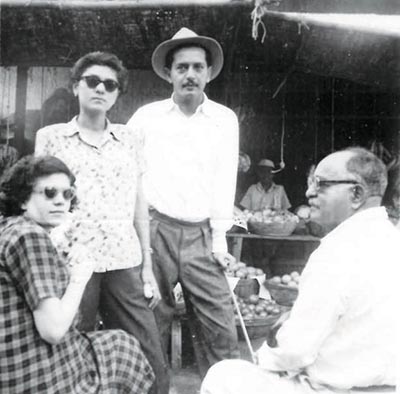
From left: Khorshed, unidentified friend, Shapoor and Ardeshir Irani
"I heard from my mother Khorshed (née Panthaky) that when she was newly married to my father Shapoor, he (Ardeshir) was so active that he would run up and down the stairs (of Zaver Mansion). Also, he told my mother that in his young days he could walk up a flight of stairs on his hands doing a handstand, so he was a gymnast as well.” Shapoor "was not fond of the movie business but reluctantly took it over from granddad. I think he wanted to be a farmer since he liked animals and hunting, fishing, etc.
"He received a title Khan Bahadur from the British government which did give my father Shapoor and his sister (Nergish Marazban) some status at the time. My father had no interest in preserving any of his old movies, which were all stored in a non-climate controlled ‘shed’ in the Jyoti Studio compound. I don’t think there is a single copy of any of his movies that is viewable which is why he has been largely forgotten,” Mehraboon stated.
Mehraboon has a few memories of the studios in central Bombay: "The green villa in the compound housed the offices of the Imperial Film Company and its successor Jyoti Studios. I remember going there as a child but by then a lot of the premises were rented out to tenants who had businesses related to the movie business, for example, India Cine Laboratories run by one of his tenants. The actual studio set buildings were behind the "villa” but since they were so close to the railroad tracks and not soundproofed, they gradually fell into disuse. It is hard to shoot a movie with sound and have the periodic rumble of a train in the background. My father used to keep animals on the premises, including goats and even a buffalo, when I was little.”
The grandson recalled that "Master Vithal (the lead actor of Alam Ara) was an employee of a different studio and there apparently was a legal dispute about him being able to work for grandad. The case was won in my grandfather’s favor by none other than (Pakistan’s founder) Mohammed Ali Jinnah, a practicing attorney in Bombay at the time.”
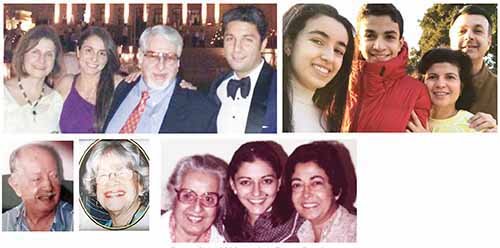
L-r (top): Rashna, Ria, Noshir and Xerxes Talati; Freya, Ardeshir, Kamal and Mehraboon Irani;
(above): Shapoor and Khorshed Irani; Nergish Marazban, Sharlene and Zarina Irani
The pioneer’s Kisan Kanya "was a terrible failure at the box office,” according to Mehraboon. "That led to Imperial Film Company going under. However, Ardeshir did recover from this and founded Jyoti Studios in 1939, but this time he did not actively make movies but just rented out the premises to independent producers to make their movies. The business did fairly well until his death. I have vague memories of going to the silver jubilee celebration of Jyoti Studios in 1964 when I was only five years old.”
Talati told Parsiana that as children, she and her sister Banoo were not encouraged to visit the Studios. "We were always made to wait in the car outside…Maybe it was not the right place for young girls to be seen,” she stated. Talati recalls the dissolution of the Studios. "The machinery was sold off by my father and the old prints sold for their chemical value,” she noted. "If only I had a print of the film (Alam Ara) I would have been a millionaire,” Shapoor had told The Independent (India) in a December 1990 interview. Banoo Parpia is based in the USA and is a fund raiser for Cornell University.
Zarina, who was born a year after Alam Ara was made, recalls that Ardeshir "would be at the window looking out in reverence, if he had news that the British governor was to pass by their building.” The filmmaker taught and made her recite Persian couplets before being sent off to school from Zaver Mansion. Mehboob Khan, then an extra at the Imperial Studios, who went on to make 1957’s notable Mother India, kept Ardeshir supplied with paan (betel leaf), she reminisced.
"Sadly not one (of Ardeshir’s descendants) has gone into the movie industry. My daughter wants to do music performance (classical) which is the closest thing to entertainment,” stated Mehraboon.
"It is a shame that he was not commemorated as one of the stalwarts of Indian cinema in 2013. He certainly is one,” rues the grandson. The Indian postal department issued a set of 50 stamps commemorating important film personalities in that year, the 100th anniversary of the making of Raja Harishchandra, believed to be the country’s first full length silent film. Ardeshir was not among the 50.
◆ ◆ ◆
From the archive