
Events & Personalities
The love of his life
The personal life of Muhammad Ali Jinnah, founder of Pakistan, arouses great compassion simply because he was an astutely rational man, writes Khaled Ahmed, director at the South Asia Free Media Association, in an article published in The Express Tribune on May 23, 2010.
Though the story of his wooing and winning the beauteous Ruttie Petit is the stuff of legend, few are aware that Jinnah was first married at the age of 16, while yet a schoolboy. In 1892 he traveled from Karachi to Kutch to wed Emibai and then took off for England to pursue his studies. So little is known about Jinnah’s first bride that "you have to look up the book Ruttie Jinnah by Khwaja Razi Haider (Oxford University Press, 2010) to know that she may have died in Bombay when Jinnah was studying to become a lawyer, Ahmed writes. It is believed that "Emibai fell victim to an outbreak of cholera” while living with Jinnah’s father and sister in Bombay’s Khoja Muhalla. When his father wanted Jinnah to remarry he refused "and stood by this decision for about 22 years.” As Ahmed notes, "The granite in the man showed early.”
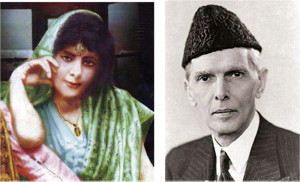
Ruttie Petit and Muhammad Ali Jinnah: they defied convention
At the Parsi Club where he socialized with his clients Jinnah met Ruttie, daughter of Sir Dinshaw Manockjee Petit. Born in 1900, she was "arguably the most beautiful girl in Bombay with a readiness to shock with unorthodox views.” She was drawn to him perhaps because he was so "understated,” Ahmed writes. When the Petits went on holiday to Darjeeling, they took Jinnah along. That is where he "had his defenses down and Ruttie got close to him.” Ruttie, aged 16, wanted to get married. Her father obtained a restraining order from the court and the couple had no choice but to wait for two years till Ruttie reached the legal age of consent. At the age of 18 Ruttie left her parental home to marry Jinnah.
They wanted a civil marriage but the law said for that they would have to foreswear religion in which case Jinnah would have had to resign his Muslim seat in the Imperial Legislative Council. So Ruttie embraced Islam. "The Parsi community was outraged as were the Muslim religious leaders. They kept referring to a civil marriage, which never took place, and called Jinnah an apostate for having contracted it.” But Jinnah did not care, even going to the extent of insulting the Viceroy Lord Willingdon to defend his wife against criticism, according to Ahmed. Ruttie was with her husband in the 1921 Nagpur joint session of the Muslim League and Congress and defended his not addressing Gandhi as Mahatma, explaining that it was only because he did not want religion dragged into politics.
It remains a mystery why the couple separated, never to get together again, a few months before her death at the age of 29 in 1929. Their daughter Dina was then 10 years old. It is reported that Jinnah cried when Ruttie died. In later life, he used to take out her belongings and look at them, lost in memories. Years later, Jinnah met Dina Wadia and his two grandchildren in Bombay in 1946. His grandson Nusli liked Jinnah’s signature cap and wanted it. "Nusli prizes the cap to this day,” Ahmed writes.
◆ ◆ ◆
From the archive