
Business
Managing centrally
It is set to step into its milestone 100th year on December 21, 2010. The Central Bank of India has long been known as the safe depository of tradition and trust. "But we are a vibrant organization too. We have taken a number of new initiatives. Central Bank is the exclusive ‘official banking partner’ for the XIX Commonwealth Games, Delhi 2010 that begin on October 3. We have the sole right of opening ATMs (automated teller machines), dealing in foreign currency and travelers’ cheques and providing all types of banking services. This will enhance the Bank’s visibility,” asserts Hector Vesuna, chief general manager (CGM), corporate credit, Central Bank of India. A special cell has been created, he says, under a general manager (GM) for the centenary celebrations. "The Sir Sorabji Pochkhanawala Memorial Lecture by Kamlesh Sharma, Commonwealth secretary-general has already been held and was the first in our lecture series,” he notes. "On Foundation Day (December 21), there will be a grand function in Bombay. The grandchildren of the founder Sir Sorabji Pochkhanawala will be invited and we plan to felicitate on stage our very old customers, now in their 80s or 90s,” he states. The commemoration will go on till December 2011.
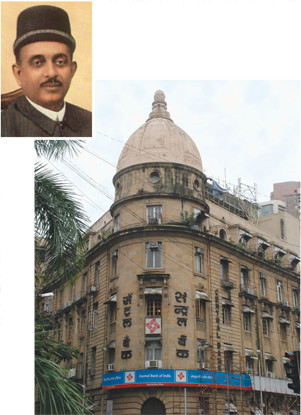
Central Bank’s founder Sir Sorabji Pochkhanawala (inset) and the landmark building at Flora Fountain in Bombay
In charge of corporate credit for the whole of India, Vesuna was appointed to his new post in May this year. "Earlier we had only GMs. I am the first GM to be designated as CGM,” he explains. Heading the corporate credit portfolio means evaluating very large financial requirements. "A company may be in need of a Rs 200 crore loan. They need an immediate response. If you delay they will move on to other banks that are waiting in the wings. We have very good clientele as compared to other banks — the Tatas, Godrejs, Wadias, Bajajs… I am mentioning only a few. We have a legacy of corporate clients well known in their respective fields. Navratna companies (public sector corporations like, for example, the petroleum companies) are our customers. A branch manager, depending on his cadre, regional and zonal managers have the authority to sanction amounts of up to rupees six crore. For higher amounts sanction has to come from the central office. It’s a challenging job!” Vesuna’s earlier assignments as GM have been in the fields of HR (human resources), Recovery, BIFR (revival or closure of sick industrial units), etc.
The Bank has a pan India presence with 3,577 branches as of March 31, 2010, states their brochure. "Only 35 percent of our branches are in urban and metropolitan areas; 65 percent are in semi urban or rural areas. By our deadline of December 31, 2010 or even before that, 100 percent of our branches will be on the Core Banking Solution (CBS) platform,” he declares. (CBS is the networking of branches, enabling customers to operate their accounts from any branch of the bank on the CBS network, regardless of where they hold their accounts.) The Bank is the third largest in branch network. "Right from the beginning, the thrust has been on rural areas, providing banking for the masses rather than classes!” he smiles. Established by Pochkhanawala on December 21, 1911, Central Bank had a swadeshi (nationalistic) outlook right from the start, being the first commercial Indian bank owned and managed by Indians during the days of the British raj. Sir Pherozeshah Mehta was the first chairman. In 1923, it acquired the Tata Industrial Bank, as per Wikipedia.
The Central Bank, Vesuna declares, has remained true to the ethos and principles of its founder. "You will not find our name associated with scams like those of Harshad Mehta or Ketan Parekh. Yes, we do suffer from certain weaknesses like the age profile of employees (average age 50+), excess staff strength which results in reduced per employee profitability (the Bank has around 35,000 employees), etc,” he notes. These issues are being addressed by direct recruitment of MBAs which will create a younger profile in the Bank. Speedier promotions, no further recruitment in place of retiring employees except in special categories, etc will help enhance the Bank’s credentials and carry it more nimble-footedly into its next century.
"When Indira Gandhi nationalized 14 major banks in 1969, Central Bank was at the top of the table among the 14,” Vesuna narrates. The position deteriorated in the subsequent decades and was aggravated by the arrival of private banks. "Private banks had an earlier edge over nationalized banks due to prior automation and being on the CBS platform. Private banks are also more aggressive in marketing and have a very good network for handling ancillary business. They also have very good cash management [transfer of clients’ funds from one center to another in RTGS (real time gross settlement)] and can do it as fast as 15 minutes. Their decision-making is also very quick,” the banker analyses. "The banking sector, however, is almost free now. There is the least amount of interference from either government or RBI (Reserve Bank of India). We can open branches, recruit people on higher salaries…” India’s banking system is one of the best in the world, he believes, and is not as fragile as in the US. Here, there is more conservative banking with restrictions on foreign direct investment, etc and that is why we could withstand the global downturn better, Vesuna remarks. In the last three years Central Bank’s advances and deposits have doubled. The net profit for the year ended March 31, 2010 stood at Rs 1,058 crore, the highest ever, which is an 86 percent increase over the previous year, he elucidates.

Hector Vesuna: heading corporate credit for all of India
The loyalty of their customers is one of Central Bank’s main plus points, the CGM believes. Even though they may be experiencing some difficulties, they stick with the Bank. Vesuna smilingly narrates how Parsi customers keep seven to Rs 10 lakhs in their savings accounts, coming in once a year to get their passbooks updated! "The idea is not to earn interest as much as it is to keep the money safe with Central Bank of India.” Known at one time as the ‘dharamshala of Parsis’ as far as the staff was concerned, Vesuna notes that there are very few left now as many took VRS (Voluntary Retirement Scheme) or have moved out due to age. Bombay Parsis show a high degree of immobility as far as transfers are concerned, he observes. "I lived on my own in Bombay from 1998-2001 when I was transferred to Bombay from Gujarat. My wife Yasmin was in Ahmedabad where she was working with Central Bank and joined me only after she took VRS.”
Vesuna himself had joined the Bank in Ahmedabad in 1973 in the clerical cadre soon after graduation. He passed special exams and took on additional qualifications — CAIIB (Certified Associate of the Indian Institute of Bankers) and AIB (Associate of the Institute of Bankers, London), standing first in India and 14th in the world. He also stood first class first in LLB from Gujarat University, states his bio data. He was offered a good job by a rival bank, but not wanting to lose him, Central Bank asked him to stay on. He put in his resignation from the clerical cadre and was directly appointed an officer in 1977. From the Lal Darwaja branch in Ahmedabad he was later posted to the Boriavi branch near Anand. "It was a rural center, a cold storage hub, with a population of just 12,000 in 1980. There was no transport. You had to walk from the railway station to the branch,” he remembers.
Transferred to bigger branches in Gujarat, Vesuna was subsequently appointed head of the Central Bank’s Staff Training Centre in Ahmedabad. "Those five years were an enjoyable part of my life. I was delivering lectures and I also got the opportunity to expand my own knowledge,” he says. Promotion as the chief manager, corporate finance branch at Flora Fountain in Bombay provided the platform for further prospects. "This is the single largest credit delivery branch in India. Ahmedabad seemed too small, Bombay was too big; you needed an immediate shift in mindset!” When he joined in 1973, banking was still in its primitive stage, he chuckles. "There were no sophisticated tools of appraisal. If a Mafatlal walked in, you lent the money. A lot depended on the personal relationship and the reputation of the borrower. Today we have so much technological advantage.”

Vesuna regrets that there are very few Zoroastrians now in the top echelons of the banking industry. As a community we have retained our integrity, he asserts. "Yes, young people are doing well, but my observation is that Parsi boys are not getting married! Girls are acquiring more and more degrees and Bombay girls are not willing to go even to a big city like Ahmedabad!” he comments. With daughter Mahafreen Jambusarwalla and son Cyrus still living in Ahmedabad, Vesuna describes life there: "It’s a circular city, so commuting doesn’t take more than half an hour. It’s a calm, cool life, though it’s a fast developing city with malls and multiplexes.”
In its centenary year, the Bank has two main themes — youth and sports and health for the disabled, as per its chairman and managing director, S. Sridhar who is seeking to shed the ‘old-age bank’ image. "The focus will be on retail lending, financial inclusion (of disadvantaged sections particularly in rural areas), technological upgradation and making the Bank a customer-centric and profitable organization,” Vesuna sums up.
Written and compiled by Hilla P. Guzder
◆ ◆ ◆
From the archive