
Media
Limki’s labor of love
Nearing its 60th year of publication Mahila’s Goshasp Limki narrates the travails and successes of the publication
She was a 17-year-old college student and newly married when she started the Mahila magazine in September 1951. And when Goshasp with husband Phiroz Limki used to staple the journal at home and then thump the copies to ensure the pin was sufficiently affixed, "the neighbors complained to the landlord” about the racket, reminisces Goshasp. But one of the building trustees Kaikhusroo Kerawalla, part of the Kerawalla family that makes sapats (slippers), told the aggrieved tenants that when he started the sapat-making business, sounds also would emanate. He recommended the tenants ignore the inconvenience in the interests of assisting the young entrepreneurs starting out in life.
Those were difficult days for Parsi-centric journals. "Nearly 10 publications closed down in one year after we started,” recalls the soft-spoken, petite lady attributing "acute labor problems, cost of printing going up” and scarcity of paper as the primary reason for the closures. In the Jamshedi Navroz issue (March 25, 2010) Limki noted in an editorial, "We were warned by publishing giants that it was foolish to start a new publication just then, and to do so without any experience was suicidal…
"And it was no doubt an uphill task, creating a strong, devoted readership, canvassing for subscribers even in the remote corners of Gujarat, in villages where even the concept of a magazine was foreign... one lady inquired whether the magazine she subscribed to would contain the same reading matter as her neighbor’s, if she also subscribed to” it!
A Rs 2,000 loan from The Zoroastrian Co-operative Bank guaranteed by Pervez Bhiwandiwalla and a Mr Reporter of Ness Baug enabled the Limkis to purchase Gujarati type fonts. Bhiwandiwalla’s wife, Homai, became their first subscriber. A treadle machine came later when the fledgling publication started its own press. The printery enabled them "to make both ends meet,” Limki explains.
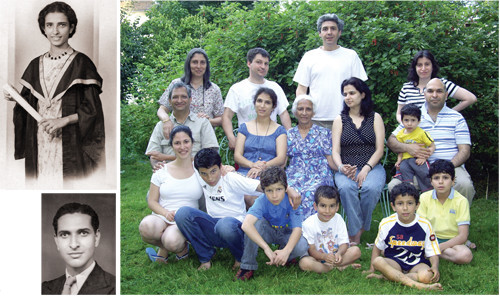
Above: Goshasp Limki at graduation and Phiroz Limki. (Alongside) Goshasp Limki (center) with her family: Pheroza (standing), Marzban (seated) and Rashné (squatting) at extreme left
"Very good friends” at The Bombay Samachar (Muncherji Cama) and the Jam-e-Jamshed (Jer Dhondy) guided her on the intricacies of obtaining a license to buy grey newsprint, a controlled commodity at the time. She would bring a "truck full of paper sitting next to the driver” to give him directions. The young publisher would trudge from office to office and home to home, college books in hand, selling advertising and subscriptions. In-between appointments or visits "I would read during whatever time I got,” recollects Limki. Her mother used to be "frightened” of her daughter treading off alone and counseled her to "go in pairs.” Instead the intrepid editor carried an umbrella and only once when a potential advertiser attempted to take advantage of her she brandished the implement and fobbed him off. "I never went to that person again,” she emphasizes.
Her first yearly 12-page advertising contract came from the Central Bank of India for a total of Rs 96, or Rs 8 a page. She felt on top of the world. An annual subscription was priced at four rupees. Single copies were not sold though sets of the journal were. Fifty copies of every issue however were given to her friend who ran Karani & Sons, publishers and printers.
"I never felt odd going out and meeting people,” she remarks. "I wanted to make friends.” She recalls a supportive Parsi lady, a Ms Mehta, at the Sanj Vartman press who, dressed in a sari and mathabanu (white cotton cloth covering the hair), would spend the whole day at the premises, resting occasionally on a deck chair. She also remembered two Parsi women who sold cups of tea and bread butter to people waiting for buses next to the Oriental Insurance building in the Fountain area between the years 1960 to 1965. "They had no shed, only a chair. Nobody tried to take undue advantage of them. I used to admire the two of them. They earned their money with the sweat of their brow.” Only when the bus stop was shifted did the ladies give up their roadside business.
Mahila started as a monthly, became a fortnightly in 1960 and a weekly in 1965. The publication "prospered. We got advertisements.” Out of a 100-page issue, 50 pages constituted advertising, she estimated. "People came knocking at our door” with editorial contributions, poems, stories, articles pertaining to women, horoscope predictions. "Except for the stories, everything is in English,” she notes. Eruch Pavri, an editorial member of Gupsup, Minoo Desai, the editor of The Bombay Samachar and a Natwar Bhatt assisted Limki in editing and proofreading Mahila.
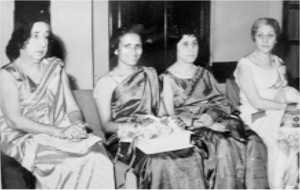
From left: Goolestan Billimoria, Goshasp Limki, Erna Homi Pesina and Thrity Taleyarkhan at the felicitation function
A write-up on the occasion of the publication’s 48th anniversary noted the reason for the magazine’s popularity. "This was a result of door-to-door canvassing done by the publisher herself for many years… not only in Bombay but in Poona and throughout Gujarat. Other cities like Calcutta, Nagpur, Secundera-bad, Hyderabad and Madras were covered by sending personal letters to Parsi ladies in these towns, requesting them to subscribe to a truly women’s magazine in Gujarati.”
Among the leading serial storywriters was Erna Homi Pesina. A nurse by profession who then became a homemaker and writer, "she passed away at a young age in 1968,” says Limki. She wrote romantic tales and all her heroines "were very pretty and well endowed. The girls all had gulabi gaals (rose colored cheeks).”
The publication honored Pesina at a public function at the Birla Matushree Sabhagriha on May 19, 1968 with Thrity Homi Taleyarkhan as the chief guest. "We must have been the first publishers to felicitate a writer,” states Limki proudly. Illustrations for the journal were drawn by an Adi Irani. Other prominent writers included Jini Paymaster and a Kalpana. With a dearth of such writers today, Limki notes that subscribers "want repetition — the all-time classics.” These are reprinted in the publication and greatly appreciated.
One of four children, Limki’s "love of literature” came from her father Munchershaw Bhumgara. "He wrote stories and poems which he sent to the Jam-e-Jamshed and Kaiser-E-Hind. He started Rojnameh, a Gujarati daily. "Daddy used to fill up the space” for the paper before it folded, recalls Limki. He also started the Rathestar Weekly which sadly closed down in 1953. Limki’s paternal grandfather Sorabjee Bhumgara was an "ivory worker” and one of his handiworks was presented to Queen Victoria, says Limki. "He had shops in Paris, London and Budapest.” He returned to India but Limki believes the shop in Paris still exists. When asked the origins of the surname Limki, she replies with a smile that her mother, Tehmina, said it was "khattu meethu dodhi ma gosh (sweet and sour mutton in bottle gourd).” Four generations of the family have been vegetarians, "not because of health reasons but because we should not kill for reasons of food,” asserts Limki. When she started Mahila because she wanted "to say something,” her mother "was very, very happy. It runs in our family. Maaraa loi ma chhè (it’s in my blood).”
Munchershaw was a manager of Khatau Mills "till he decided to go into literature,” recalls Limki’s son Marzban. In between he joined Mahatma Gandhi at his ashram at Sabarmati "and burned silk saris.” Phiroz who studied aircraft frames in Scotland returned to India and started Lim Advertising which canvassed advertising for various publications. He died in 1998.
Goshasp was born in Karachi and studied in the English medium, first at the Mama School and then in Bombay at the J. B. Vachha High School for Parsi Girls in Dadar. One of her brothers, the late Roienton Bhumgara, settled in London while sister, Ghaver, who married a Scotsman, was a French teacher at J. B. Vachha for 37 years before retiring to look after the family. Another sister Boktar died early.
Of Limki’s four children her son Farzad is a hedge fund manager in London and twin daughters Ashishwangh and Annahita both teach English and French. The twins are married to Frenchmen with Ashiswangh living in Algeria and Annahita in France. "I have beautiful sons-in-law,” says Limki. Their children’s navjotes have been performed with their fathers’ blessings. In the Jamshedi Navroz issue she noted ruefully, "Unknowingly we have come to know and speak of all non-Zoroastrians as darvans (low caste).”
Marzban says he "did not want to go abroad.” He looks after the family’s printing business, Limkigraphics. His wife Pheroza helps with the publication. Their daughter Rashné is studying for a PhD in violence against women and children at the University of California at San Diego. She is unlikely to return to India, feel her parents.
Today the publication "is no longer a money making business. Mahila just pays for the cost of paper and printing,” says Limki. The magazine’s "base is dwindling,” adds her son. "The future is not very secure.” Four issues in a year, Jamshedi Navroz, Pateti, Diwali and the January New Year garner advertising that helps to defray the costs of the remaining 48.
"The core readership (constitutes) people who read the Gujarati stories,” observes Marzban.
Goshasp alludes to one of their storywriters Perin Naval Hormusji who used to state in her tales, "that which has a name has to perish.” "Anything is perishable,” says Limki philosophically. "Even if Mahila closes down it is a natural thing.” "It’s a bridge (we’ll cross) when we come to it,” says Marzban. But the optimistic write-up on the 60th anniversary notes, Mahila Weekly "will soon celebrate a centenary.”
◆ ◆ ◆
From the archive