
Events & Personalities
The Parav at the pier
The voice of nearly 1,000 devotees resounded on the pier of the Bombay Presidency Radio Club in a humbandagi on Avan roz, Avan mah, on March 26, 2010 following a jashan ceremony led by Dastur Khurshed Dastoor, High Priest of Udvada along with 20 other priests on the occasion of the Avan Yazad Parav. The Avan Ardevisur Parav function, which started on a small scale decades ago, is now being celebrated on a grand scale in Bombay, due entirely to the efforts of eight committed and dedicated individuals. Sadly, one of them, Ervad Naval Rustomji Unwala expired a day before the Parav. This information was provided in a write-up by Cyrus Patel that was forwarded to Parsiana via e-mail by Kersi Commissariat.
In his address Dastoor bemoaned the fact that though our community is forward looking in most things, it is not progressing at the rate it should. Educated females of our community — who can influence their children to reach greater heights — are unable to teach them the basics of our religion, customs and our Parsipanu. Though children are given lessons in karate, dancing, music, art, etc there is a lack in the imparting of religious knowledge. Children are sent to agiaries and atash behrams but they do not know much about Zoroaster and Ahura Mazda. Dastoor stressed the need to disseminate religious knowledge to youngsters, acquainting them with our history, culture as they are our future, Patel reports.
Dastoor also expressed disappointment at the fact that even after explaining over the past three years the need to not pollute the sea and wells, Zoroastrians still continue to throw flowers, coconuts and dar-ni-polis into the sea and other water bodies, adding to the already existing pollution. Instead of this, he suggested that Zoroastrians pray to Avan Yazad, perform the kusti and try to invoke the diety’s blessings, observances which will not go unheeded. He hoped that he would not have to witness such pollution in the future.
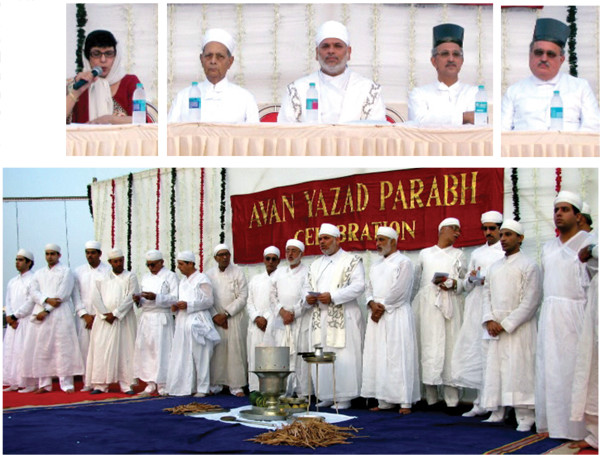
(Top row, from left): Zarine Commissariat, Nadir Modi, Dastur Khurshed Dastoor, Kersi Limathwalla, Zarir Bhathena; (alongside): Dastoor (center) leads priests in prayer
The main speaker of the evening, senior member of the legal fraternity Ervad Nadir A. Modi, was introduced by master of ceremonies Zarine Commissariat. Modi took the congregation on a journey through times when there was a sizeable Parsi population till the present day when the community is facing the danger of extinction. There cannot be a religion without the community and there cannot be a community without religion, he maintained. Religions have faded with the extinction of communities, he warned, the e-mail notes.
In 2005-2006, the government of India, apprehensive over the dwindling Parsi population, sent experts who had conducted the census of India to Bombay. These experts had sounded an alert about our declining numbers, but some community leaders did not accept this as a fact. Today few people can refuse to recognize the truth that the Parsi population in India is indeed on a precipitously steep decline. One of the reasons for this is immigration to foreign countries. Those who go abroad seldom return. And, with the passage of time, their Parsipanu evaporates.
The lifestyle of members of the community, like late marriages, no marriages; celibacy (30 percent), also aggravates the problem, Modi explained. Since there are few opportunities for Parsi boys and girls to meet, the Bombay Parsi Punchayet (BPP) has stepped in and is offering an opportunity for males and females, up to the age of 40, to meet once a month under its aegis. Also, since late marriages could result in infertility, the BPP is offering free medical aid to infertile couples through a program under the guidance of Dr Anahita Pandole, an initiative that has met with a fair response and results.
Modi mentioned that marriages outside the community are on the increase. People feel there is gender based discrimination since children of Parsi fathers and non-Parsi mothers are deemed Parsis, but not vice versa. He maintained that although marriages within the community are still the preferred norm, times have changed and one-third of Parsis marry out. In any case, in order to survive, there must be the will to survive. Parsis should realize the danger of extinction and take steps to increase the population, the write-up records.
Rusi Bhumgara extended thanks to all those who had contributed to the success of the evening, specially Dastoor, the panthaky and priests from the Sethna Agiary for performing the jashan, the management of the Bombay Presidency Radio Club for making available their premises at a concessional rate, Commissariat for her inimitable compering, Sarosh Daruwalla for his public address system, the Athornan Mandal, Bombay Jashan Committee, World Zoroastrian Organisation-India, Young Collegian Zoroastrian Association, the Kathawallas, P. K. Tavaria for the photographs and videography, Marzban Mehta and his group for the entertainment provided.
◆ ◆ ◆
From the archive