
Readers' Forum
Ill advice on Avan parav
I have been attending the jashan and the speeches on the occasion of Avan mah, Avan roz at the Radio Club every year and I always returned home enlightened with the knowledge that the eminent speakers had imparted. In fact, I would send e-mails to my friends coaxing them to attend and after the event I would send them another e-mail educating them on what I had learnt.
This year too, I attended, along with my 28-year-old son, his fiancée (26) and my niece (17). However, this time, i.e. on March 26, 2010, my experience was different.
Chief guest Nadir Mody’s speech was good, his English impeccable, his accent, admirable and his flow of thoughts, absolutely fluent but I was still not impressed. He spoke on how to save the Parsi community from getting extinct. I lost all the respect that I had for this elderly gentleman who was impressing upon the audience that the community was shrinking because of celibacy and infertility and that’s why Zoroastrians should think of permitting Parsi men to marry non-Parsi ladies. In other words, he advocated interfaith marriages.
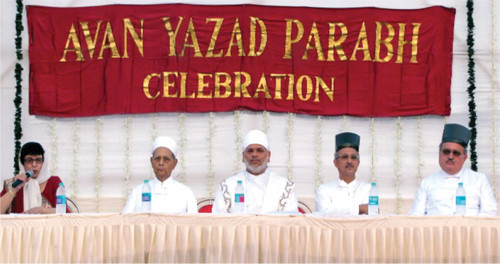
From left: Zarine Commissariat, Nadir Modi, Dastur Khurshed Dastoor, Kersi Limathwalla and Zarir Bhathena
This took me and several others too completely by surprise. This was not what I wanted to instill in the minds of our young children and the youth of our community. I want Mody to understand that even the youngsters were taken aback by what he preached and were upset that they ever attended the program. I only want to request him to understand that such words of advice need not be given to our youngsters when other elders of the community are doing their best to preserve our religion through positive measures.
I firmly believe that it is because of our small numbers that our community has survived. Had we been too many, there would have been chaos. As a professional photographer I take pictures and record videos at innumerable navjote ceremonies and find that all the children of our community know how to pray their basic prayers at their navjotes. Please let me know if this phenomenon exists in other communities that are much larger than us in number.
A mere higher figure does not make a community great. Unity means strength. So please do not indulge in again dividing our small in number but great in philosophy community by your negative advice.
I also request the organizers of this function to be more careful in their choice of speakers in the future.
RUSTOM A. HAVEWALLA
rustomhavewalla@msn.com
Nadir Mody replies
It is entirely untrue that I have advocated inter-communal marriages. I have always been, and am, of the view that for our community in India intra-communal marriages are, and should be, the preferred form for a number of good reasons.
My Avan Yazad talk was focused on placing before the audience the declining figures (which I find disturbing) of our Parsi population. For example, the census figures for the community in India in 1941 was 114,890 which declined to 69,601 in 2001. I had also pointed out that the figures in the 2001 census showed that 24.1 percent of the Parsis were above the age of 65 years which is considered to be an alarmingly high figure.
I put these figures before the audience and pointed out how the Government of India was concerned enough some years back to arrange for a census experts’ day-long seminar. This year on the day of the Avan parav itself, Salman Khurshid, minister for minority affairs, had arranged a meeting at Delhi to discuss among other things the subject of population decline in our community. I had been invited to this meeting but could not attend due to the Avan parav function being on the same day.
Both at the beginning and towards the end of my talk I had said that if any group wishes to survive it is essential that it must first display a will to do so. There are no problems that do not have solutions. However, what is important is for the Parsi community as a whole to demonstrate that it has realized the seriousness of the problem. I did not go into any discussions as to what the corrective actions could be. I refrained from expressing what the "survival steps” ought to be, but among the causes of the declining numbers of our community I mentioned late marriages, celibacy, infertility and inter-communal marriages. As regards inter-communal marriages, I believe that the figures indicate that at present about one-third of Parsi marriages are inter-communal marriages, which in the present set-up contributes to the decline of our population.
In support of intra-communal marriages, in my talk I had specifically referred to the Bombay Parsi Punchayet (BPP) having stepped in and given an opportunity to our young folk to meet once a month. I had also mentioned about the BPP offering Rs 1,000 and Rs 3,000 per month for the second and third child till he or she turns 18; and the BPP having facilitated a fertility program since January 2004 under the stewardship of Dr Anahita Pandole, the benefit of which I understand has been taken by 526 couples and through which fertility program there has been an average annual 28 new births.
◆ ◆ ◆
From the archive