
Comment
‘To the Waters of the World’
The Avan roz nu parav is a time to appreciate the life- giving liquid and also a time for spiritual and moral retrospective
"This evening, we were surprised to see, as we strolled along the beach, more Parsis than ever before, and more Parsi ladies, richly dressed, all wending their way towards the sea... Here on the shore of the ocean, as the sun was sinking in the sea, and the slender silver thread of the crescent moon was faintly shining on the horizon, they congregated to perform their religious rites. Fire was there in its grandest form, the setting sun, and water in the vast expanse of the (Arabian Sea) outstretched before them. I could not but participate with these worshippers in what was so grandly beautiful. There was no music save the solemn moan of the waves as they broke into foam on the beach. But where shall we find so mighty an organ, or so grand an anthem? How inexpressibly sublime the scene appeared to me and how insignificant and unworthy of the unknown seemed even our cathedrals ‘made with human hands,’ when compared with this looking up through nature unto nature’s God! I never expect in all my life to witness a religious ceremony which will so powerfully affect me as that of the Parsis on the beach of Bombay,” wrote Andrew Carnegie, one of the greatest industrialists of USA, on his visit to Bombay on Avan roz nu parav over a century ago.
Zoroastrians the world over celebrate Avan roz nu parav, a day dedicated to the Waters of the World. It falls on Avan roz (the 10th day) of Avan mah (the 8th month) of the year of the Parsi calendar. To us mortals, it has two great properties, a wondrous cleansing element and a life-giving and sustaining element so vital for plant, animal and human existence. Interpreting it philosophically and ethically, it represents purity and God’s creative energy.
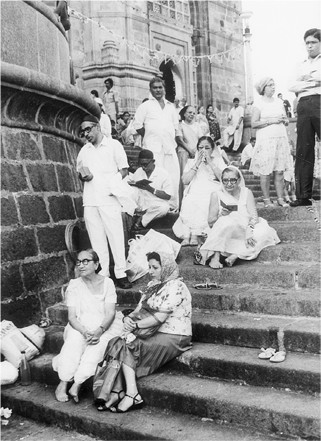
Devotees outside the Gateway of India on Avan roz nu parav
The purity of Avan Ardvisura should cleanse us not just physically but deep within us. Our minds should not harbor any adverse thoughts; through words of wisdom and peace we should spread the message of Zarathushtra and dedicate our lives to the service of mankind. This is the only way of expressing our gratitude to Ahura Mazda. Rituals and prayers are necessary, but they need to be backed by a clean mind, a kind word and a good deed.
Ardvisura is the female divinity of the waters of the world and a manifestation of Ahura Mazda. In the 65th chapter of Yasna, she is described as courageous, strong, beneficent and of noble origin. It is said that Ahura Mazda has entrusted to her the work of guarding His holy creations like a shepherd guarding his flock. She is defined as one possessing great beauty, glamor and purity. She is adorned with a studded golden crown, heavy jewelry and rich garments. Her majesty is unmatched and she rides a chariot of four white stallions representing wind, cloud, rain and sleet. She was revered and worshipped in ancient Persia. There were temples and statues dedicated to her name and she received recognition from Achaemenian kings. Her boon was invoked for a variety of purposes, with sacrifices made in her name for sovereignty, victory on battlefields and to ward off sorcerers and fiends.
As one symbolizing purity, prosperity and plenty, she is also worshipped for a compatible life partner, successful marriage and fertility as she is known to bless the seeds of men and wombs of women for easy childbirth and nutritious milk. She blesses the progeny with good health and strength to combat evil and bestows countless boons for a happy married life. Procreation and family life as opposed to celibacy and ascetic life is not just recommended but enjoined as a duty; a puthrane (one with children) is praised as against aputhrai (one without children) in the Vendidad.
In our scriptures, Ardvisur is referred to as the flowing waters, which are supposed to be clean and clear as distinct from stagnant water. In the Ardvisura Nyaish, Ahura Mazda enjoins Zarathushtra to worship flowing waters, which are pure, crystal clear and undefiled as they spread health, plenty and prosperity.
According to the Ardvisura Nyaish, Ardvisura is the name of a mythical river, a river larger than all rivers of the world put together, having its source in the mythical mountain Hakairya and flowing into the sea of Vouru Kash. On its banks are trees and medicinal plants. When the leaves and branches from this foliage fall into its waters the river derives its healing properties.
It is also said that Vouru Kash is the Avestan name for the Caspian Sea. The Pahlavi name is Frakand. In the pav ceremony, as the mobed pours water over the utensils, he recites in baj, "Yaozdathra Zareh Frakand, Yaozdathra Zareh Varkash, Yaoz-dathra Zareh Puiti” (Puiti, referred to as the Sea of Aral). He thus invokes Ardvisura and allows the water to overflow over the utensils for the highest level of purity. It needs to be appreciated that purity cannot perpetuate in isolation unless and until we synergise physical purity with mental and spiritual purity.
Physical purity is not supposed to be superficial or cosmetic; the underlined reason for making it part of religious customs is that it also ensures good health. The Zoroastrian religion enforced such practices long before science recognized them. There are several purification ceremonies like padyap kusti, nahan, riman and bareshnum. The simplest of them, which we perform daily, padyap kusti has an inert hygienic, philosophical and ethical significance.
Stress — the scourge of modern day urban living is a product of the mind. Purity therefore has to begin in the mind before it percolates into the body and soul. Unfortunately our religious customs and rituals which have a strong time-tested scientific base have over years been reduced to monotonous mechanical rites. This is the community’s loss. We for the better part are so embroiled in controversial issues that we miss the essence and consider our religion mundane.
Reciting Avan Yasht and/or Ardvisura Nyaish is recommended at least on Spandarmad, Avan, Din, Ashishvangh and Mahraspand rozs. Ahunavar (Yatha Ahu Vairyo) can be recited 65 times, if unable to recite Ardvisura Nyaish as it is considered its equivalent. Avan Ardvisur has great powers and strength and we all seek her favors. Even Ahura Mazda seeks her assistance that Zarathushtra may spread the Mazdayasni religion and Zarathushtra seeks her boon that King Vistasp may embrace his faith. Such is the might of the divinity that we revere. But we need to be worthy and selfless to invoke such divinity and adopt an attitude of total surrender. It is the righteous amongst us whose prayers are answered.

Having founded the firm Kersi Jamshedji and Company 25 years ago, Kersi Limathwalla is a practising chartered accountant and tax advisor. He is actively associated with community organizations like the Committee for Economic Revival as also the World Zoroastrian Organisation and is presently chairman of the M. J. Wadia Fire Temple Trust and the Lowjee Wadia Dispensary Trust.
◆ ◆ ◆
From the archive