
Comment
Bawal blues
Though lakhs of bawal trees have been cut over the years, new planting has not taken place
Day by day the procurement of bawal wood has become very difficult. For the last 35 years we have been informing members of our community and particularly trustees of all fire temples and punchayets. We had also raised this matter at the meeting of the Federation of Parsi Zoroastrian Anjumans of India.
When our father, the late Framroze Govadia bought the firewood business in 1942, the selling price of bawal wood was Rs 40 per ton. In the year 1972 it had gone up to Rs 100 per ton so the average yearly increase was two rupees per ton. Presently it is Rs 8,000 per ton and within a very short period, may go up to Rs 10,000 to Rs 12,000 per ton.
Our company, H. Sidhwa and Son, was established 100 years ago by Hormasji Sidhwa in 1907. After several years Hormasji started a more lucrative business of timber wood and handed over this firewood business to his brother-in-law Sorabji Govadia who due to his ill health sold this firewood business along with the goodwill to our father in the year 1942. After our father’s demise we three brothers — Farroakh, Hoshang and Mehernosh — have been looking after this business.
In 1942, bawal wood was available at a very low cost. In those days, Karnataka state permitted merchants, particularly from Karwar District, to export firewood to Bombay and Maharashtra. Firewood used to be transported by sailing ships at very low costs.
In 1972 the Karnataka government stopped exporting firewood to other states, leading to an escalation in prices over which nobody had any control.
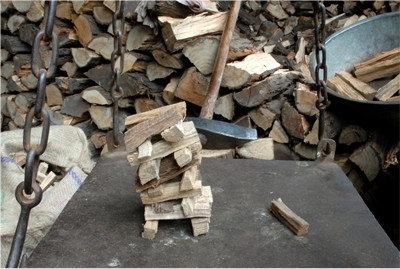
Dry bawal wood stored at the depot of H. Sidhwa and Son
According to our estimate, about 800 tons of bawal wood are consumed in Bombay. This requirement is now met by talukas of south Gujarat viz Bulsar, Pardi, Dharampur and Chikhli. Almost all agiaries in Bombay and beyond up to Surat are dependant upon these four talukas. Additionally most of the industries and all sugar factories from Vapi to Surat use bawal wood. Plus bawal is used for cremation and other individual requirements.
Over the years lakhs of bawal trees have been chopped off but no one — not the forest department nor social workers — has bothered to grow new bawal trees. The lands where the bawal trees were growing naturally are in fact being used for growing other food products.
Earlier there were approximately 10 to 20 wholesalers each in Bombay, Vapi, Udvada, Bulsar, Billimora and Surat to sell the bawal wood. At present there are neither wholesalers nor wholesale depots. Bawal trading has changed its system. Today small farmers have their depots in their respective villages. There are more than 30 such depots in the four talukas named earlier. None of these stockists are in a position to supply our yearly requirements. So we have to move from village to village and from stockist to stockist in search of bawal logs of minimum nine-inch diameter. One stockist can supply a maximum of one to four tons of bawal wood.
Although Poona and Nasik districts also have bawal trees, there are no stockists anywhere, but small individual dealers aplenty on whom we can never rely. As per their system of supplying bawal wood, they cut down two or three trees and pack the truck with the whole tree — the trunk portion, small and big branches and the roots of the tree. Wood branches are of no use in agiaries where seasoned thick wood is required.
For the last 40 years we have been stocking bawal wood at our farmhouse in Talasari taluka. We keep it for one year to allow it to dry completely before supplying it to fire temples. Mobeds refuse to use wet bawal wood. This means that we have to invest more money than other merchants who buy and sell wet wood. The drying process involves a loss of about 20 percent in big thick logs of wood and about 35 percent in thin logs. So the average loss of weight is about 25 to 30 percent. It means if we buy and stack 1,000 tons we get only 700-750 tons after drying.
Additionally we have to twice bear the transportation costs — from Gujarat to our depot, and then again from our depot at Talasari to our Bombay depot. While transporting the goods we have to face octroi charges of three percent on the value of goods. Besides paying two times for the loading and unloading we have to spend on cutting and splitting. Dry wood requires heavy labor for cutting and splitting, and for that we have to pay double the labor charges prevailing in the market. Our laborers are trained and we have to retain them by paying higher wages. While cutting and splitting we face waste materials which we have to discard and hence once again incur truck charges. We also face pilferage problems at our depot in Talasari as the neighboring Warli tribes prepare their food only on firewood.
Taking all these factors into consideration, the cost of bawal wood is becoming prohibitive. Are our trusts ready to spend this amount? Have they made provisions for such expenses? If we sit together and try to solve this problem we can. This acute problem of bawal wood can be solved in a very short time if everybody is sincere and deliberates on the many ways to grow bawal trees.
◆ ◆ ◆
From the archive