
Events & Personalities
Dear sandalwood
"India’s sandalwood industry is going up in flames,” declared a write-up in The Indian Express of September 24, 2002 titled "Can you smell the stink in sandalwood? Blame the Govt.” As compared to last Diwali when sandalwood was available at Rs 1,400 a kilo, by April 2002 the consumer had to pay Rs 2,000 for the same quality sandalwood. Not surprisingly, many Zoroastrians patronize the vendors who do brisk business outside the shrines selling their sandalwood perfumed sticks at less than one-fourth the rate of pure Malbari sukhad. "A government monopoly, ostensibly aimed at protecting the tree, has encouraged roving gangs of smugglers to strip the forests in the south of the precious commodity. Critics say the result shows how socialism continues to fuel corruption and eat away at competitiveness despite a decade-long campaign to revive its economy,” mentions the newspaper.
Forty years ago Karnataka and Tamil Nadu imposed a monopoly over ownership and harvesting of the trees. Not only did the states limit production, "they also failed to cultivate, relying instead on once-abundant wild reserves. That opened the door for a growing black market where a single tree (which takes 40-60 years to grow to commercial viability) can fetch more than a lakh of rupees,” reported The Express.
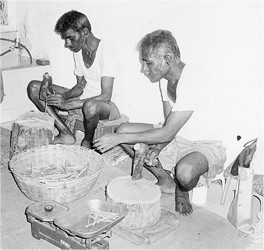
Sandalwood cut into splinters
Sandalwood dealers usually get their stock from the government auctions held periodically. As against the 30-40 tonnes of sandalwood usually released at the auctions, 200 tonnes of sandalwood were released at the last auction. But instead of the prices falling, they skyrocketed, especially when the government announced its policy of permitting 200 tonnes for export, mentions a sandalwood dealer. "India, once the undisputed leader in the $ 100 million-a-year market for global sandalwood exports is losing its position to upstart suppliers in Australia and Indonesia,” states The Express. If the government had not monopolized the industry "sandal would have been as plentiful as coconut trees in southern India,” R. N. Murthy, managing partner of N. Ranga Rao and Sons, India’s largest producer of incense sticks, was quoted in The Indian Express.
◆ ◆ ◆
From the archive