
Business
The buzz of business
The World Zarathushti Chamber of Commerce, Bombay Chapter mentors and rewards budding entrepreneurs at the first all-India Business Plan Contest
The range of ideas was rewarding — opening a jungle lodge in tiger country, manufacturing and marketing doughnuts to international standards on a pan-India basis, customized and low cost ERP (enterprise resource planning) software solutions, credit and risk management services, a registry of bone marrow donors, a super speciality hospital for women, an asset management company/mutual fund, a holistic gym and fitness center, e-waste recycling, corporate gifting with a social cause, etc.
Promoting the ‘business today’ mantra among Zoroastrians and encouraging them to do more and do it differently, the World Zarathushti Chamber of Commerce — India (WZCCI) felicitated on December 20, 2009 at the West End Hotel in Bombay, 18 budding entrepreneurs who had successfully presented their detailed business plans as part of the WZCC’s first ever all-India Business Plan Contest. Six of them were honored with cash prizes totalling one-and-a-half lakh rupees. The main sponsors of the prize money were The Zoroastrian Co-operative Bank Limited, Shernaz Vakil of the Neterwalla Foundation and Zarir Bhathena of Hilla Builders.
It was also announced at the function that the WZCC’s choice of Honorary Member this year was Nusli Wadia, chairman of the Wadia Group. Each year the WZCC confers honorary membership on an eminent Zarathushti selected on a worldwide basis.
Conducting the proceedings with her usual verve and zest, mistress of ceremonies and WZCC international board member Zarine Commissariat invited on stage the winners. "Ah, I see your fellow competitors clapping away and (judge) Homi Khusrokhan smiling away,” she said as she announced the first prize winner — Farokh Irani of Poona, "the baker and entrepreneur” who makes 24 varieties of doughnuts under the brand name Donut King, whose products are "of international quality, known for their freshness and variety,” who is seeking to expand his business on a pan-India basis. A beaming Irani received Rs 50,000 and a certificate. .
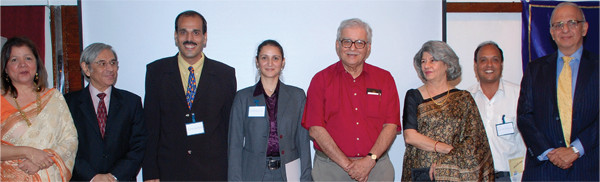
Encouraging enterprise: (from left) Shernaz Vakil, Homi Khusrokhan, Farokh Irani (1st prize), Tinaz Billimoria (3rd prize), Jamshed Irani, Shernaz Mehta, Hormazd Yazdabadi (2nd prize) and Behram Sorabji
Hormazd Yazdabadi, also of Poona, won the second prize of Rs 30,000 for his plan of making software products for the use of medium and small scale industries "whose USP (unique selling point) is its price and availability.” The third prize of Rs 20,000 went to the lady of "intense belief and passion” Tinaz Billimoria whose International Credit and Risk Management Services (ICRMS) focuses "on operational excellence. She has proved her ability to present her Plan.”
The "Best Marketing Plan,” with a prize of Rs 15,000 sponsored by Bhathena, went to Jehan Bhujwala of Bombay whose "pioneering spirit” led him to establish the Shergarh Tented Camp in the Kanha Tiger Reserve in Madhya Pradesh. Bhujwala now looks to open a new venture at Melghat in the Satpura Tiger Biosphere of central India. Firdosh Roowalla of Poona won Rs 15,000 donated by Bhathena for the "Best Financial Plan.” Roowalla’s Cell Source India Private Limited proposes a registry of bone marrow stem cell donors, with bone marrow promising a cure for several diseases. His "meticulously itemized plan shows a four-year profit projection...”
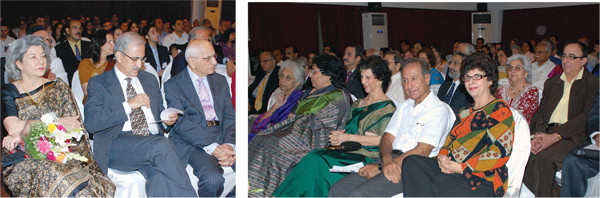
WZCC members and guests at the West End Hotel
The "Social Enterprise Award” of Rs 25,000 sponsored by the Neterwalla Foundation for a business that "makes a difference to society” went to Nahid Elavia whose Gifting Goodness seeks to encourage corporates to buy gifts made by smaller NGOs and "is passionate about her cause.”
Certificates were awarded to the other finalists — Anosh Doctor, Cyrus Driver, Darayas Khajotia, Prof Faredoon Kapadia, Frazer Rustomji, Jimmy Patel, Mehernosh Deboo, Shahzad Daver, Sonya Vazifdar, Sohrab Bharucha and Viraf Tavadia — for delineating the art of the possible and taking a game shot at the big cheese.
"We read so much in the Parsi Press that the Zoroastrian youth have become lazy, that they only take up bank jobs, that they are too protected in the charity baugs and so on and so forth,” Cyrus Bagwadia, WZCCI vice president and ex-managing director and chief executive officer of Essel Propack, told the distinguished gathering. "But is the youth really sleeping?” he queried. Forty entries were initially received, many of them from people who had not ventured into business earlier. After a short period of training and professional mentoring intended to help turn green shoots (ideas) into stalks (detailed business plans with facts and figures), 18 finalists were shortlisted and made their presentations in the first half of December to the judges and nearly 25 investors (experienced professionals and businessmen themselves) who evinced interest in funding the ventures. "There are angel group funds in India (so called because they are like angels who come to the rescue of and guide those in need of funds), but none offers the kind of coaching and mentoring that we did. Also, this contest is the first one in India which is promoted and run by a community. The whole program took six months but the results and outcome are terrific,” stated Bagwadia. The funding required by the budding entrepreneurs ranged from Rs 10 lakhs to over a crore of rupees. "Are you looking for free giveaways, donations, charities, guys?” Bagwadia queried. "No,” chorused the participants. Investors have started to indicate which Plans they would like to fund or be associated with. A reasonable return on the investment within three to four years is what they would be looking at, he added.
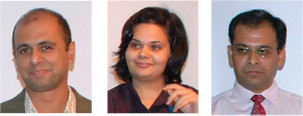
Winners (L to R) Jehan Bhujwala, Nahid Elavia and Firdosh Roowalla
The WZCC’s core mission is to stimulate, support and get free enterprise going, stated Bagwadia who was the architect of the Business Plan Contest, with the GOF (Group Of Five) consisting of Bagwadia, Yazdi Tan-tra, Nowroze J. N. Vazifdar, Bombay Chapter chair Pheroze Kharas and Firdosh Tolat shouldering the nitty-gritties of implementing the project which started in July last year. Slicing and dicing the Plans to select the winners were the judges — Aspi Katgara, Behram Sorabji, Adi Cooper, Minoo Mody and Khusrokhan.
Over the last 20 years, Zoroastrians have fragmented globally, making mentoring and a support system of greater importance in unlocking value. A number of businesses try to operate from home and affording office space is a major constraint. "Microsoft and Google may have started in a garage,” observed Bagwadia, suggesting that Zoroastrian corporates could make available a small room as well as expertise in legal, financial and HR (human resources) matters for a maximum of 12 months, which would be a kind of incubation period for the budding businessman.
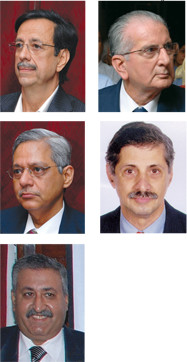
Clockwise from top left: Cyrus Bagwadia, Pheroze Kharas, Nowroze Va-zifdar, Firdosh Tolat and Yazdi Tantra
"I have a confession to make. I am not an entrepreneur, I am a scientist and implementer of other people’s ideas,” remarked chief guest Dr Jamshed J. Irani, former managing director of Tata Steel who is currently on the board of Tata Sons. "Jamsetjee Tata was the biggest entrepreneur of them all. He worked against all odds and laid the foundation of the largest industrial house.” He was followed by various notable successors. "J. R. D. Tata in a way shaped my career. My own contribution to entrepreneurship was something I introduced called ‘Dare to try.’ There are several people with good ideas whose efforts do not bear fruit due to a combination of circumstances — the environment around them, regulations or other factors beyond their control,” Irani explained. "Those people also should be recognized. I have been fortunate to be a mentor.” With the entrepreneurial spirit encouraged and developed, "some more Jamsetjee Tatas will come out of our community in future years,” stated the man of steel.
Minding their own business!
For many, business was a first time venture, fascinating and frustrating. And they surprised even themselves! "The quality of the Business Plans, the presentations and the caliber of the participants was very good. We never expected this quality. There is a myth being broken here — that there are no Parsi entrepreneurs, that youngsters are not interested, etc,” asserts Yazdi Tantra, one of the GOF (Group Of Five) who was actively involved in the Business Plan Contest.
"Not only have I been working an equal number of man hours writing my Business Plan, but also simultaneously restructuring my business. Donut King was established in July 2008 in Poona with the intention of making international quality American doughnuts in a wide variety of flavors and fillings. Since this concept did not exist in India we wanted to be the first movers in this business,” states first prize winner Farokh Irani. As part of their main revenue, they would like to implement the franchise model, he narrates. "Our goal is to build a business out of franchises on a pan India basis and run each franchise as a profit center...Our doughnuts are fried in zero percent trans fat which is the international standard for fried food,” he emphasizes. Irani has hands-on experience, as his family runs the Imperial Bakery on East Street which has been in existence for over 50 years. "Donut King looks to open one store per quarter... competition is coming in a big way. We need to establish the brand...” he asserts. "I have received communication from more than five individual investors who have shown interest in the venture, one of them from Poona itself who would have never imagined that I had plans to make it big, had he not read through my Business Plan!”
Under the name of Cinetech India Enterpises, Hormazd Yazdabadi currently develops software products at project level. His Business Plan involves the making and marketing of software products with minimal customization for medium and small scale industries. "I feel motivated. Writing the Plan clarifies your own focus and puts things in perspective. You put the facts down on paper...in a series of very logical steps. If step one goes wrong, step two and three will go wrong as well. The Contest puts on you the larger responsibility of making the Plan work. There is always the problem of getting finances, but even if funding doesn’t materialize this is a positive step, an intrinsic learning process,” he says. A long-term project, his IT product will be launched in 2012, breaking even three years later.
Tinaz Billimoria set up a limited liability company in Egypt in 2007. International Credit and Risk Management Services (ICRMS) provided consultancy services, project management, data management and training services to I-Score, Egypt’s first Credit Bureau for the period June 2007 to May 2008, states their website. ICRMS creates specific competencies, says Billimoria, for banks, financial institutions, credit bureaus, manufacturing, retail, etc, enabling businesses and consumers take sound decisions and attain their goals. Currently ICRMS is in the process of implementing customized solutions for a courier company and banks in Egypt, says Billimoria. The Business Plan Contest enables "a young company like ours build a good network of contacts,” she adds.
Jehan Bhujwala set up Shergarh (a complex of six well spaced tents with all modern amenities) at the Kanha Tiger Reserve in 2004. Wildlife tourism is a required conservation tool, he declares. "We (eco-lodge owners and managers) are the eyes and ears to report things to the government officials,” he states. The hands-on experience, knowledge and goodwill he has garnered through these years have prompted him to want to set up a second eco-lodge at Melghat, about 200 km from Nagpur as well as Bhopal. The wildlife parks in central India form an exciting tourist circuit, the second most important wildlife hub after Africa, he believes. The business holds promise as "there is a lack of current infrastructure for tourists to stay.” Natural materials (stone, wood, thatch, etc) sourced locally would be used, with social and economic benefit to the locals. Elephant and jeep safaris, watchtowers, etc provide opportunities to sight the magnificent, endangered beast and other wildlife in their natural habitat. "We know industry needs,” says Bhujwala who divides his time between Bombay and his wildlife venture.
Firdosh Roowalla’s Business Plan aims to start a registry of people who can donate bone marrow stem cells which can be used to cure blood disorders like leukemia, thalessemia, etc. "Cell Source India Private Limited will have a big database of donors with their medical history, matching type of donors, etc and will be updated every six months. Doctors will be aware of this and will contact me when required,” he explains. Stem cell therapy holds much potential for the future. "I have learned so much from the WZCC mentors and am still in touch with many people,” he says.
Roowalla’s plan of a registry had earlier made it to the shortlist of the top 1,000 ideas in The Economic Times "Power of Ideas” business summaries competition, conducted on an all-India basis. In January, the Indian Institute of Technology in Bombay shortlisted his plan in two contests — "Eureka” where he made it to the shortlist of the first 50 and Vulture’s Nest (where he was due to make a presentation).
Her business card says Nahid Elavia, ideapreneur, chief executive officer, Gifting Goodness. Instead of run-of-the-mill gifts like stationery items, etc, Gifting Goodness promotes the presenting of gifts made by smaller NGOs (nongovernmental organizations) like Aseema, Cancer Patients Aid Association, Nani Kali and others who support the differently-abled and the underprivileged. "We as a team (consisting of Nahid, her father Bomy and Nilesh Talreja) are very excited to have won this prize for ‘making a difference to society.’ We believe that all gifting should be two-way gifting, benefiting the corporate as well as the ones who make the articles,” she explains. A dipstick survey has shown that 60 percent of companies are open to trying out something new. "What differentiates us is that we will find the ideal NGO (whose products best suit the company’s image). We will tailor gifts for corporate needs... keep increasing our vendor base, work with them on a captive basis,” she asserts.
"Thanks to the Business Plan Contest of the WZCC, we are now on the verge of starting to live a dream that we always had. They pushed us to consider our idea and check its potential using various benchmarks. It was a platform to gauge reactions to our ideas from a plethora of senior, experienced businessmen and professionals whose inputs are priceless,” states Nahid. It also gave an opportunity to meet like-minded entrepreneurs who were "passionate, driven and some of whom had experience of a business,” she adds. Potential investors have offered "suggestions and support ranging from office space to finance... Actually getting investors to back our idea will be an add on. Getting the recognition we now have the confidence to take a loan and start off even on our own, but investor backing would be great. The germ of an idea is always there but it takes some water, some soil and manure to grow and flourish.”
◆ ◆ ◆
From the archive