
Events & Personalities
Ethics and environment
"Environmental protection within particular societies involves a complex balancing process and order of socioeconomic priorities,” stated Chief Justice of India (CJI) Sarosh Kapadia while addressing the valedictory session of the International Seminar on Global Environment and Disaster Management in Delhi on July 24, 2011. His speech was excerpted in The Indian Express (IE) of July 26, 2011.
At the same session Prime Minister (PM) Dr Manmohan Singh said that the cause of environment cannot be served by mere "exhortation” and that an independent environmental regulator would soon be set up so that there is a "complete change in the process of granting environmental clearances” to industrial projects, reported IE on July 25. The proposed body, the National Environment Appraisal and Monitoring Authority, would perform this task as well as monitor whether green norms were being complied with. The PM also spoke of the National Green Tribunal which has been set up recently with a mandate to resolve environmental disputes.
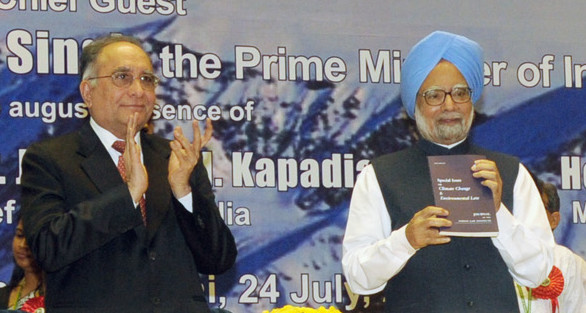
CJI Sarosh Kapadia with PM Dr Manmohan Singh at seminar on environment
Kapadia elaborated on the inherent dilemmas. "Where does an environmental right fit into a hierarchy of human rights and how should the conflicts with other human rights, such as right to property/livelihood, be resolved? How to balance environmental protection with a general or collective right to economic development?” He explained that our courts are of the view that there cannot be one universal applicable standard to judge all environments. In any case, there is some difficulty in defining what "environmental rights (are) so as to satisfy diverse ethical and cultural criteria. Hence, the need for regulatory mechanism. Courts are active, regulators are proactive. However, substantive environmental rights are more effective.”
The CJI suggested that "the solution lies in empowering people with robust procedural rights” as that will foster debate in the matter. "The choice of the elected representatives of the people cannot be entirely supplanted by the wisdom of the court... decisions relating to the utilization of natural resources for productive purposes have to be tested on the anvil of the well-recognized principles of judicial review: is the decision strictly in accordance with the legislative policy underlying the law, if any, that governs this field? Is the decision consistent with the principles of sustainable development...?” The doctrine of "margin of appreciation” should be made available to the decision making authority subject to these parameters, the CJI commented.
Referring to the problem of illegal mining in the country at the seminar, the CJI blamed the faulty pricing policy, reported the Hindustan Times on July 25. It is the huge difference in royalty paid to the government and the international sale price of minerals that has led to illegal mining in many states. "I am not against profit but it should not lead to greed,” Kapadia told those present.
◆ ◆ ◆
From the archive