
Readers' Forum
“Death by diva”
On reading your cover story "Death by diva” (Parsiana, August 7, 2009) I feel that the primary precaution of utmost importance would be to create awareness among priests that fire can be hazardous to them if not handled properly. Very often priests exhibit a casual and overconfident attitude without concern for personal safety. If the trustees and panthakies highlight this to the priests it will go a long way in preventing fire accidents.
Another way in which to achieve this would be to modify the priests’ seating arrangements during ritual prayers. It is highly unlikely that hot embers flying out from the fire can set a priest’s garments on fire. At worst, they would burn a hole through the garments up to the skin of a very startled priest. It is contact with a live flame from the afarganiu or diva which would result in a blaze.
At the Sir J. J. Agiary in Poona priests perform the ritual afringan and farokhshi prayers while seated on stools before a low table on which all the implements required for the rituals are placed. The table is 60 inches in length, 12 inches in height and 40 inches wide. The table top is protected by a galvanized aluminum sheet which is fixed by folding the edges and nailing them to the table. Over this is placed a shétranji and a white chadar. The table can comfortably accommodate one afarganiu with four priests seated opposite each other. The stools are 16 inches in height (four inches higher than the table). This makes for a very safe and comfortable seating arrangement as the priests are at some distance from the afarganiu flames and the diva kept around it. Also, the priest avoids the potential hazard of tripping over his jaamaa while sitting down or getting up.
This arrangement results in less exhaustion for priests because when they are in the traditional cross legged position they have to frequently cross and uncross their legs due to discomfort, which affects their concentration while praying.
If, despite these preventive measures an unfortunate accident does occur, the provision of fire blankets at strategic locations in the agiary and copious amounts of water would help save lives. Though having a fire extinguisher is a good idea, it has limitations. Fire extinguishers require frequent maintenance checks and regular training about their use. In most cases, after a few years the fire extinguisher becomes just another appendage with stuck levers/handles, depressurized cylinder and untrained new priests.
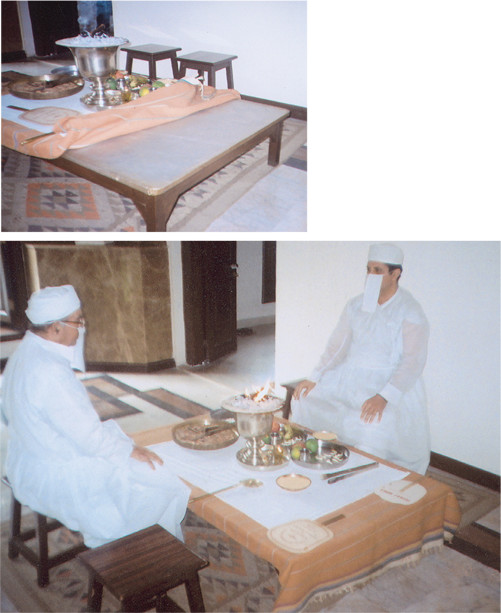
Seating arrangements for priests at Poona’s Sir J. J. Agiary ensure safety
The most practical fire fighting device would be a fire blanket. It is maintenance free, easy to use with minimal training and is very effective. I would suggest that the trustees and panthakies of each and every agiary provide two fire blankets, one near the kebla and the other at a location close to where the priests perform ritual prayers.
The second line of defence would be to have plenty of water. A 10-foot long half-inch diameter hose with an attached quick connect coupling placed next to the nearest tap in the agiary building should suffice. Washing the burnt part of the body with plenty of cold water before professional help arrives has saved lives. Both the hose and the fire blankets should be stored properly with adequate signage to show that they are "for emergency use only.”
Other worthwhile suggestions would be to limit the use of sukhad to a bare minimum during prayers, wearing shorter jaamaas, and displaying a list of hospitals and ambulance services along with their phone numbers in a prominent place in the agiary.
Some suggestions are entertaining, such as provision of a smoke alarm in the agiary (for heaven’s sake, there will always be smoke in an agiary!). Some are a bit over-the-top like having exit signboards at the agiary (are we discussing priests-on-fire or agi-ary-buildings-on fire?) and automatic water sprinkler systems (is it for the agiary building or for the priest?)
Parsiana deserves a round of applause for initiating this discussion. If only this information could be circulated in Gujarati it would help many more priests.
KHURSHED J. GOVADIA
Poona
While reading Parsiana (a pleasure), I came across the article "Death by diva” (August 7, 2009) and was surprised to note that nobody has thought of the simplest remedy — of changing the priests’ jaamaa to a less flaring and flowing garment. Perhaps, a slightly thicker material can be used. A slight change in the garb of the priests would not come amiss, as long as the pattern or design remains the same and it is white in color.
The currently favored flowing robe and thin material may be suitable from our climatic point of view, but the most careful priest can inadvertently cause an accident by leaning too close to the flames while exchanging things like flowers with the priest sitting/standing opposite him.
N. K. PLUMBER
◆ ◆ ◆
From the archive