
Zoroastrians Abroad
Malaysia’s Mazdayasnis
This Asian haven has attracted Zoroastrians over the years
He had a dream job, scouring the world for "projects that would work.” After spending months in countries such as Ireland and Greece, Noshir Pundole decided on Malaysia.
"There were more forests than buildings then,” recalls the 88-year-old businessman who set up palm oil refinery Edible Oils Limited for the Birlas in partnership with Sleater Walker. "Malaysia is the largest producer of rubber and palm oil,” states Pundole who was the newly formed company’s managing director. It was the first palm oil refinery and fractionation plant established in Asia, states his nephew Cyrus Pundole on the family website Tyabji.net managed by Pundole’s daughter Hootoksi and her husband Robert Tyabji.
So began a 40-year romance with this idyllic Asian peninsula which borders Thailand in the north and Singapore in the south. "Things are good,” in the former British colony, says Pundole. "The minimum wage is high. There is free education after the secondary level… In the last two years (the economy) has increased tremendously. Indian expatriates are very much in demand. Lots of Parsis are here with families” on job postings. "Twice in a year we all (Parsis/Iranis) get together.”
An ordained navar and maratab, Pundole and longtime resident Dr Sam Tata perform jashans, marriages and navjotes. Pundole approximated around eight Parsi families are permanent residents in Malaysia, four in Kuala Lumpur (KL) and four in Penang. Around 25 to 30 others are on work permits. "All are well placed,” he says.
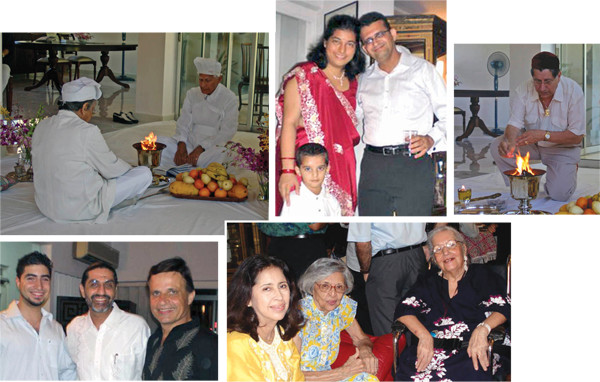
Clockwise from top left: Sam Tata (l), Noshir Pundole.; Delna, Zend and Melvyn Taraporewalla ; Jimmy Mistry. All photos taken on March 21, 2009 Navroze celebration ; From right: Roshan Pundole, Khorshed and Katy Surendran, Phil Captain, Yazdi Bankerwalla and Jehangirshaw Parakh
Three Zoroastrian deaths have occurred during his tenure in KL, recalls Pundole. Two of the corpses were buried and one cremated. The geh sarna ceremonies were performed by Tata and himself.
Unlike the small families Parsis are inclined to, amongst Malaysians "a family of five to six is normal,” observes Pundole. The country’s population is pegged at around 27 million. Substantial wealth earned from natural resources — Malaysia also exports oil — is "spread” among the population. Even "my driver can afford a car. He can send his children overseas for studies,” he notes.
At the age of 16 Pundole had to take over the running of the family watch shop in Bombay as his father, Nowroji, suffered a stroke. He managed to continue his college studies at St Xavier’s College, notes Cyrus.
But when war was declared in 1939, "imports stopped,” states Pundole. He recalls the family "letting out” a part of the shop premises. Their shop was later converted to the Pundole Art Gallery at Flora Fountain. Pundole joined the Trade Wings travel agency. This instilled a love of traveling in him, states Cyrus. In 1964 he became managing director of a textile mill and in 1965 he started a pharmaceutical company in Ahmedabad for Mehta Corporation Private Limited.
Around this time he become involved with the Lions Club movement and by 1960 he was president of the Bombay branch and in 1964 served on the international board of directors. "He is known as the Father of Lionism in India and was the founder president, district governor for two terms and the first Asian to hold the office of international director,” states Hootoksi on the website.
Pundole retired from Edible Oils in 1977 and started a property development business, Pundole Holdings Private Limited. The company built and owned properties in KL. "It was good… the real estate market is good even today. KL has grown so fast. People coming from the districts need accommodation.”
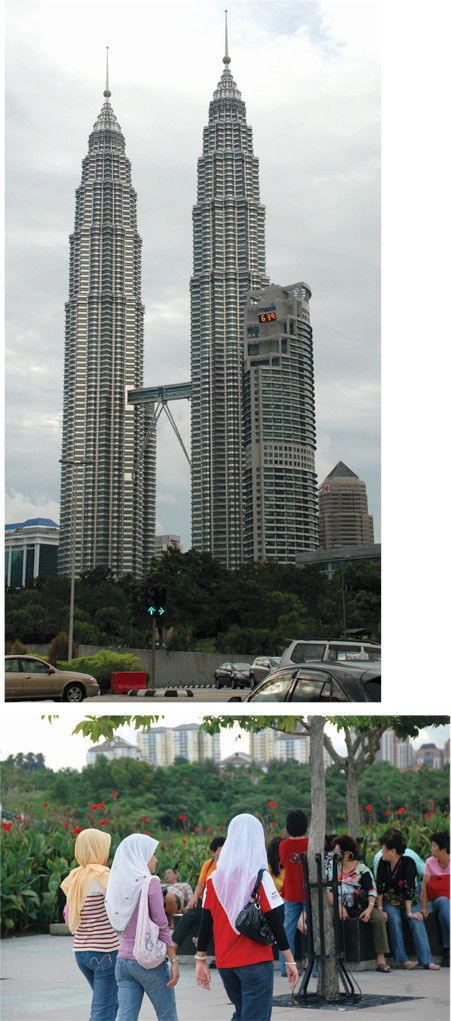
Top: The iconic Petronas Twin Towers which dominate the downtown Kuala Lumpur and are the tallest twin towers in the world. Above: young Malays sightseeing at Putrajaya, the administrative centre of the Federal Government of Malaysia
Pundole sold the company as he and his wife Roshan (née Lalkaka) "wanted to move back here” (to Bombay). But their Nepean Sea Road home is under litigation with the present occupant claiming tenancy. The dispute is in the Small Causes Court and while in Bombay to offer evidence along with his son Kershasp, Pundole met Parsiana on February 13, 2009.
His daughter Shehernavaz and Kershasp are residents of North America while Hootoksi and Robert, who are British citizens stay in KL to look after their parents.
On returning to Bombay Pundole would like to "visit agiaries and things like that,” which he misses while living abroad.
"Living in Malaysia under the government’s ‘Malaysia My Second Home’ program gives us special privileges and we are welcome guests in this country where systems work and the standard of living is high. There is every modern facility available but the pace of life is gentle and slow and the values and customs of the people are very similar to ours making retirement here pleasant, affordable and hassle free,” writes Hootoksi in an e-mail about life in Malaysia.
Liberal outlook
"Destiny” is what prompted Tata, Malaysia’s longest residing Parsi, to settle in the archipelago. In a phone conversation with Hootoksi Tyabji, the one-time Surat resident who is now retired recalled, "I got a job in Singapore to set up a power laundry through an advertisement that I read in The Times of India. I went there in 1952. After about one year working there, I applied for and was accepted for a job in Malaysia with the Rubber Research Institute. They were looking for graduate students and I fit the bill.”
Earlier Tata used to visit India "often but now I have not been back for the past five years. I am now just past 80.” He misses not meeting his sisters. Is he able to observe Zoroastrian customs and traditions in Malaysia? "I do the best I can and I enjoy discussions with my good friend Noshir Pundole.” Tata "enjoys being with other Parsis when we do get together for Navroz and Pateti.”
He views himself as a liberal. "My wife of 46 years is Chinese… I approve of interfaith marriages and feel the children of these unions must be accepted into the Zoroastrian faith if they want to be. Especially in the case of a Zoroastrian woman who has married a non Parsi, her children should definitely be embraced into the religion.”

Entrance to Batu Caves a limestone hill 13 kilometres (8.1 miles) north of Kuala Lumpur, one of the most popular Hindu shrines outside India, dedicated to Lord Murugan
Sound logic
"I want to see, feel and experience different parts of the world. This opportunity came knocking and so I grabbed it with both hands. This gives me an opportunity to see Malaysia and Singapore and understand the culture and be part of it. Most importantly, this was a good opportunity for me to move into the management,” says Melvyn Taraporewalla who moved to Malaysia in March 2008 along with his wife Delna and their three-year-old son Zend. He was replying by e-mail to Parsiana’s questionnaire forwarded to him by Tyabji.
"Currently, I am working in Emerio Corporation — headquartered in Singapore. I am leading the Offshore Development Center (ODC) here in Malaysia. Emerio is a MSC (Multimedia Super Corridor) status company here in Malaysia and is into managed services big time. With my arrival Emerio has started the ODC for software services here in Malaysia. We cater to the Singapore market and the Singapore Government is our biggest client.
"I have always been fascinated with computers and that explains why I am into software development. I did my graduation from Mumbai University and simultaneously did my diploma course from Aptech. I have been in this industry for the last 10 years now.”
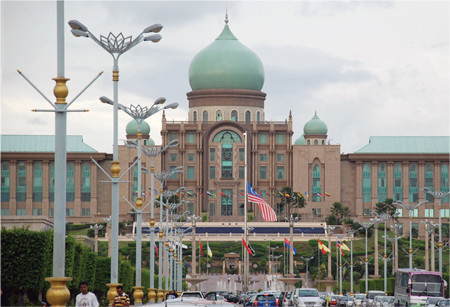
The Prime Minister’s office in Putrajaya
Born and brought up in the western suburbs of Bombay, Taraporewalla says he misses his "parents, the lovely dhansak prepared by my mother, the public transport, the chaos and obviously our fire temples.”
Is he able to observe Zoroastrian customs and traditions in Malaysia? "Well the definition for Zoroastrian customs is very broad. I am sure I was not able to follow 100 percent of it in Mumbai too,” Tareporewalla replies. "But yes we do (recite) the kusti prayers, that is mandatory. We have our own prayer room with divo and we do loban on weekends.”
Would he define himself as orthodox/liberal/middle-of-the-road? "Don’t know how to define this but I have my own views on each and every aspect of our religion,” he notes. "So I may be orthodox in one but may be liberal in another one. It really depends on what the argument point is and what sound logic with rationale do we apply.
"I believe that interfaith marriage can happen, there is no harm in doing what one likes. We all are humans first, religion came very late into the history. We as Parsis and Zoroastrians look at interfaith marriage as a problem or a solution to our dwindling population, whereas it is none. There are various other factors due to which we are at such numbers throughout the world and we should look at those as root causes…
"As for acceptance of children as Zoroastrians, we should allow the kids of either gender (in an) interfaith marriage to be part of the religion. But this should be a very conscious decision from both the parents and the family. The problem is when the Parsi girl (marries outside the faith), the kids will be in an environment where a different religion is practised and that will make it more difficult for (them) to really understand the basis of Zoroastrianism. I feel they will be more confused and if they do embrace the faith then it will be out of compulsion. So for the kids of either gender in an interfaith marriage, they can embrace Zoroastrianism but not with (coercion) but with an understanding of the religion, the basis of it, knowing the history and what we stand for. It has to be by mutual consent from all the family members.”
◆ ◆ ◆
From the archive