
Zoroastrians Abroad
The role of ‘mimic men’
Sociologist Dr Shireen Roshanravan speaks of the pressures that can lead to the loss of one’s cultural heritage
"I wanted a career that would allow me the time and opportunity to read, research and think about issues of social justice. I also encountered professors as an undergraduate who inspired me to ask critical questions about myself, society and the world. I found this to be exhilarating.”
Shireen Roshanravan, assistant professor of women’s studies at Kansas State University where she teaches courses on the philosophy of feminism, women and society, sexuality studies, and feminist research methodology, explained to Parsiana her advent into academia. She says she is also continuously researching on women and Indian immigrant community formation in the United States and "our continued ties to India — both historical and present.” Roshanravan had completed her doctorate in philosophy at the State University of New York in Binghamton with research focused on the history of colonization in India and how it affected Indians who immigrated to the United States in the 1960s.
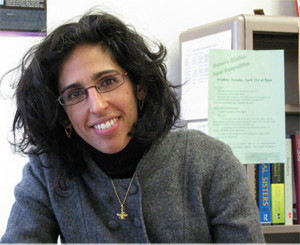
Shireen Roshanravan: "we learned to adapt”
Her doctoral research had led her to Dr Homi Bhabha at Harvard University. As she explains the significance, "Homi Bhabha’s work (was) important to this study because he has developed a theory of the ‘mimic man.’ According to Bhabha, the ‘mimic men’ were those Indians who served as translators between the European colonizers and the rest of the colonized Indian population. They quickly adopted the English language and English etiquette. In other words, they learned to ‘mimic’ the British enough to occupy a place in between the colonized (their fellow Indians) and the colonizers (the British). Although Bhabha does not write often from a personal point of view, he is a Parsi Zoroastrian. As much historical work on Parsis indicates (see, especially, Tanya Luhrmann’s The Good Parsi - 1996), we were, in many ways, prime examples of what Bhabha calls ‘mimic men.’ As migrants to India from Persia, we learned to adapt to our surroundings for our own benefit and preservation. Our early involvement in certain trades — like shipbuilding — made us particularly useful to the British upon arrival. As migrants to India, we were more willing to adapt to new ways of speaking, dressing and thinking than other groups. My own research examines how this historical location of ‘mimic men’ persists amongst present day Indian immigrants in the United States, and how this ‘middleman’ position affects processes of community formation. I focus especially on how an investment in being ‘middlemen’ within different historical and social locations affects women in these immigrant communities.”
Chicago born Shireen — her father Meherban Roshanravan immigrated to the US in the 1960s, mother Bakhtawar followed a few years later — remembers frequent trips to Bombay as she and her sister Shayzreen grew up, becoming more infrequent as they became older. Speaking of variation in the view points of the first and second generation immigrants, she notes, "Parents may fear that we will speak with an accent if we speak Gujarati at home and the children may become embarrassed by their cultural differences and refuse to speak the language or eat the food. This is understandable, but the consequences can be a regrettable loss of culture.” On her part Shireen says she is actively pursuing grants that would allow her to spend more time in Bombay. "I would like to return, not only to do more research, but also to connect with a part of my heritage that remains too vague and distant from my everyday life. The pressure to assimilate to ‘American’ ways of life can often lead second generation North Americans to lose ties to their cultural heritage.”
Shireen pursued her undergraduate studies at Southwestern University which she describes as a small liberal arts university in South Central Texas. "There I earned degrees in both philosophy and Spanish. During my time there I was able to study in Argentina for six months where I learned to become fluent in Spanish. For my postgraduate studies (masters and PhD), I attended the State University of New York in Binghamton, a city located three hours north of New York City. During my postgraduate studies, I became actively involved in social justice activities that focused on ending violence against women, especially minority women and immigrant women.” In the process of researching and asking critical questions, she says she has "learned to see social injustice as something that could be challenged, and this gave me hope. As an academic, I get to pass this hope on to students in the classroom.”
Shayzreen is a medical doctor, specializing in the healthcare of women over 40 years of age. She lives in Dallas, Texas near the senior Roshanravans. Meherban is an environmental engineer and works with companies that recycle waste from places like restaurants and grocery stores. Bakhtawar has been a banker but is now actively involved in women’s groups within our community, Shireen fills us in on the family’s professional links.
We learn too that the Roshanravan family has been very involved in the Zoroastrian Association of North Dallas. "Both my mother and father have served in official capacity as leaders in the Association. My mother became actively involved as a director in 1994 and was an early member of the building committee that sought to raise funds for a community center. My father also became a building committee member in 1998 and then served as president from June 2002 to May 2004. During his presidency, my mother became the social director. In that time, the entire family was involved in organizing social events for the community and producing newsletters for the Association members that would help keep everyone connected and also allow members a forum to voice their opinions. My father wrote several plays on the history of Zarathushtra that were performed at Navroz functions and encouraged community members to become actively involved through performance. He especially encouraged the younger generation to become involved in community activities through music and dance. Another Zoroastrian issue that my family has been actively involved in is raising money to build a community center in the Dallas area. Their efforts have paid off as our Dallas Association finally has enough money to begin the building process,” Shireen notes with filial pride.
Fond of all kinds of dancing — "That’s my favorite thing to do in the whole world! I wish I had more time and opportunity to learn different kinds of dances” — Roshanravan also enjoys watching good films, reading good books and drawing. Despite her sociability and the family’s community connections, she has found no Zoroastrians within her environment with whom to connect. "Kansas is not a very diverse region of the United States. I believe there are a few families within a couple hours of where I live and perhaps will be able to connect with them in the near future,” she writes.
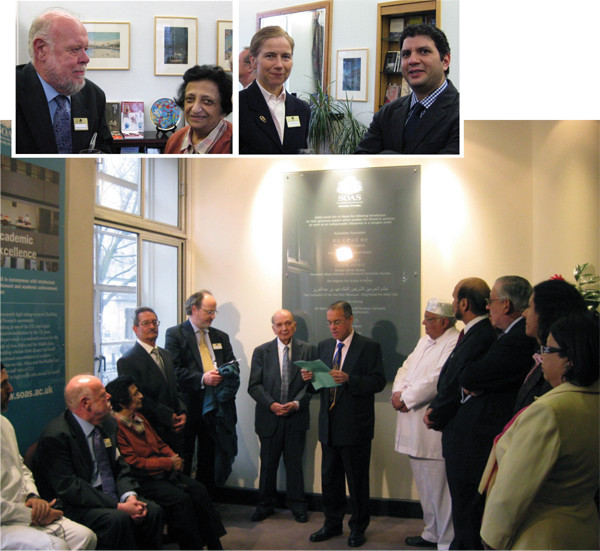
L to R: Prof John Hinnells and Dr Roshan Dalal. Prof Almith Hintze and Ervad (Dr) Jamasp Dastur (JamaspAsa). (Below) Unveiling of the donor plaque at SOAS. Dorab Mistry reading the citation
We ask her opinion about how the Zoroastrian community is evolving and what it should do to participate more actively in world affairs. "It is difficult to make a general statement as to the current state of the Zoroastrian community because we are a diverse group of people,” she responds, adding, "I recently read that there is a group of Zoroastrians actively pursuing an oral history project so that we do not lose the stories that make us who we are. I think that actions such as these are important for our evolution as a people who remain connected to our histories as we continue to adjust to our present reality. We live in very difficult times: wars, economic crises, global poverty, water shortages, global warming.
"I would like to see more Zoroastrians become involved in efforts to end these threats against humanity. We are a small community, and I am proud when I encounter leaders of social justice efforts who are Zoroastrian. As a community, we have a long legacy of social justice activism that is not discussed enough in my opinion. I hope that the oral history project is able to make these stories more visible. If we can learn to nurture our cultural and spiritual heritage in relation to social justice efforts around the globe, then I foresee a long and sustainable future for our community.”
◆ ◆ ◆
From the archive