
Cover Story
The hospitable hotelier
From owning hotels, winning gold medals for yachting and managing community affairs, Byram Avari believes in lending a helping hand
"I have seven children. Three are from my wife Goshpi. I do not know who the mothers of the other four are,” says Karachi’s prime Parsi industrialist with a straight face. But they sleep in the same room and go to the office with him every morning where he claims their growls help him keep bankers in line!
Meet Byram Avari, chairman of the Avari Group of hotels and industries, whose infectious joie de vivre welcomes a constant stream of visitors to his hotel room. Avari relates how his granddaughter Fareezeh took umbrage at the names he has given the dogs: "You can’t name all of them after alcohol!” She wanted the latest acquisition, a golden retriever, to be named Biscuit. Her wily grandfather agreed, provided he could decide on the spelling of the name. And so Bisquit (saluting the acclaimed French brandy) joined the gang of Bourbon and Bacardi (both Pekinese) and the boxer Budweiser!
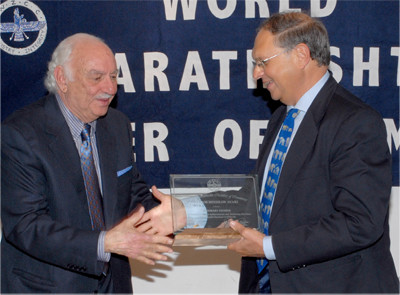
Real estate developer tycoon Pallon Mistry presenting the WZCC plaque to Byram Avari Photo: Homyar Mistry, Homz Prints
In Bombay to attend the World Zarathushti Chamber of Commerce (WZCC) annual general meeting and receive its most prestigious honorary membership — each year the body names one outstanding Zarathushti entrepreneur to its guild of honorary members — Avari became the sixth distinguished individual on the panel on January 6, 2007. It is only the latest addition to the slew of awards he has pocketed over the years including the Pakistan President’s Gold Medal in January 1979, Pride of Performance Medal in Yachting from the Government of Pakistan in 1982 and its Commemorative Postage Stamp issued December 31, 1983 featuring him with wife Goshpi in an Enterprise class sailing dingy subsequent to their gold medal win at the Asian Games in 1982, the Corporate Excellence Award and the Hamdard Institute of Management Science Award presented by the President of Pakistan in March 1999.
A mix of devotion, determination and persistence has helped him garner the fruits of his labor, Avari told the WZCC. Acknowledging his great debt to his pioneering parents and liberally quoting his late father Dinshaw Avari’s many aphorisms that have guided him, together with his Zoroastrian prayers, Avari noted ![]() how his wife and children have stood by him through travail and triumph, emphasizing the need of such a support base for a successful entrepreneur. Avari’s sons Dinshaw and Xerxes help him in the business. Daughter Zeena is married to independenet businessman Behram Aga.
how his wife and children have stood by him through travail and triumph, emphasizing the need of such a support base for a successful entrepreneur. Avari’s sons Dinshaw and Xerxes help him in the business. Daughter Zeena is married to independenet businessman Behram Aga.
It took a while for Parsiana to get an interview with Avari. He was agreeable to it from the start. The question was to find a niche within the many interests and personalities that surround this gregarious achiever. And having got it, he responded to our queries with fairness and gusto, even though we overstayed our allotted time.
Hotels are Avari’s core business. According to their website, inside Pakistan the Group owns and operates the five-star Avari Towers hotel at Karachi, the five-star deluxe Avari Lahore Hotel and the seafront Beach Luxury Hotel at Karachi. His is the first Pakistani company to have obtained management contracts to operate internationally so that they manage the 200-room four-star Avari Dubai in the UAE and the 200-room Ramada Hotel Toronto Airport in Canada.
He also controls real estate through Spencer and Company (Pakistan) Limited, a holding, investment and real estate management company owning prime city centers and properties which was listed in 1948 on the Karachi Stock Exchange. Reckoned among the Top 20 Listed Companies of Pakistan, Spencer has 53,000 sq ft of prime real estate in the banking sector of Karachi, which is on long term lease.
Spencer-Pharma Private Limited [formerly Fisons Pakistan (Private) Limited], produces high quality branded generics and undertakes contract manufacturing for multinationals like Wyeth, Lederle and others as well as local companies producing tablets/capsules/liquids/injectibles. Beach Brewery (Private) Limited is licensed to manufacture alcoholic beverages at Karachi. The factory is producing various types of whisky, vodka and gin, red and white table wine; Canned beer will be produced under its own label. With 30 million minorities in Pakistan as its clientele and with only two other competitors, this company has tremendous potential and produces quality products, notes their official handout. Avari Travel Agencies (Private) Limited are the General Sales Agents for American Airlines (AA) for the last two decades and have won Outstanding Sales Achievement Awards for AA cargo and passengers year after year. The Avari Group has had previous experience also in power generation and communications.
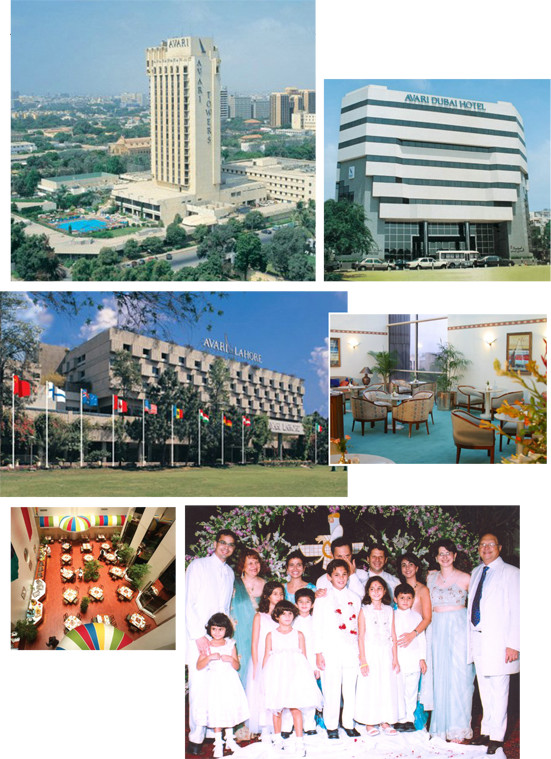
Top row: Facade of Avari Towers in Karachi and Avari Dubai; 2nd row: Avari Lahore and its lounge; 3rd row: Dining room in Avari Dubai and the Avari family on grandson Dinshaw’s navjote
But that is part of history. Avari is riding the current business boom in his country constructing a "top of the line” 750,000 sq ft property in Islamabad that is expected to go on stream early next year. The six-star hotel will comprise 750 sq ft suites only —360 of them —with American oak bleached white wooden floor and equipped with one different exercise equipment each. "It will be unique in that the guest can say ‘I want the room with a treadmill’ or ‘I want a room with (something else).’ It will be horrendous for the manager but it will be a tremendous marketing technique,” Avari notes with confidence, adding, "It will have about eight restaurants.” It was planned as a 32-storey building but Avari says he’s been advised that it has been cut down to 25 stories. He ascribes the move to "some hotel politics,” and, reflecting his pragmatic approach, says "sometimes we have to go on with it.” Speaking of the inroads of technology into the hospitality industry he tells us that all the rooms in his hotels are wi-fi equipped with no extra charge for internet usage. The new hotel will have "smart rooms” where everything will be controlled through a small gadget like a mobile phone — switching on the TV, calling for room service, closing/opening curtains, switching lights on and off…
He is also looking at secondary cities in Pakistan to establish or manage three and four-star hotels as he expects the boom to last a long time. A lot of hotels are coming up all over the country. Another favored location for Avari is the Emirates. Eschewing the "cut-throat” five-star competition in Dubai he says they are looking "to feed the four-star market.”
Describing the economic scenario in Pakistan which "for the first time has seen prices in the hotel industry remunerative enough to allow new hotels to come up,” Avari ascribes the present stable environment to the policies of President Pervez Musharraf and Prime Minister Shaukat Aziz in contrast to the earlier governments. "Extremist elements are under control and the policies (and ministers) don’t change every year. There has never been so much foreign direct investment in Pakistan as in the past few years,” he notes. And, despite the attempts on the General’s life, Avari says, "Musharraf is extremely strong.”

Exterior of Ramada Hotel Toronto Airport and its front office
A former Member of Parliament (1982-85 and 1988-93), Avari maintains his interest in social and political reform. He is enthused about the Women’s Protection Bill which permits women inheritance rights on agricultural property for the first time in the teeth of opposition from the Mullahs. It also removes the draconian law which denied bail to a raped woman unless she could produce four male Muslim witnesses, in effect incarcerating her for life. Thousands of women had been locked up, he notes. Avari says he is not connected with Parliament but he will continue to be a responsible citizen though he won’t stand for any elections other than those of the Parsi anjuman. Deeply involved with minority movements, he says there is constitutional change afoot, with a bill to be tabled in early February "to allow minorities to vote for Muslim legislators of their constituencies.” Previously, he says, they couldn’t vote. Now a minority member can also stand for election — a change which Avari says he spearheaded. "Now 10 minority members can be elected on a proportional system of representation,” unlike the previous situation which had resembled that of the Iranian Majlis where the religious minorities like Zoroastrians, Christians and Jews can elect one representative from their respective communities. At an interfaith dinner organized by the Minorities Alliance on Xmas when all the ambassadors and the Mullahs and everybody was there, Avari urged the gathering to aim towards the removal of religion from passports and identity cards, religion and domicile from government and private application forms – details which make for discrimination in employment and social life.
The chairman of the Karachi Parsi Anjuman Trust Fund since 1990, Avari estimates the Zoroastrian population in Pakistan at 2,300, agreeing that it is a "very aging” community. As for the world Zarathushti community, "I don’t see it dwindling,” he says, refusing to endorse a "doomsday scenario. It’s remained 1,50,000 for 100 years. It will remain 1,50,000.” He accepts the change in demographics as a change in the migration pattern. Wouldn’t the thinner, more widespread diaspora itself weigh against the chances of the community’s survival? we ask. "Let me tell you, we have been running religious classes in Toronto (they are held at the Avari managed Ramada Hotel) . The religious fervor of the Parsis who have gone outside is much stronger than the religious fervor of those remaining here…It is a bond they feel. They enjoy and realize the value of prayers and they want to teach their children. How many people here are teaching their children? There we are organizing classes right through the year, every Sunday for the last 10 years, at our Toronto hotel for about three to four hours. They bring their children and sit with them. Here catch anybody sitting with their children on a Sunday and spending four hours!”
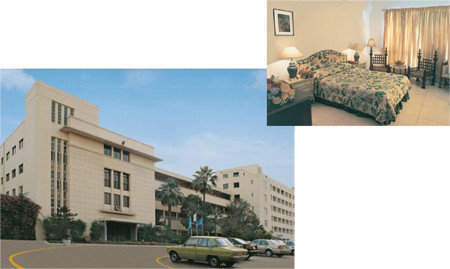
The Beach Luxury Hotel and a glimpse of its room
We seek his reaction to the stalling of the World Body (WB). He has counter questions: "How would a WB be able to control? How would a WB stipulate what has to be followed in Pakistan or Canada or America? If you say have conversion, we can’t allow conversion in Pakistan or Iran!...If we start converting, we’ll run into a problem. The Mullahs will kill us. What will the WB do? It will be a PR job, I agree. But if they give a fatwa or say this or that has to be done?… Who elects the WB? …We are creating so many problems for ourselves. India has the largest Zoroastrian population. So how will India be represented? Will it be like the UN with one vote?...I am totally open regarding the WB so long as it doesn’t dictate or direct that anybody can walk into the atash behrams without a cap and anyone can go in and put the sukhad on the fire…What is the WB going to do?” In answer to the WB’s projected role to bind the world wide community and provide concerted action when required, Avari notes that when the farmers of Gujarat needed aid, Zoroastrians around the world contributed for their betterment: "It didn’t need a WB!” We remind him that at that point in time the World Zoroastrian Organisation (WZO) considered itself the WB. It touches a nerve: "That is wrong. The WZO is not a WB…(It) nominates people on its board; it does not elect. It does not provide accounts. We closed down the WZO branch in Pakistan a long time ago.” (The WZO representative in Pakistan Toxy Cowasjee states proxy forms are circulated along with the annual general report and yearly accounts. She says she herself is elected to her post once every three years. The Organisation has a bank account "Toxy Cowasjee WZO account” in Karachi. Cowasjee is also on the international WZO board and edits the institution’s publication Hamazor.) Avari further noted that there were four lakh rupees in the WZO account when it was closed which the Karachi anjuman sought on behalf of the khandhias "because we had contributed so much, we had been paying our dues.” But WZO insisted on it being repatriated to them in the UK. "I am not for or against the WB but if WZO is the WB, then go ahead and form a WB to get rid of the WZO.”
Avari believes "our religion is evolution…I have very firm ideas on conversion. I really believed that a man’s children can become Zoroastrians. But then we had heated argument, heated discussions, heated in the sense that we were yelling at each other across the table (at this point Goshpi, who was on the point of leaving for another appointment, interposed quietly to say she did not agree with him). Now with my sons and daughters-in-law I am changing my views and I think even the children of Parsi mothers should be accepted.” He cites the instance of Jews who consider the child born of a Jewish womb more Jewish. "But I think it is important that the woman should have kept her Zoroastrian faith. Now in Pakistan we have different problems so my thinking is different from the rest of the world. In Pakistan there is no civil marriage.” Avari related how a Parsi woman with three children had converted to Islam and contracted marriage with a Muslim. When the matter went to the court, it had ruled that her earlier Parsi marriage stood annulled. "In Pakistan you cannot marry a Muslim without being a Muslim. If you try to get out of the Muslim faith, you’d be beheaded… There is no civil marriage in Pakistan, so you must convert to Christianity or Hinduism or Judaism. Such a woman’s child cannot be accepted into the Zoroastrian faith.” However, he disagrees with the dictat of the priests that a Zarathushti man who converts can be reconverted to the faith, but not a Zarathushti woman in the same situation. "These things need to be settled by our priests through dialog…These are the problems that need to be addressed.”
He says he agrees to the acceptance of the children of a man or woman married out who continues to profess the faith. "But if you say convert this German lady who says the prayers, does the kusti, I am going to have a problem in Pakistan. I’ll be beheaded, my children will be beheaded; in Iran they’ll be beheaded because what you are doing is a threat to the Muslim faith. Because Muslims do not allow conversion. What is the conflict with Hindus and Christians today? Why are there riots in Pakistan? Because they are converting. Originally any ‘masi’ was a convert from Islam to Christianity and they were the sweeper class. And this is why the conflict is taking place. I do not want to have this liability on our community.”
Avari considers himself "orthodox in some respects. I believe if there is a dakhma, the dakhma should not be closed down… But we are a very open religion. If someone wants to be cremated or buried, let them be cremated or buried so long as they make the arrangements. If there is a dakhma, I don’t think the anjuman has the responsibility to create a crematorium or a burial ground. If you want to be buried, go to Lahore or Quetta or Rawalpindi (where there are burial grounds). For example, Mr Marker died in Quetta but he wanted his body to be put into the dakhma so his body was flown to Karachi… But we should be open about this…We should grow out of this mindset… The dakhma should be maintained. With due respect to what is being photographed and circulated, I believe khodai ni laakdi no aavaj nathi but khodai ni laakdi laagsé (God’s stick is not seen but felt)…The photos infringed on the tranquility of the dead. (The person) who took the photographs cannot hope to have a happy life.”
He referred to the letter he had issued as chairman of the Karachi Parsi Anjuman Trust Fund regarding the efficacy of the Karachi dakhmas. "We use no powders, nothing. I am quite proud of that.” Avari said that there are between 35 to 45 deaths in Karachi per year. He recalled that there had been "a big controversy here regarding the dakhma.” Noting that the most expensive residential colony has been developed around the dakhma to preserve the land — the Dinshaw B. Avari Colony — he maintains that there is no smell to disturb the residents. However, in response to a demand to set up solar concentrators they had found that for them to be effective, the pavis would need to be raised, which was not feasible. A high priest in Bombay initially agreed to the idea of nailing highly polished stainless steel sheets around the inner wall and later wrote rescinding the idea. Not one to be stymied, Avari says they innovated by hanging the polished steel over the dakhma wall like a clamp. "No one objected because there were no nails…It has worked better than the solars!” He insists the dakhmas had worked perfectly even when the population in Karachi was much larger, even when there was more rain. "It’s just a mindset… Whenever two Parsis meet there are five opinions — not just two, because we are 100 percent educated!” He dismisses the controversies and underlines where he stands: "On the left, the right and the middle!”
Another Zoroastrian institution in Karachi where Avari’s presence has made a sizable difference is the Dastur Dr Dhalla Memorial Institute. Having succeeded his father and the late Faridoon Dadachanji to the presidency, Avari recounted how Dhalla’s library – "a fantastic collection of thousands of books” — had been promised by the late Dastur to the Dinshaw family in exchange for some much needed cash. When Dhalla died, the Dinshaws got the library and being unable to deal with it, donated it to the Pakistan archives. "When my father died, I went into many of his positions and I found out about the library,” a passion with Avari Sr. Avari says he wrote to the Dinshaw family who said they had no objection if he took it over. Next he had to approach the government of Pakistan which meant he had to go all the way to the President and convince him that "this is our heritage and should be returned to us.” When the permission came, Avari says he checked out the library but did not take it over until a couple of Parsis he appointed had documented the contents over a period of six months. "Then we took it over and I kept it at the Beach Luxury Hotel.” In the meanwhile he says he built two bunglis near the dakhmas where the prayers for the dead could be said with flats for six nassessalars on the upper floor. When the anjuman registered its inability to pay, Avari says he contributed 8.5 lakh rupees and, with donations from trusts and others, built the bunglis. Initially the nassessalars refused to move from their original accommodation. Avari says he had to plead with them ["Maari ijjat ni vaat ché (my honor is at stake)”] to stay for a month and then leave, if they didn’t like it. When the month was over they refused to go back, saying "Aai to tamé hamuné béhést aapyuch (You have transported us to heaven).” At the same time Avari decided that one of the bunglis would house the Dastur Dhalla Library though the premises would also be used for prayers when required.
Around that time Avari says Rusi Dalal of the Zoroastrian Trust Funds of Europe had received a call from the British Library saying they were being offered Dastur Dhalla’s manuscripts. The Library urged Dalal to ensure they were originals and whether they had a clear title. When Dalal conveyed this information to Avari, the latter requested Ervad Godrej Sidhwa, Pakistan’s senior priest who was on his way to the UN to attend an interfaith session, to break journey in London and check out the manuscripts. A jubilant Sidhwa phoned Karachi to confirm that the manuscripts were originals — having been a student of Dhalla’s in his younger days, he had found annotations and changes he had made therein in his own handwriting on Dhalla’s instructions! "We checked in our records and found three boxes missing from the Pakistan government archives. We notified them (the British Library) that this was stolen material,” says Avari. The upshot was that the vendor, in a hurry to get away, sold the folios for 750 pounds sterling to Dalal who acquired them on behalf of the Dhalla Institute and the large, leather-bound tomes were deposited with a friend in London. Blightly expecting to bring them back to Karachi as hand luggage some time later, Avari realized just how heavy they were: "Étli bhari, étli motti, jèm tèm hamé uchki né lai aaya (They were so big and heavy we brought them home with difficulty)!” Unfortunately only seven of the original number – estimated anywhere between 18 and 25 — have been recovered, he notes. These were never documented by the two Parsis who had recorded the contents of the library in the government archives, he adds.
Then there was the Young Men’s Zoroastrian Association library which couldn’t continue to exist at the Katrak Hall. So Avari convinced them to get it documented and conveyed to the second bungli. Now a resident of the Parsi colony is looking after both libraries.
When the conversation veers to the WZCC Avari responds frankly: "It will only be successful if there is a mentor for every entrepreneur. Otherwise it is not going to work. People need guidance — what to do, how to do.” He is a mentor of the Prince Trust in Karachi which means he has to visit the assigned entrepreneur two to three times a month. If a lady who makes pickles wants to set up as an entrepreneur, she has to learn to market them. When she goes into business, she suddenly has to deal with health certificates, labor registration, tax payments… "She discovers that business is much more and collapses with the load. Money is not the problem…A mentor is required for each and every businessman. The trouble is that our Parsis get such high salaries because they are at a premium… In Karachi people are willing to pay a Parsi executive an extra 10 thousand rupees just because he/she is a Parsi. Parsi secretaries earn anything from 40,000 to one lakh rupees (a month) because people know they are faithful, discreet – no information will go out – they have integrity…People say ‘social work, social work.’ I say to hell with social work. You are running around asking for money to do social work. Get into business and use 25 percent of your profit to do social work. That way you satisfy your own needs, your family’s needs and the community’s needs!”
At 65, Avari and his wife continue to sail every Sunday but says "My greatest thrill is that my grandson, who is 12, wins a trophy every month and my son just went to the Asian Games representing Pakistan. Last year he had won the silver, but at the Asian Games he didn’t succeed…There was freak weather in Doha. It was dreadfully cold, it was raining and there was no wind. The swell and waves were weak and my son and his crew are heavy. The others were so light — just 110 pounds each! So they won. It’s all a part of sailing. But the whole family sails. My wife still crews for me. And she says I didn’t win the gold medal (in 1982), she did, because she crossed the winning line first!”
A violinist from the Trinity College of Music, London, Avari speaks glowingly of his mother’s love for music. Unfortunately his children didn’t take to it. But the next generation has come back with a bang: Of his eight grandchildren one granddaughter plays the drums, a grandson plays the electric guitar and sings, another granddaughter is on the manual guitar. Now his son Dinshaw has taken to the violin and two other grandchildren play the piano. He is nostalgic about the New Year’s eve performance that the family band put up for their private entertainment.
Avari thinks "every religion is the greatest religion in the world.” He also thinks that "tolerance, which was the hallmark of Zoroastrianism, is being lost.” And he remembers that what propelled Parsis to the forefront was the acceptance of "98 percent perspiration and two percent inspiration, which is being lost. Now everybody wants an easy life. Nonetheless, our religion is a great bond. Being Parsi is a feeling. You intuitively recognize each other…”
◆ ◆ ◆
From the archive