
Booking the maestro
Persistent efforts by writer Bakhtiar Dadbhoy resulted in a new biography on conductor Zubin Mehta
"I’m glad I persisted,” chipped in Dadabhoy.
"No one was as persistent as he was,” agreed Mehta. The 498-page tome published by Viking from the Penguin Group was released on April 15 at the Taj Mahal Palace Hotel by Mehta who also urged Dadabhoy "tamé bhi kholo (you also unwrap a copy).” Dadabhoy, a division manager of the Indian Railways and "the highest ranked Parsi officer in the civil service,” started work on the biography eight years ago. "It took you eight years to write the book?” queried Mehta. "No,” replied Dadabhoy, "less, but it took me eight years to get you around!”
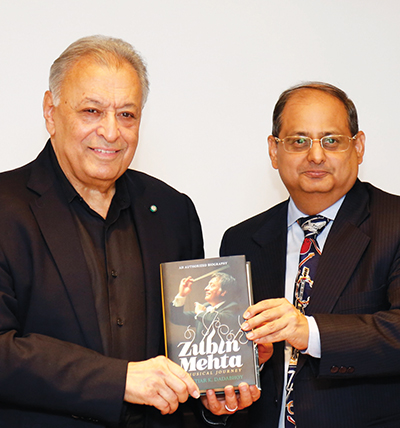
Zubin Mehta (left) with author Bakhtiar Dadabhoy: "a balanced account"
Actually the seed for the book was sown in 2006 when Dadabhoy wrote a brief profile of the maestro for his collection of 12 eminent Parsis, Sugar in the Milk. "The only thing he wanted to know when I approached him (via email) at the time was who were the other worthies with whom he would be sharing the publishing real estate. I reassured him he was in the best company.”
Mehta jocularly inquired if any cricketers featured in that book. Regrettably not, replied Dadabhoy, none of them met the criteria. The names of a few Parsi cricketing greats such as Polly Umrigar, Farrokh Engineer, Nari Contractor and Rusi Surti were bandied about by members of the audience that included Mehta’s childhood friend and neighbor Dr Yusuf Hamied, chairman of Cipla Pharmaceuticals. Mehta noted that on the night of the Brabourne Stadium concert (April 20) with the tenor Andrea Bocelli and soprano Maria Katzarava, an Indian Premier League match was being played at the Wankhede Stadium. Both Mehta and his biographer are avid cricket fans with the maestro once even considering taking it up as a career! The singers and the orchestra had waived their charges. Mehta noted he had played at several concerts for Bocelli’s charities free of cost and now asked the visually impaired tenor to return the favor.
Dadabhoy met Mehta in Bombay in 2008, also at the Taj, when the conductor released the English edition of his memoirs, Zubin Mehta: The Score of My Life published two years earlier in German. Mehta had dictated his recollections in German at the suggestion of a German publisher. Dadabhoy felt the autobiography was "very understated and that Mehta had led a far more interesting life.” But when he suggested writing a biography, Mehta "predictably said no,” having just released his memoirs. Dadabhoy however persisted and began work on his book, the first draft of which was ready around 2011. When Dadabhoy’s friend and the current president of the prestigious Cricket Club of India Kekoo Nicholson informed him, "Janéj ké (do you know) Zubin is coming to Bombay in 2016 and for his 80th birthday he will be giving a concert at the Brabourne Stadium?” Dadabhoy reasoned that Mehta may now agree to the book; the conductor did so but wanted to vet what the author had written.
"I had to read the book and correct it,” Mehta confided. "I didn’t correct his opinionated (laughter) inscriptions on my life and my music making but I had to correct facts, dates, etc.” Dadabhoy had stated the book was not going to be a "hagiography but a balanced account” of Mehta’s life. He read over 1,000 articles on Mehta, mostly online. Mehta noted Dadabhoy quoted much material from The New York Times, "most of it negative” (laughter). The musician, however, referred to "the incredible research this gentleman has done, most of it correct. He went into details, all the important stations of my musical activities in North America, Israel and elsewhere... I take my hat off to him.” For those who are interested in such details, the book is an "encyclopedia,” commented the musician.
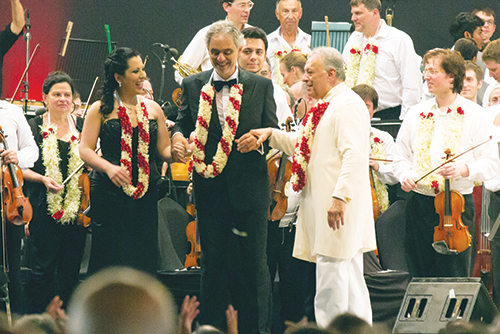
Maria Katzarava (2nd from left), Bocelli and Mehta: Waived fees
Dadabhoy noted that aside from the flak Mehta faced in New York, a Los Angeles based critic appeared to bear animosity against him. Mehta said he was surprised because a meeting and interview with the critic had gone off well. But then a socialite friend who knew the critic alleged the writer felt snubbed because the conductor didn’t ask him to stay for lunch! "It’s a principle of mine. I never have lunch with a music critic,” asserted Mehta "You don’t do that. The freedom of the Press has to range freely. You cannot take them for lunch (laughter).”
Dadabhoy had confided in the Taj lobby before the book launch that Mehta did not know anything about his biographer. At the Press meet Dadabhoy told all gathered he was not a professional writer, as they may assume, but a bureaucrat in the railways. He was in charge of overseeing the dispatch of water from the Poona division by train to the drought affected district of Latur. Mehta asked Dadabhoy if he had mentioned that his "great-grandfather built the (meter gauge) railway from Poona to Dharwad. As children we used to ride in the train. A lot of my relatives used to live in Hubli.”
"You never told me,” protested the writer. Mehta then noted one of his grandfather’s brothers who lived in Mauritius was a trader. When King George V stopped in that Indian Ocean island en route from England to India, his grand uncle’s firm supplied some of the provisions of which the monarch may have partaken.
Did he see much talent coming forward in western classical music in India? "This is what we hope for from our school,” run by the Mehli Mehta Music Foundation named after his father who was also a conductor. "The inherent talent there is. They have to be nurtured,” said the maestro. He referred to a Japanese violin teacher "who goes into the slums of Bombay” and elsewhere to teach youngsters. "A lot of good work is being done. I’m happy about that.” Abroad Mehta noted a few Indians playing in English orchestras. "I try to help from the outside.” One-third of the proceeds from his 80th birthday concert in Vienna will go to the Foundation, the other two thirds being divided between Amnesty International and another trust that promotes music and runs an orchestra comprising Arabs and Jews.
Did he miss Bombay? inquired one reporter. "It’s really like I never left. But every time I come I get frustrated with the city.” He recalled living in a quiet nook of south Bombay, Cuffe Parade. "It was heavenly.” He referred to the house he stayed in and three others that should have been preserved as "architecturally they were very special. Only two are left now. I can’t respect a government that lets those kind of things happen…
"Governor’s House (Raj Bhavan) hasn’t changed. My father used to give concerts there so I remember the place. Depending on the governor, concerts were held. One Englishman loved music, one didn’t. My father also played for incoming viceroys.”
Regarding the Bombay concert at the Brabourne when Nicholson told him nearly all the 8,000 seats were sold out, he suggested, "Jaasti khursi mukh ni (put more chairs).” "I’m trying,” replied Nicholson. For members who couldn’t be accommodated in the lawns, two large screens would be put up and the members could sip whisky and watch.
"Don’t do that,” advised Mehta. He stated that the clinking of glasses was distracting.
He recalled his wife Nancy Kovack was "so shocked when we were playing in Beijing in the Great Hall of the People where the Chinese Congress meets. Ten thousand of the public were sitting there and they were eating sandwiches, sending SMSes, babies all around. That is the Chinese way.” While Western classical music was booming in China, Delhi did not have a concert hall. "It’s a scandal,” he remarked.
Asked about his performing concerts in Kashmir and other conflict areas, Mehta replied, "I wish I could do more. I feel I do so much in the Middle East but not enough in my own country. The concert in Kashmir came from my heart. Although we had a lot of trouble with the separatists, we did it. In the end, 70% of Kashmiris watched that concert on television.”
He said the concert was possible thanks to the financial support from Hamied. "To go some place and play for free costs a lot of money,” he quipped. The German consulate and German companies also helped. "You cannot underestimate the power of music in such places.”
He wished the gathering goodbye and when asked to autograph books did a few suggesting more could be signed at the rehearsals the following days. "Amna dorwanu chhè (I’ve to run now),” he concluded.
Not medicine, music
‘Parsis have about five or six professions. We are doctors, lawyers, engineers and accountants. And the aptitude shown as a child prompts the family to choose your profession. So, I might have played with a thermometer as a three-year-old, and my mother decided that I should be a doctor. So I was sort of nurtured with that thought in my mind, brainwashed, and of course after leaving school, I went to university to do my pre-med studies…’
Unsurprisingly, when his anatomy teacher asked him to cut up a dogfish in a practical class, Zubin left the room with the words: ‘Cut it up yourself!’ Zubin recalls. ‘Every time I sat down to cut up a dogfish, there I was with a Brahms symphony running through my head.’ It was clear to everyone that his medical career was ending even before it had started…
More importantly, Mehli and Tehmina also agreed that music was Zubin’s calling and it would be criminal to foist any other career on him. Mehli recalled how Zubin had come to talk to him about his future when he was praying. Since it was unusual for him to be disturbed at this time, he knew Zubin wanted to tell him something important. ‘Daddy, I can’t go on with medicine. I must quit because I’m a musician. I must go to Vienna and take up music.’ And so he did.