
Zoroastrians Abroad
Commending Katrak
Educator and rehabilitation medicine practitioner, Ervad (Dr) Peshotan Katrak was made a Member of the Order of Australia
"The recipients of Australian honors and awards are very special men and women whose actions have set them apart and enriched our community across a broad range of professional, public and community service sectors. In their daily lives these admirable people demonstrate those values that we as a nation hold dear — compassion, civility, dedication, courage, kindness, tolerance and energetic ambition. They inspire us all to be more enthusiastic and giving, to uphold the responsibility of being fully engaged citizens,” noted a message from the Governor General of the Government of Australia Sir Peter Cosgrove, carried on the website www.gg.gov.au
.jpg)
Ervad (Dr) Peshotan Katrak: fully engaged citizen
.jpg)
Katrak (sitting in the middle, in white shirt) was recently felicitated at the AZA Arbab Rostam and Morvarid Guiv Darbe Meher
.jpg)
Katrak with Pope Benedict XVI in Sydney, 2008
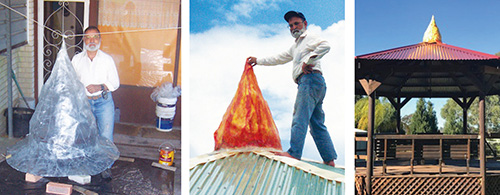
Far left and center: Katrak creating and installing fiberglass flame Photos: Shanaz and Tim Desai;
right: wooden pergola with flame on AZA property
Among the 340 "special” individuals awarded the AM (Member of the Order of Australia) in the 2018 Australia Day Honours List was Ervad (Dr) Peshotan Katrak who was recognized for "significant service to rehabilitation medicine as a practitioner, to medical education and professional organizations, and to the Zoroastrian community.”
Respected as the head priest of the Australian Zoroastrian Association (AZA) of New South Wales, the honor for Katrak was a cause for jubilation within the community that takes pride in his progressive accomplishments. Last year the Association felicitated him when the AZA Sunday School started by him celebrated its 40th anniversary (see "Sunday School success,” Zoroastrians Abroad, Parsiana, May 7, 2017). Having performed the first navjote and the first mobed-led jashan in Sydney (probably the first in Australia) in 1977, he has been leading prayers at the Association’s annual jashans ever since. He has also served as the Association’s president, trustee and managing committee member over the years.
Erstwhile president of the Australasian Faculty of Rehabilitation Medicine, Royal Australasian College of Physicians (AFRMRACP), Katrak was among the pioneers of rehabilitation medicine in Australia. "At that time there were only a handful of fully qualified specialists as there was no program for young doctors in this field in Australia,” he said. In 1981 he helped to set up a training program and establish a national medical college for doctors to specialize in rehabilitation medicine. Honorary secretary to the Board of Censors of the Australasian College of Rehabilitation Medicine for the first 13 years, he was awarded a Foundation Fellowship of the College and its subsequent incarnation, AFRMRACP.
He has worked as a rehabilitation physician at the University of New South Wales teaching hospitals since 1977 being actively involved in training more than 100 registrars in rehabilitation medicine and in teaching undergraduate medical students for nearly 40 years. Senior staff specialist in rehabilitation medicine, Prince of Wales Hospital for the last 25 years, he is currently honorary medical officer at St Vincent’s Hospital, as also conjoint (honorary) lecturer, rehabilitation medicine, School of Public Health and Community Medicine, Faculty of Medicine.
Bombay born Katrak migrated to Australia in 1975 with postgraduate qualifications from three continents: MD from Bombay University, Member of the Royal College of Physicians in London, and Fellow, American Academy of Physical Medicine and Rehabilitation, from California.
"When I arrived in Sydney in 1975, the relatively small numbers of Zoroastrians had formed the Australian Zoroastrian Association of New South Wales and had regular social get-togethers. For the first seven or eight years I was the sole practicing mobed in Sydney but fortunately other mobeds came in and life became much easier. Now we have over 10 mobeds who perform religious ceremonies from time to time. Amongst these are a number of young men from the Sunday School who have had their navar ceremony performed in India,” says Katrak who has donated all monies he has received for prayers since 1977 to AZA. Many other mobeds in Sydney have continued to follow this practice.
Parsi and Iranian Zoroastrians have always had a very cordial relationship here. "In 1978 we decided to start a Building Fund to acquire ‘a place to call our own.’ After many years of painstakingly slow progress, the Ostowari family who were amongst the early settlers in Sydney gave us a boost with a $60,000 donation. We purchased a five-acre property on the north-western outskirts of Sydney with funds gathered entirely from our members,” recalled Katrak who was on the Foundation (Building Fund) Committee from its inception in 1978 till 1986, being its chairman when AZA purchased the land in December 1985.
"Some years later we received a substantial donation from the Guiv Foundation and the Zartoshty Brothers that helped to erect a new building on the Association’s property. As per the terms of this donation the building is named the Arbab Rostam and Morvarid Guiv Darbe Meher but is still commonly referred to as AZA House.”
He was involved in drafting the AZA constitution in 1984 and being on subsequent constitution review committees. Additionally, he was principal author of Basic Information Guide for Zoroastrian Funeral Arrangements published by AZA in 2005.
"Under our constitution the non-Zoroastrian spouse of a Zoroastrian member and their children are considered full members of the Association. Consequently non-Zoroastrian spouses are welcome at all our functions and prayer ceremonies; and in fact many of them are often involved in the Association’s activities and have served in executive roles on our management committees,” observed Katrak.
Fond of tennis, painting and sculpture, Katrak made a farohar in clay (1.5 m wide) for the entrance of the Darbe Meher and a meter high ‘flame’ in fiberglass for a pergola (trellis) on the AZA property.
When Katrak and his dedicated Working Bee team had earlier finished the wooden pergola, the roof appeared plain. To put some decoration, Katrak added the fiberglass structure in the shape of a flame (fiberglass is a type of fiber-reinforced plastic).
He will soon be taking lessons in stained glass picture making.
In February 2007 he painted a portrait of the famous Australian cricketer Dennis Lillee and gifted it to the writer of this article and his wife Villie on their 40th wedding anniversary. A few years later it was autographed by the great Lillee to make it a priceless possession!
Married to Shernaz, the couple has two sons, Sohrab and Arash. To the community mentor, "The future for AZA, as I see it, is quite bright. We have a solid foundation for the organization with many good traditions that our younger generations have grown up with. Several pupils from our Sunday School of early 1980s have returned to join me in teaching the newer generations and we have an active ‘youth group’ that is involved in the Association’s activities.
"Although time consuming, being a Zoroastrian priest Down Under has been a very rewarding experience and I feel fortunate in having been able to play a small part in the establishment of our Zoroastrian community here and in helping to preserve some of our religious traditions,” says the satisfied priest.
◆ ◆ ◆
From the archive