
Cover Story
Charting a new course
Noted lawyer Berjis Desai’s intervention in community affairs helped bring about adult franchise in the Bombay Parsi Punchayet trusteeship election
The chances of success of the World Alliance of Parsi Irani Zarthoshtis’ (WAPIZ) special leave petition in the Supreme Court (SC) challenging the divisional bench order of the Bombay High Court sanctioning universal adult franchise (UAF) "are minimal,” says noted lawyer and columnist Berjis Desai. "At most they may delay matters a bit,” adds Desai who strategized the electoral reform scheme of the Bombay Parsi Punchayet (BPP).
In the unlikely event the apex Court admits WAPIZ’s petition, the judges "may not grant a stay,” he opines. Instead they may serve a notice on the BPP trustees stating they "want to hear the matter.” This though could amount to an "effective stay,” he notes. "The trustees may continue with the elections” but in all probability they will wait till the apex Court arrives at a decision. As the SC vacation will be over end June the matter will only come up for hearing at that time. The judges may of course dismiss the petition "in limine” (at the beginning) in which case WAPIZ "goes home with Bharuchi akoori on their faces,” says Desai with a grin.
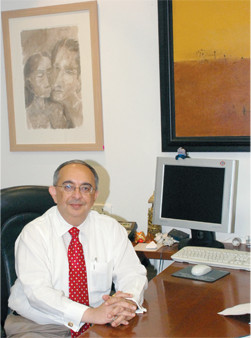
Berjis Desai: "We want good people to be elected”
Countering the assertion of WAPIZ founder trustee and noted tax lawyer Homi Ranina that the Bombay High Court divisional bench decision was flawed (see "WAPIZ’s supreme challenge,” Events and Personalities, Parsiana, May 21, 2008), Desai counters the judgment "is absolutely correct. The judiciary has done yeoman service to the community.”
Should the SC uphold the resignation of the four BPP trustees (Minoo Shroff, Dinshaw Tamboly, Maneck Engineer and Burjor Antia) the recently formed Anjuman Committee (AC) packed by WAPIZ would "also go as well as all other acts” of the trustees, states Desai. "WAPIZ will be hoisted on their own petard.” Ranina had argued that the newly formed AC would remain in office as its formation had been sanctioned by the Bombay High Court. The BPP needs a quorum of three to function. If the four are disqualified, the remaining two trustees, Dinshaw Mehta and Dadi Engineer, would not constitute a quorum. The office of the seventh trustee has been vacant following the demise of Silloo Kavarana in October 2005.
The SC has to decide on two issues: whether the trustees’ resignation is valid or not and whether adult franchise can be sanctioned, says Desai. "The chances of the Supreme Court saying no to UAF for the Parsi community are minimal.” The Bombay High Court judge A. M. Khanwilkar and the divisional bench of Justices Dr S. Radhakrishnan and Anoop Mohta had ruled in favor of UAF. Justice Roshan Dalvi had termed the trustees’ resignation invalid as had Radhakrishnan and Mohta.
"Bad blood”
As part of the deal authorizing UAF, all the six sitting trustees of the BPP had agreed to submit their resignations. This would allow for "a fresh new beginning,” says Desai. "Too much bad blood has flowed” in the Punchayet, he avers. "If any existing trustee decides to recontest, such a candidate will become a focal point for judging the past performance of the Punchayet… Only a sadomasochist would stand for election after undergoing all the trauma and stress” the Punchayet and the community has been witness to over the past two years or more. Besides the chances of any other trustee standing for reelection except for Mehta "are minimal… None of us are standing,” Desai adds referring to himself and the leaders of the Alert Zoroastrians Association (AZA), Kersi Randeria, Percy Patel and Zeree Jehangirji. The AZA together with Desai hammered out the compromise formula with the BPP trustees following the resignation fiasco. It was primarily to assist his one-time ally, Mehta, that Desai fell into the cauldron of community electoral reforms, (see "Adult franchise at last,” Parsiana, October 7, 2006). The AZA and WAPIZ were both threatening to move the various courts of law to oust the trustees. They went ahead anyway and the appeals are pending.
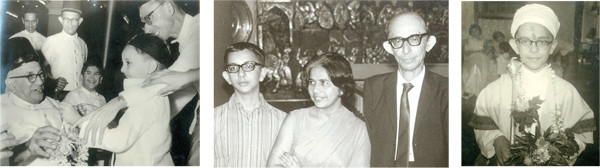
Left: Berjis and Minoo Desai with Muncherji Cama (seated in pugree) of The Bombay Samachar at Berjis’ navjote; Berjis, Mani and Minoo; ordained as a priest in Navsari in 1966
Desai, the AZA leadership and others are "trying to get prominent individuals… people with stature” to stand for election. Matters are still at "a formative stage,” says the lawyer. He does not wish to name the potential candidates. In the past whenever a name was proposed people dissuaded the individual from standing, claiming that community politics was a murky affair, he observed. As to who else may stand beside his group’s panel, Desai comments, "It’s difficult to say at this stage… all good people are welcome… a plethora of many good people standing (however) is unrealistic.” He believes independent candidates as versus slates will find the going tough.
When asked if geographic consideration would affect the selection of suitable candidates he replies, "So far as our group is concerned we are selecting purely on merit.” But he expects "representation to (geographically) larger areas” will be made. Around 6,000 Parsis/Iranis reportedly reside in Dadar for example. As for the religious views of the selected candidates, Desai says there is "no intention to control” their outlook. "We want good people to be elected. Then our task is done. The community gets what it deserves.” But like-minded individuals would be selected to avoid future clashes.
He believes that "socioeconomic issues, the past performance of the trustees of the BPP on issues such as housing, fund management will dominate the election process.” The religious aspect he believes will play "a small role” in the election, though of course WAPIZ may raise the ‘religion in danger’ bogey.
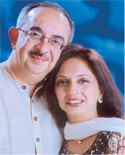
Above: Berjis and Vandana Desai
Pressing matters
When asked to comment on the role of the Parsi Press on the forthcoming elections, Desai, a columnist on Zoroastrian affairs for the reputed Gujarati daily The Bombay Samachar, feels the Fourth Estate "can highlight the issues and provide information on the candidates — their strengths, weaknesses, policies, etc.” When told that The Bombay Samachar, Jam-e-Jamshed and Parsiana are all liberal in outlook while the orthodox section basically has only the fortnightly WAPIZ Page (the publication of The Parsee Voice is erratic), Desai opines "people may take out newsletters,” for the duration of the elections.
He says the public interest in the election issues "is to be seen to be believed… People who did not think themselves as Parsis are gulping down issues of The Bombay Samachar, Jam-e-Jamshed and Parsiana… The community is in a mood to teach (the Punchayet trustees) a lesson.” They want "a sweeping change.” But Desai is all praises for BPP chairman Shroff’s "remarkable efforts in trying times.” Terming him an "excellent chairman,” Desai commends his ability in the "management of egos.”
Desai predicts the electoral "turnout will be huge. This is the first time all seven trusteeship seats” are up for grabs. He believes the earlier AC system was "maneuverable, controllable... at the end it was a cabal — a small group” that determined the final outcome.
Desai became involved with the move for UAF after coming in contact with Randeria through their mutual acquaintance, Dhun Baria of Doongerwadi fame. Mehta and the AZA were and are at loggerheads. In trying to cut the Gordian knot created by the BPP trustees through their internecine squabbles, a compromise formula was reached: elections were to be held under adult franchise, the existing trustees were to resign after a new panel of trustees was elected. "AZA was the catalyst, I acted as the instrument” for change. "There was not much resistance” to the proposal, Desai recalled. "Not a single trustees said, ‘we are against adult franchise.’” Despite the understanding, both WAPIZ and AZA moved various courts seeking the trustees’ ouster.
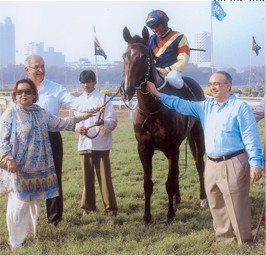
(Above) Winning the Allah Rakhkha Gold Trophy with horse Aurora Aureals (from left): Mr and Ms K. N. Dhunjibhoy and (right) Berjis Desai
"Practicing, believing…”
Desai grew up in a household where community matters held sway as his father, Minoo, was the editor of The Bombay Samachar. Around the age of 13 while a student at the Bharda New High School Berjis wrote his first letter to the Kaiser-E-Hind Weekly attacking BPP trustee Eruch Nadirshaw. While his father wrote "several stinging editorials,” in the Samachar, Berjis says his father did not feel as strongly as he does on community issues. "He was more middle-of-the-road.” His mother, Mani "is on the liberal side though not as liberal as me.” An ordained priest, he completed his navar and martab training in Navsari and performs navjotes, geh sarna and other ceremonies when required, especially for those married out of the faith. He goes "seven or eight times a year to agiaries of my choice.” He sees himself as a "practicing, believing Zoroastrian.”
Married to Vandana (his first wife, Poonam, died from complications during pregnancy) Desai is an office bearer of the Association of Inter-Married Zoroastrians.
Desai views the liberal Association for Revival of Zoroastrianism as "very well meaning. I am in full sync with them.” But regarding some of their reforms "I would go a little bit slowly,” he says. "I would not preach or propagate outright conversion.”
What Desai favors for the present is gender equality — giving Parsi/Irani women who marry outside the faith the same rights as Parsi/Irani men who marry non-Parsis. He also believes that the Doongerwadi bunglis should be made available for performing the funerary ceremonies of those opting for alternate means of disposal to dakhmenashini. He wants non-Parsis to be permitted into the bunglis while the obsequy ceremonies are being conducted. "There should be no discrimination on that count,” he emphasizes. He believes that these reforms can be achieved in the next 20 years. Asked why not sooner, he replies "it can happen… let us see what message this election sends us.”
Have the recent developments strained his long-time friendship with Mehta? we asked. Desai notes that "in the last two or three years I started disagreeing with his methods of functioning. He was a very, very close friend. Unfortunately he refused to compartmentalize” the community issues from the personal ones. "The Punchayet is everything with him. I genuinely believe it is in his best interests” not to stand for reelection. He has served "14 years… why rake up (another controversy) now. Let the rancor and the bitterness die out. Give a break, then (campaign) for whoever he wants” or seek reelection later, Desai counsels.
A graduate of Elphinstone College and Government Law College, Desai won a Rotary International scholarship to study law at Cambridge University. At 51 he is the managing partner of J. Sagar and Company, one of the largest law firms in the country with offices in Bombay, Delhi, Bangalore, Hyderabad and Dubai. He is a director of nine listed companies and is a director and shareholder of Capricorn Stud Farm in Poona.
Are Parsis entering the law profession? we ask. "In a big way,” answers Desai. Both Mehta’s and Randeria’s sons work in his firm.
◆ ◆ ◆
From the archive