
Zoroastrians Abroad
Croweaters continues
Within two days of an article in Lahore’s Daily Times announcing the closure of the Croweaters Art Gallery situated in the heart of The Mall near the old Tollington Market, its administration reversed the decision. Founded by the late Pakistan MP (member of parliament) and beer baron Minoo Bhandara in 1999, the Gallery served as a sale window for indigenous arts and crafts and a place where budding artists could display their works. Parsi cuisine was a feature of the Croweaters Café, situated on the first floor directly above the Gallery.
Named after the rambunctious semi-autobiographical novel by Bhandara’s sister Bapsi Sidh-wa, the Gallery will now be shifted to a new location in the city, notes Afnan Khan in the Daily Times (October 29, 2008), perhaps in the Defence Housing Authority or Gulberg, no definitive address having been located
"A large number of people had visited the Gallery after learning of its impending closure and several had requested the family to keep the historic location open for business,” Khan quotes gallery curator and general manager Nayab Shami. " She said that the family had been overwhelmed by the public outcry and had decided to shift the Gallery instead of shutting it down to entertain the public’s request and keep the family tradition alive,” writes Khan.
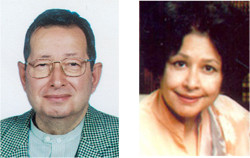
File photos of the late Minoo Bhandara (left) and Bapsi Sidhwa
Describing the Bhandaras as a family of traditionalists, art lovers and philanthropists who had helped to preserve the culture of Lahore and the Parsis who lived there, Beaconhouse National University (BNU) Visual Department chief Saleema Hashmi said that it also had great historical significance because of its presence in the cultural hub of the city, writes Khan. "In light of this, she requested that the family keep the Gallery intact in Anarkali, saying that it was a monument to the role and presence of the Parsi community in Lahore.”
" Bhandara’s linking of the Gallery to the writing of his globally renowned sister …was intended to highlight the contributions of their family to the cultural and social development of the city. He used to invite artists, writers and dignitaries to the roof of the building to celebrate Basant and conduct meetings. His love of the Gallery clearly indicates that his vision was to keep the cultural value of his ancestral home intact,” she added.
Noting that shifting the Gallery would be a blow to the beauty of historic Anarkali, as it had been situated there in various forms for over a hundred years as a symbol of the Parsi community’s services and presence in the city, renowned artist Professor Dr Ajaz Haider urged the Bhandara family to open a second gallery in a different part of the town. It was his opinion that the proliferation of art and the liberal values associated with it could counter terrorist and fundamentalist ideas.
"Bhandara and his family have owned the site for more than 150 years and his ancestors used to both live in the current art gallery and run several businesses, including a restaurant, a café, a liquor shop and finally an art gallery,” Khan had noted in an earlier article in the paper announcing the Gallery’s intended closure on October 31, 2008 coupling the decision to the demise of its founder in June this year.
The owners had felt that the city, once considered the Paris of the East, had greatly changed and there was now a lot of hostility against liberal arts and culture but bowed to public opinion and agreed to keep the Gallery going.
◆ ◆ ◆
From the archive