
Law
Why Beaman concurred
The fissure between the two judges was coated in understatement and deference to maintain the appearance of a unified judiciary, a symbol of the rule of law
The most important legal case concerning the Zoroastrian community was The Parsi Punchayet Case 1908 also referred to as Petit vs Jeejeebhoy. In this historic litigation, two judges, Dinshaw Davar and Frank Beaman, laid out the definition of who is a Parsi namely:
The descendants of the original emigrants into India from Persia who profess the Zoroastrian religion.
The descendants of the Zoroastrians in Persia who were not amongst the original emigrants, but who are of the same stock and have since that date, from time to time, come to India and have settled here, either permanently or temporarily, and who profess the Zoroastrian religion.
The children of a Parsi father by an alien mother, if such children are admitted into the religion of their fathers and profess the Zoroastrian religion.
The implications of their landmark judgment have influenced the course of the community for 100 years.
In her insightful three-part article "Judging Conversion to Zoroastrianism: Behind the scenes of The Parsi Punchayet Case (1908),” legal scholar Mitra Sharafi writes about the the background and circumstances that helped shape the two jurists’ judgment. In the first installment ("Opposite routes,” Parsiana, August 21, 2008) Sharafi wrote about the relationship between the two judges. In the second instalment ("The ‘yea’ and ‘nay’ of Modi,” Parsiana, September 21, 2008) Sharafi dealt with the testimony of noted Zoroastrian scholar Sir Jivanji J. Modi and the impact his testimony had on both the judges.
In this final installment Sharafi explores the reasons that could have prompted Beaman to concur with Davar.
This article was previously published in John R. Hinnells and Alan Williams, eds., Parsis in India and the Diaspora (London: Routledge, 2007). Permission to republish the text in Parsiana has been granted by Routledge. The Hindi Punch images are reproduced courtesy the Bombay University Library.
• • •
A United Front?
Justice Frank Beaman yielded to Justice Dinshaw Davar because he was the weaker judge in several ways. The Times of India’s obituary of Beaman noted his submissiveness: after having taken throughout a strong line in favor of recognizing the rights of converts to Zoroastrianism, at the end he somewhat weakly gave in to his more practical and masterful colleague, and became party to a monumental judgment which has been freely criticised.
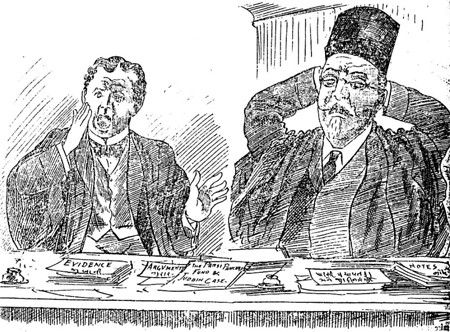
‘Ahaaaaa! Justices Davar and Beaman Yawning a Yawn of Relief after the close of the Parsi Panchayat Fund and Juddin case, heard before them from 8th February to 14th April.’ Illustration courtesy: [Hindi Punch (19 April 1908), 20.]
Beaman himself opened his judgment by describing the shift in his position:
"When I left India, in April, I did not feel prepared to adopt, in their entirety, what I then understood to be my brother Davar’s reasoning and conclusions…But it was also understood that, in the time which must elapse before we could meet and deliver judgment, we would give unremitting attention to the principal points and to each other’s views upon them, so that, if possible, we might, after all, avoid the necessity of any difference of opinion, if possible, even of pronouncing separate judgments…I have carefully studied the elaborate second part of Davar J’s judgment; and while I am doubtful still whether we look at all parts of the complicated question eye to eye, it is a source of great satisfaction to me that I am able to agree with the main conclusion.”
A popular Parsi song by the early 20th century satirist Dr Jehangir Wadia made the point more bluntly: "Justice Davar bétha chukado karva né saté bètha Beaman ha ji ha dhunva (Justice Davar sat to do justice and beside him sat Beaman to chant, ‘Yes Sir!’).” The advocate P. B. Vachha reported that Davar occasionally let personal prejudice color professional opinion. At Davar’s death, one obituary noted that he never hesitated to speak his mind without restraint "when a stronger judge would have found virtue in discreet silence.” On one occasion, counsel described a client as being of respectable social standing. Instead of considering only the admissible evidence, Davar exploded, "respectable man of high position! You think I do not know him? Ask him if he was not a hack victoria driver only a short while ago!” His extrajudicial behavior during Petit was another case in point. Popular memory has it that returning home after the hearings every evening, Davar would take the long route home in order to wave to crowds of orthodox Parsis who lined the streets outside Allbless Baug, a Parsi meeting place, in his honor. One Parsi biographical dictionary reported that Davar was proclaimed ‘the savior of Zoroastrianism’ by the orthodox section of the community for his 1908 decision. A 1917 book dedication to Davar made the same point, calling him:
"A true Parsi hero, who has for good routed the efforts of the advocates of juddin-marriage and conversion, who has saved the Parsi community from racial degeneration and extinction, who has by his learned decision from the bench in the year 1908, given effect to the wishes of thousands of Parsi donors that the use of the charity funds, fire temples, dakhmas and other religious institutions endowed by them should be allowed to Parsis only.”
One further connection reinforced Davar’s ultimate identification with the orthodox in Petit. His son, Jehangir D. Davar, was married to the former Virbaiji J. Jijibhai, presumably a member of the family of one trustee-defendant, Sir Jamsetjee Jeejeebhoy who was the unofficial head of the Parsi community in Bombay.
One factor contributing to Beaman’s deference was Davar’s seniority. Davar was made a judge of the Bombay High Court on November 9, 1906. Beaman’s judgeship was confirmed two months later, in January 1907. Although this made Davar only slightly senior to Beaman, judicial culture took seniority seriously. It was the judgment of the senior judge that would prevail even if the other judge disagreed. Judicial culture and etiquette may have informed the politics of dissent for Beaman.
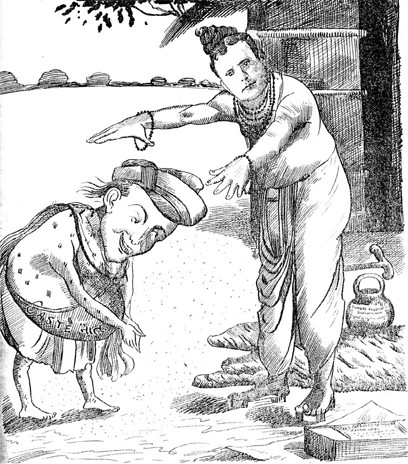
‘A Rishi come to judgment! Rishi Beaman-Mitra: Kalyan, beta, kalyan! You’re of the hoary past, and you deserve to be cherished! The Bloated Bogey: Rishi Maharaj, how can I sufficiently thank you! You are my saviour! My friend, not judged a true Rishi, when my own kith and kin level anathemas against me and heap coals of fire on my head!’ Illustration courtesy: [Hindi Punch (26 April 1914), 17.]
Davar’s seniority gave Beaman a procedural reason to concur. Only if the Davar-Beaman ‘special bench’ reached a unanimous finding could the plaintiffs leapfrog over the next level of the Bombay High Court to be heard directly by the Judicial Committee of the Privy Council in London. By an odd procedural twist, Beaman could help the plaintiffs more at the next level by ruling against them in the immediate term. In other suits, Beaman delivered his rulings with the likelihood of appeal explicitly in mind. Perhaps he was trying to clear the way for a swift appeal to London. Despite general expectations, it was a road not taken by the parties.
Finally, Beaman was out of India on furlough "on urgent private affairs” between June 9 and October 18, 1908. The hearings ended on April 13, 1908, and judgment was delivered on November 28, 1908. Beaman referred somewhat sheepishly to his absence from India for the period when the judgments were being written. The two judges corresponded about the case while Beaman was away, but it still seems that Davar did the bulk of the work associated with the case. Beaman wrote:
"I cannot close without expressing my deep sense of gratitude and obligation to my brother Davar for the immense amount of labor he has spared me. All the drudgery of the case fell on his shoulders…No one who was not associated with him can fully appreciate his unwearied patience and serenity, sustained throughout a great trial which must have imposed upon him — himself a leading member of the community whose interests were so vitally at stake — an almost unprecedented strain and responsibility.”
The last sentence further explains Beaman’s weakness in Petit. Beaman was a British judge in a colonial court, but he was well aware that he was an outsider in Petit.
Petit vs Jeejeebhoy caught the colonial legal profession at a moment when South Asians — and Parsis in particular — were making their presence felt in bold new ways. One managing clerk of a Parsi law firm declared triumphantly that South Asian firms were taking over. Writing in 1911, he commented that Europeans were finding it hard to compete with Indians "who have secured almost the whole of the native public for their clients. The European firms were obliged to consolidate together to make a stand against the native firms.” In the early 20th century, Parsis constituted between a quarter and two-fifths of all the advocates and solicitors in Bombay, despite being just six percent of the city’s population. They were even over-represented on the bench of the Bombay High Court, constituting almost 11 percent of judges. As the first Parsi appointee, Davar led the way.
The structure of legal judgments also reflected the shift in the legal profession’s ethnic makeup. Prior to 1900, South Asian judges generally contributed a single concurring line after their European colleagues’ leading judgments, if they said anything at all. Nasty anonymous poems about the few South Asian judges of the late 19th century surface in the private papers of their European colleagues. As South Asian judges became more senior, though, they began to deliver the court’s judgments. In this way, the idiosyncratic religious and political views of South Asian judges became etched upon South Asian communities as those communities’ cases passed through the legal grid.
The larger mandate of the colonial legal system gave Beaman another reason not to dissent from Davar’s position. Rule-of-law rhetoric was an essential strand in the justification of colonialism in India, not least of all in Beaman’s own writings. By pro-colonial accounts, the law courts of British India were run both for the benefit of the South Asian population, and because Indian rulers were incapable of doing the job properly. Law courts in pre-colonial and princely states were depicted as bastions of arbitrary despotism. The rule of law was a standard pretext for annexation into British India. Judicial unity and uniformity were key bricks in the rule-of-law edifice. Colonial justice had to be seen to be meted out through a consistent process that did not depend upon the idiosyncrasies of the individual assigned to a case. Judicial uniformity was essential if like cases were to be treated alike — the definition of fairness and antidote to the ‘justice’ of Oriental despots. Because judicial dissent was particularly inappropriate in a colonial setting, Beaman may have felt obliged to yield to Davar. The final court of appeal for the empire, the Judicial Committee of the Privy Council, was not permitted to issue dissenting judgments, or even concurring ones. Like political ‘children,’ colonial subjects needed a clear and simple message. Contradictory judgments from the same bench would only create confusion, and potentially undermine the authority of the court and the legitimation of colonialism that was an unspoken part of its work. Beaman’s decision to write a concurring opinion reflected the desire to assert some independence, whilst stopping short of actually contradicting his Parsi colleague.
A final insight into Beaman’s shift may lie in his caste-based argument against conversion. Beaman was a well known admirer of the Hindu caste system. After addressing a Bombay student organization in 1914, Beaman was ridiculed by reformist Parsi magazines like Hindi Punch for declaring the "wonderful system of caste” an essentially sound organizing principle that was "admirably adapted to social needs” whilst guaranteeing social stability. Beaman rested his ruling in Petit on the idea that the Parsis had transformed themselves from a religious community into a caste. It was through this rationale that the community could initiate illegitimate children of Parsi paternity but not non-Parsi candidates, albeit from ‘respectable’ social backgrounds like the French Suzanne Tata. One wonders if this argument had special appeal for Beaman. The caste argument left virtually no mark on the Parsi conversion debates. But having the opportunity to present his pet thesis may have helped Beaman rationalize his final change of position.
Conclusion
The Davar-Beaman relationship was an inversion of the stereotypical one between European and South Asian judges. It was a reversal that became increasingly possible as South Asians rose within the ranks of the legal profession. Davar dominated Beaman by force of personality, seniority, and membership of the Parsi community. There seemed to be a sense of guilt on Beaman’s part for his long absence from India. Beaman’s Indian Civil Service background and even his blindness may also have created a residual feeling of weakness vis-à-vis his Parsi colleague. If Davar and the expert witness Sir Jivanji J. Modi became convinced to oppose conversion midway through, the real force behind the scenes may have been the charismatic orthodox solicitor Jehangir J. Vimadalal. The defendants’ lawyer’s refusal to give in to the judges’ initial pressure also enabled the shift. Beaman was probably the last proponent of restricted conversion; this may explain his unusual decision to produce a separate but concurring judgment in the case. In a period when Parsi lawyers and judges were starting to take control of cases involving Parsi litigants, the Davar-Beaman interaction is significant not just for the substantive outcome of Petit, but also as an indication of changing dynamics within the colonial legal profession. The fissure between the two judges was coated in understatement and deference for the sake of maintaining the appearance of a unified judiciary, a symbol of the rule of law. Within the Parsi community, the legal profession, and in the larger colonial context, the influence of personalities and politics underscore the contingent nature of Petit’s final outcome.
Concluded

Mitra Sharafi is assistant professor of Law and History at the University of Wisconsin following a two-year research fellowship at Sidney Sussex College, Cambridge University, and a short visiting fellowship at the Socio-Legal Research Center of Griffith University in Australia. A Canadian scholar of part-Iranian descent her research focuses on Parsi legal history. After completing a history degree in Canada (BA McGill, 1996) and two law degrees in Britain (BA Cambridge, 1998; BCL Oxford, 1999), Sharafi did a doctorate in history in the US (PhD Princeton, 2006).
◆ ◆ ◆
From the archive