
Law
The “yea” and “nay” of Modi
The testimony of Sir Jivanji J. Modi in The Parsi Punchayet Case earned the ire of Bombay High Court Justice Frank Beaman
The most important legal case concerning the Zoroastrian community was The Parsi Punchayet Case 1908 also referred to as Petit vs Jeejeebhoy. In this historic litigation, two judges Dinshaw Davar and Frank Beaman laid out the definition of who is a Parsi namely:
The descendants of the original emigrants into India from Persia who profess the Zoroastrian religion.
The descendants of the Zoroastrians in Persia who were not amongst the original emigrants, but who are of the same stock and have since that date, from time to time, come to India and have settled here, either permanently or temporarily, and who profess the Zoroastrian religion.
The children of a Parsi father by an alien mother, if such children are admitted into the religion of their fathers and profess the Zoroastrian religion.
The implications of their landmark judgment have influenced the course of the community for 100 years.
In her insightful three-part article "Judging Conversion to Zoroastrianism: Behind the scenes of The Parsi Punchayet Case (1908),” legal scholar Mitra Sharafi writes about the the background and circumstances that helped shape the two jurists’ judgment. In the first installment ("Opposite routes,” Parsiana, August 21, 2008) Sharafi wrote about the relationship between the two judges. In the second installment Sharafi deals with the testimony of noted Zoroastrian scholar Sir Jivanji J. Modi and the impact his testimony had on both the judges.
This article was previously published in John R. Hinnells and Alan Williams, eds., Parsis in India and the Diaspora (London: Routledge, 2007). Permission to republish the text in Parsiana has been granted by Routledge. The Hindi Punch images are reproduced courtesy the Bombay University Library.
• • •
Converting the Bench
Hearings lasted just over nine weeks — from February 7 until April 13, 1908. For at least the first month, both judges Dinshaw Davar and Frank Beaman urged the parties to come to an out-of-court settlement allowing conversion under limited circumstances. On March 7, 1908, the judges stated that they "might declare that the Zoroastrian religion permits conversions, but that the community (in a manner to be settled, if necessary, after further discussion) should regulate conversion by framing rules to safeguard it against abuse.” The defendants’ advocate, Thomas Strangman, noted in his memoirs that Davar and Beaman pressured him to recognize Suzanne Tata’s conversion. They even supplied the parties with the terms of a proposed settlement. Strangman advised his clients to reject the offer — he considered it even more advantageous to Tata’s side than what her own lawyers were requesting. As a result, he was "subject to severe heckling by the Bench.” He consulted his senior, J. D. Inverarity, the Scottish star of the bar who was engaged with another suit during Petit. Inverarity advised Strangman to continue resisting the judges.
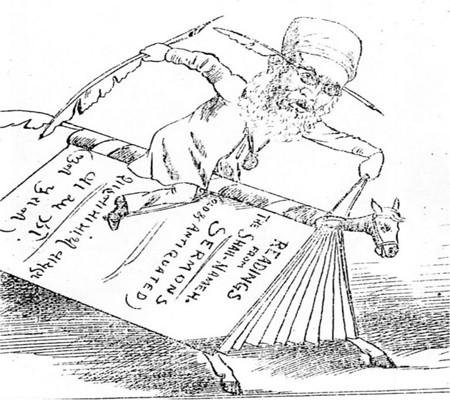
Jivanjee Jamshedjee Mody Illustration courtesy: Hindi Punch (13 September 1908)
Between March 7 and the close of hearings on April 13, Davar changed his mind about conversion. Between April 13 and the delivery of the court’s decision seven months later, on November 27, 1908, Beaman also adopted an anti-conversion stance. But his acceptance of Davar’s view was half-hearted. Beaman’s reservations surface in his judgment notebook, particularly in his notes to himself. Beaman’s notes on the cross-examination of the leading expert witness, Sir Jivanji J. Modi, reveal details that have remained unknown since the trial took place: the notes have never before been examined. They also highlight points at which Beaman disagreed with Davar, the most important of which relate to Modi. In court, Modi adopted an anti-conversion position in opposition to his earlier published works and to the Parsi Punchayet’s sub-committee report. The report, overseen by Modi, had favored limited conversion. Whereas Beaman perceived Modi to have lost all credibility by his ideological U-turn, Davar adopted Modi’s new reasoning enthusiastically during the last month of proceedings.
The scholar-priest Modi was the leading Parsi expert witness of the early 20th century. He was the most prolific author on Parsi and Zoroastrian topics of the late colonial period. Modi was secretary of the Parsi Punchayet. According to the plaint, he was in virtually complete control of Parsi Punchayet funds and properties. He had been a member of the expert committee appointed by the Punchayet to advise on the issue of juddin (non-Parsi) conversion. In fact, he drafted the committee’s report.
Davar mentioned Modi only sparingly in his judgment. However, Modi was the hidden motor behind Davar’s ruling, an unsurprising line of influence given that both men were religiously orthodox. Davar adopted the Parsi-Zoroastrian distinction from Modi. He also borrowed the ‘floodgates’ argument: if converts were accepted, the lower castes would rush in to deplete Parsi wealth.
Beaman disliked Modi intensely. In his published opinion, the judge criticized Modi for recanting during cross-examination on positions he had earlier published:
"Instead of telling the simple truth, that he had taken up these subjects without the least idea that they would ever have more than a scholarly and academic interest, and committed himself to opinions which, when brought to the test of a shattering concrete case, he could no longer maintain, he made the most pitiable efforts to show that he was perfectly consistent with himself, and that his ‘Yea’ of today was his ‘Nay’ of yesterday. I suppose few witnesses of equal eminence, character, and I hope, I may add, sincere honesty, have made a more deplorable exhibition of themselves in the witness-box than Mr Modi.”
Despite the fact that Beaman’s comments were published in the reported case judgment, discussions of Modi have been strangely silent on the episode.
Three contradictions in Modi’s testimony irked the blind judge. The first related to the fact that Modi had written the opinion of the Parsi Punchayet’s sub-committee of experts. The report’s conclusion was that Zoroastrianism permitted conversion: in court, Modi took the opposite position. In the report, he accepted conversion on theological grounds: when testifying, he rejected it on social ones. If converts were allowed, large numbers of lower caste opportunists might convert, draining Parsi resources. Furthermore, allowing conversion would encourage Parsi men to marry out, creating a shortage of Parsi husbands for the young women in the community. Another exchange with Lowndes, counsel for the plaintiffs, proceeded as follows:
A. I am a religious man. In conflicts between the world and religion, of course religion prevails.
Q. If religion told you to do one thing and the voice of the community another which would you do?
A. I would obey my religion.
And yet his contradiction of the report’s conclusion was precisely on social, not religious, grounds. In Modi’s own words, "I think that religion in a sense should give way to social considerations. I don’t think it advisable to take in alien converts in any circumstances whatever. I have thought long over the question… I drafted that (report of the expert committee) myself. I signed it. I published it to the world. I have changed my opinion since drafting that and publishing it… I have not published any recantation. I have not recanted. I had not then to consider the social side of the question.”
Beaman was unimpressed.
The second contradiction involved historical cases of alleged conversion. Three Hindu pandits were alleged to have converted to Zoroastrianism 1,200 years earlier. Their names appeared in the Zoroastrian prayer, the Dhup Nirang. Lowndes argued that "(t)ill he went into the box Modi had never doubted that the pandits were converts from Hinduism.” In court, Modi changed his view. First, he suggested that they were in fact Parsis from the beginning. He referred to a Gujarati book in which a Parsi named Dastur Edalji was spoken of as ‘pandit,’ reprinting a newspaper article from the Parsi paper, Jam-e-Jamshed, of 60 years earlier. "The statement is that Edalji was a pandit of the Pehlvi and Avesta language. That makes me think it likely that the expressions in the Dhup Nirang refer to learned Parsis, not to Hindus.” The following day, though, Modi argued that the pandits were originally Hindus and remained so, their names appearing in Parsi prayers only because they were good men. Davar accepted this explanation. For Beaman, Modi’s shift of argument meant a loss of credibility. The pandit issue only convinced Beaman that Modi’s mind "was so obsessed by the cause he had at heart, that he was utterly incapable of reasoning or even thinking correctly.”
Modi’s third contradiction concerned the alleged conversion of the Mughal emperor, Akbar. Beaman noted that Modi wrote "an elaborate treatise, or, one might say, almost a book, to prove that the priests of Navsari were fairly entitled to the credit of having converted the Emperor Akbar.” A scholarly debate ensued, evincing interest as far away as England and France. The question was whether it was a Parsi or an Iranian Zoroastrian who deserved the credit for Akbar’s religious re-orientation. Akbar was famous for inviting authorities from all religions to his court to debate the merits of each religion. A Parsi from Navsari, Dasturji Meherji Rana, attended, and Modi argued that it was he, rather than the Iranian Zoroastrian Ardeshir of Kerman, who influenced Akbar. But did Akbar convert? Modi’s book was ambiguous. In Modi’s own words, the question was: "(w)ho were the Zoroastrians that went to the court of Akbar and influenced him, to a small or great extent, towards Zoroastrian forms of worship, ritual and festivals?” Beaman was convinced that Modi’s book claimed Akbar had converted, a view taken by historian Delphine Menant, who sent Modi a key source for his Akbar project. In cross-examination, Modi disagreed: "It is not my opinion that Akbar was a convert to Zoroastrianism. That never was my opinion…When I used there the word ‘influenced’ I did not mean attempted to convert. It is correct that Akbar openly adopted some of the Parsi forms of worship. I think that was in consequence of the influence of the Naosari Parsi…It is not correct that Akbar was invested with the sacred shirt and thread.”
The plaintiffs’ advocate was critical of Modi: "Next Modi has to give up his most cherished tradition, the conversion of Akbar. He has written a book to prove it, and that he was so converted by a Naosari Parsi, and not by the Persian Zoroastrian Ardeshir. However Modi may now try to wriggle out of the plain meaning of his own words, the fact remains that he does tell of a Naosari Parsi going up to TRY to convert Akbar, and how could that be if conversion had gone out of practice for 1,200 years?”
Beaman agreed.
On several occasions, Beaman noted that he was not writing down everything Modi said because so much was irrelevant. While Modi was discussing the view of the rivayats on burial and exposure, Beaman wrote, "(I omit here notes of a good deal of unimportant and rather irrelevant talk.)” Not long after, he noted again, "more fencing on the part of the witness as to whether in those days the Zoroastrians would have allowed converts to be exposed on their towers. It is useless to take down all he says.” While Modi explained a point relating to his book on Akbar, Beaman commented, "(g)ives reasons for not believing the correctness of the statement (in) the Gazetteer, that the Parsis forgot whence they came etc. Not worth recording).”
At other times, Beaman noted that Modi contradicted himself and was visibly uncomfortable. On one occasion, Modi stated that he had never heard of any non-Parsis aside from Tata and the lesser known aspiring convert in the case, a Rajput woman, being invested with sudreh and kusti. Beaman noted to himself: "(It appears to me all through this part of his evidence and indeed all through his cross examination this witness has prevaricated and fenced and shown such strong bias, that his evidence is virtually worthless, except where admissions are wrung out of him.)” At another point, Modi was asked for his opinion of Tata’s navjote at the time of the ceremony. Initially he said that he opposed it, but then a letter he wrote several hours before the navjote was produced. In it, he accepted the initiation of juddins provided there were certain safeguards. Modi responded that he accepted juddin navjotes provided that no harm was done to the community. But harm would by definition be caused to the community, by his own account. During this exchange, Beaman remarked to himself: "The witness now begins to fence and (tries) to get out of the difficulty.”
Differences of opinion between Davar and Beaman were obvious from Beaman’s asides. On several occasions, Beaman wanted to exclude portions of Modi’s evidence but was forced to admit them out of respect for Davar who wanted them included. When Modi was about to list the social reasons why conversion ought to be forbidden, Beaman wrote, "What follows is in my opinion quite irrelevant, but my learned colleague thinks it might be remotely so, so of course the evidence must be taken.” When Modi was asked about the community’s view of conversion, Beaman again disapproved and lost: "This was again objected to, and although I am of opinion that it ought not to be put, my learned colleague thinks it may be relevant, so it is put regardless of what, if any, weight may be given to the answer.”
It seems that Modi and Davar changed their view of conversion, and left Beaman in favor of limited conversion until he too reluctantly came around. What happened? The legal record offers no clues. But external evidence makes the intervention of a Parsi solicitor named Jehangir J. Vimadalal plausible. Vimadalal was a charismatic and influential figure in late colonial Bombay. "The leader of the orthodox section of the community” and "the last of the great Parsi orators,” he was known for the "clear, placid, mellow splendor” of his public speaking, and for his leadership in orthodox as well as theosophical and mystical khshnoomist circles. By one account, Vimadalal acted as a "mighty brake on the headlong course of go-ahead reformers” who would otherwise have led the community "into the vortex of destruction.” He also took a lead in the creation and administration of a number of Parsi housing societies, the Athornan Mandal (a society for the education and well-being of the priesthood), the Zoroastrian Physical Culture and Health League, and the Jashan Committee which worked to provide religious education for Parsi children. Vimadalal was a founder of the Iran League, a body that strengthened ties between Bombay Parsis and Zoroastrians in Iran through charitable projects. He was also a prominent eugenicist. The Bombay solicitor adapted the Euro-American race theory that enjoyed worldwide favor until the Second World War to a South Asian and Parsi context. Vimadalal published two works against intermarriage, the first of which was a series of letters in the Oriental Review responding directly to Petit vs Jeejeebhoy. Although the details of the meeting went unrecorded, it is known that Davar and Beaman consulted Vimadalal during Petit. Vimadalal was a constant presence in a number of other lawsuits involving Parsis during the same period. He and Davar knew each other well through these interactions, and were two of the most powerful Parsi legal minds of their time.
To be concluded.

Mitra Sharafi is assistant professor of Law and History at the University of Wisconsin following a two-year research fellowship at Sidney Sussex College, Cambridge University, and a short visiting fellowship at the Socio-Legal Research Center of Griffith University in Australia. A Canadian scholar of part-Iranian descent her research focuses on Parsi legal history. After completing a history degree in Canada (BA McGill, 1996) and two law degrees in Britain (BA Cambridge, 1998; BCL Oxford, 1999), Sharafi did a doctorate in history in the US (PhD Princeton, 2006).
◆ ◆ ◆
From the archive