
Law
“Opposite routes”
The judgment of two diverse individuals, a Parsi and an Englishman, ruled that a person is a Parsi by birth
The most important legal case concerning the Zoroastrian community was The Parsi Punchayet Case 1908 also referred to as Petit vs Jeejeebhoy. In this historic litigation, two judges Dinshaw Davar and Frank Beaman laid out the definition of who is a Parsi namely:
The descendants of the original emigrants into India from Persia who profess the Zoroastrian religion.
The descendants of the Zoroastrians in Persia who were not amongst the original emigrants, but who are of the same stock and have since that date, from time to time, come to India and have settled here, either permanently or temporarily, and who profess the Zoroastrian religion.
The children of a Parsi father by an alien mother, if such children are admitted into the religion of their fathers and profess the Zoroastrian religion.
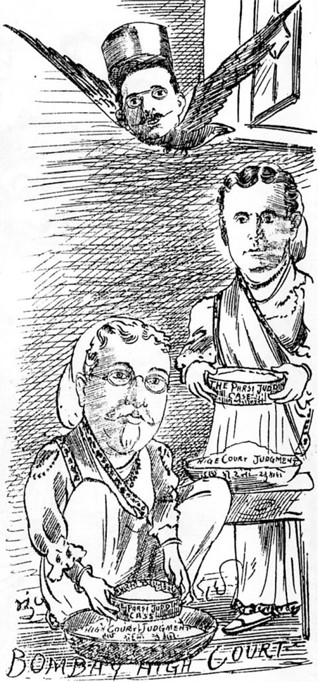
Sifting Illustration courtesy: Hindi Punch (29 November 1908)
The implications of their landmark judgment have influenced the course of the community for 100 years.
In this three-part insightful article "Judging Conversion to Zoroastrianism: Behind the scenes of The Parsi Punchayet Case (1908),” legal scholar Mitra Sharafi writes about the relationship between the two judges and the factors that influenced their final judgment.
This article was previously published in John R. Hinnells and Alan Williams, eds., Parsis in India and the Diaspora (London: Routledge, 2007). Permission to republish the text in Parsiana has been granted by Routledge. The Hindi Punch images are reproduced courtesy the Bombay University Library.
• • •
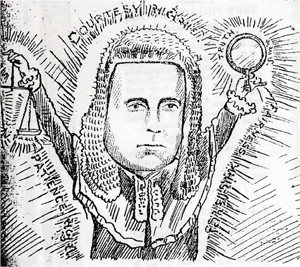
Mr Punch’s Fancy Portraits: Sir Frank Beaman Illustration courtesy: Hindi Punch (27 October 1918)
In the 89th quartier of Paris’ Père Lachaise cemetery lies the grave of a French woman who tried to become a Parsi and failed. It is testament to Soonoo Tata’s 1908 defeat in the Bombay High Court. Had Tata’s side won, her body could have been left in Bombay’s dakhmas or Towers of Silence to be exposed to vultures according to traditional Zoroastrian death rites. In 1903, Suzanne Brière married into the Tata family, the Parsi ‘royalty’ of mercantile-industrial Bombay. Immediately before, she tried to convert to Zoroastrianism by undergoing the navjote or initiation ceremony. Whether conversion to Zoroastrianism was permitted was in dispute. For orthodox Parsis, being born into the community was a prerequisite for initiation. For reformists, birth was just one possible route into the Parsi community. The other was conversion. Dinshaw Davar, the first Parsi judge of the Bombay High Court, and Frank Beaman, a blind British judge, ruled against Tata. Rather than declaring conversion itself impermissible, they held that juddins or non-Parsis were excluded from enjoying the benefit of Parsi trusts, the legal instrument governing Zoroastrian religious properties and funds.
This article goes behind the colonial bench to offer new insights into Petit vs Jeejeebhoy, informally known as The Parsi Punchayet Case. It provides a full account of the judicial dynamics at play — ethnic, personal and professional — between the two individuals who decided the case. The case is generally taken to stand for the rejection of juddin admission into the Parsi Zoroastrian community, although a debate rages over whether the judges’ comments on conversion were obiter dicta (of no precedential value) because the aspiring converts were not parties to the case. New archival sources from the Bombay High Court emphasize the contingency of this final outcome.
Drawing upon Petit vs Jeejeebhoy’s unpublished case papers and the judgment notebooks of Davar and Beaman, I show that the two judges were initially in favor of permitting limited conversion, that the position of Davar and the leading expert witness, J. J. Modi, turned against juddin admission in the final month of proceedings, and that ultimately Beaman also yielded to their view. Beaman’s judgment notebook is particularly revealing because, until now, the only information available on witness testimony consisted of a few references in the published judgments. Beaman’s notebook documents the cross-examination of Modi in great detail, along with Beaman’s own reactions to Modi’s testimony. His notes do not explain why Davar and Modi changed their position midway through the proceedings, but the informal influence of the Bombay solicitor and orthodox orator, J. J. Vimadalal, seems likely. The refusal of the defendants’ lawyer to accept a compromise earlier during proceedings was also an important precondition for the final outcome of the case. By filling in the details of who these two judges were and how they interacted, I aim to historicize two judicial texts that have acquired pre-eminent status — both famously and infamously — in the Parsi community over the past century. Petit vs Jeejeebhoy was as much a story about personalities as about principles.
A number of scholars have analyzed the case. Tanya Luhrmann misreads the case as a reformists’ victory, taking the case as authority that Parsi men who married out of the community could have their children recognized as Parsis, following proper initiation. The case was not in fact about the status of offspring of mixed parentage. The issue was whether a juddin who converted to Zoroastrianism could enjoy the benefits of Parsi funds and facilities. The court ruled that she could not. Rashna Writer, Jesse Palsetia, Michael Stausberg and John Hinnells offer more careful readings of the case as an orthodox victory. They untangle the knot of public meetings, petitions, and published judgments that the juddin controversy produced. Because the existing scholarship does not rely upon unpublished court records, though, it reports on the final outcome of the case, rather than on what happened in the courtroom en route. This article tells that story.
The Judges and the Case
Frank Beaman and Dinshaw Davar arrived on the Bombay High Court bench by opposite routes. Frank Clement Offley Beaman (1858-1928) came to India as a covenanted member of the Indian Civil Service (ICS) at the age of 21 in 1879, having completed undergraduate studies at The Queen’s College, Oxford. His father was Arderne Hulme Beaman, a Surgeon General in the army stationed at Hoshangabad in India. His mother was a member of the illustrious Gompertz family of Jewish converts to Anglicanism. From 1883 on, Beaman served in the judicial wing of the ICS. He began his judicial career in Gujarat, and spent the next 14 years there and in Kathiawad and Baroda as an assistant collector, magistrate and sessions judge. Beaman became a High Court judge in 1907. Although members of the covenanted ICS enjoyed status and privilege generally, the judicial wing had long been the poor cousin of the revenue branch. Similarly, judges in the High Court who came through the ICS were considered second-class. This put Beaman in a doubly inferior position. Judges trained as barristers at the Inns of Court in London viewed ICS or ‘civilian’ judges with wariness on account of their lack of formal legal education: they were not actually lawyers by training. On the other hand, ICS judges could usually boast a greater knowledge of Indian languages and customs than their barrister colleagues.
Beaman learned his trade through years of experience at the middling levels in the mofussil or provinces, which were notorious for low-quality legal work. At his death, colleagues agreed that he was a remarkably able judge, particularly given his ‘civilian’ background. Magnifying this achievement was the fact that Beaman went blind over the course of his judicial career. He hired readers and learned to take notes on a typewriter in court. Beaman was a theosophist and a freemason, and published conservative articles extra judicially that attracted public criticism — for defending the caste system and opposing women’s emancipation. He died in 1928 after diving into an empty swimming pool at his Swiss villa.
Dinshaw Dhanjibhai Davar (1856-1916) arrived at the High Court with the more prestigious pedigree of a London-trained barrister. He was the only son in a wealthy family of the priestly class. After studying at Elphinstone College in Bombay, Davar went to London in 1877 where he joined Middle Temple. He was called to the Bar in 1880. Davar returned to Bombay in the same year and was admitted as an advocate of the Bombay High Court. He built up a successful practice in the Small Causes Court and Police Court where he excelled at cross-examination. On October 27, 1906, Davar was made a judge of the Bombay High Court, the first Parsi appointed to the post. His appointment would have huge ramifications for the Parsi community’s relationship with colonial law. It was Davar who decided most major Parsi cases originating in the city of Bombay during his decade on the bench. He also famously sentenced the nationalist hero Bal Gangadhar Tilak to six years’ rigorous imprisonment for sedition. Davar campaigned for equal rights for Indian advocates. In 1914, he became the first Parsi to serve as Acting Chief Justice. Davar remained a High Court judge until his death in 1916 which struck before he could testify in the case deemed a Rangoon sequel to Petit vs Jeejeebhoy, the Privy Council appeal of Saklat vs Bella.
Petit vs Jeejeebhoy was originally meant to be heard by Davar alone. At first, he refused to take the case on ethical grounds: he had advised the defendants as a lawyer a few years earlier. But even the plaintiffs insisted that he hear the case. Finally, convinced that there were new issues involved, Davar accepted provided that another judge be brought in to hear the case with him, forming a ‘special bench.’ Beaman was the Chief Justice’s addition.
The chain of protests, petitions and meetings leading up to the litigation has been documented by the existing scholarship. In court, the defendants argued that although Zoroastrian scripture permitted and even encouraged conversion, the Parsis had not accepted converts since their arrival in India from Persia in the eighth century. Convention trumped text. According to Davar, the point was moot because even if conversion were allowed, Parsi religious trusts were framed for the benefit of Parsis only. It was Davar’s judgment that established that the term Parsi referred to an ethnic category and Zoroastrian, to a religious one. In Beaman’s view, the Parsi community had metamorphosed into a caste. The Parsis had adopted the institution after living amongst Hindus for over a millennium, and one could only enter a caste by being born into it. Together, the judgments of Davar and Beaman prohibited Tata from entering Zoroastrian fire temples, benefiting from Parsi charitable funds, and having her body consigned to the dakhmas. Even if she may have been able to convert to Zoroastrianism — a point left technically unresolved by the judgments — she could never avail herself of the ritual, material and social benefits that came with membership of the Parsi Zoroastrian community.
To be continued.

Mitra Sharafi is assistant professor of Law and History at the University of Wisconsin following a two-year research fellowship at Sidney Sussex College, Cambridge University, and a short visiting fellowship at the Socio-Legal Research Center of Griffith University in Australia. A Canadian scholar of part-Iranian descent her research focuses on Parsi legal history. After completing a history degree in Canada (BA McGill, 1996) and two law degrees in Britain (BA Cambridge, 1998; BCL Oxford, 1999), Sharafi did a doctorate in history in the US (PhD Princeton, 2006).
◆ ◆ ◆
From the archive