
Cover Story
Acknowledging Astad
By bestowing a Padma Shri award the country has recognized Astad Deboo’s contribution to modern dance
"If they answer not to thy call walk alone,/If they are afraid and cower mutely facing the wall,/O thou of evil luck,/open thy mind and speak out alone,” ring the words of Rabindranath Tagore’s Ekla Chalo Re.
Like Mahatma Gandhi, contemporary dancer and choreographer Astad Deboo found comfort in Tagore’s Ekla Chalo Re. At a performance in Calcutta Deboo interpreted the song to depict his struggle as an artist initially rejected by both the Indian classical dance and corporate worlds. As he recites the first line of the song he adds the phrase "walk tall” explaining that alone, yet not disheartened he journeyed to pioneer modern dance in India. May 2007 found Deboo walking towards the carpeted platform on which President Dr Abdul Kalam stood to be conferred the Padma Shri award for his contribution to Indian art. A month later he was dancing for a packed audience at the Rashtrapati Bhavan, President Kalam so pleased with the performance that he insisted the food be promptly brought from the kitchen so that he could himself serve the snacks to Deboo’s co-dancers, students of The Clarke School for the Deaf.
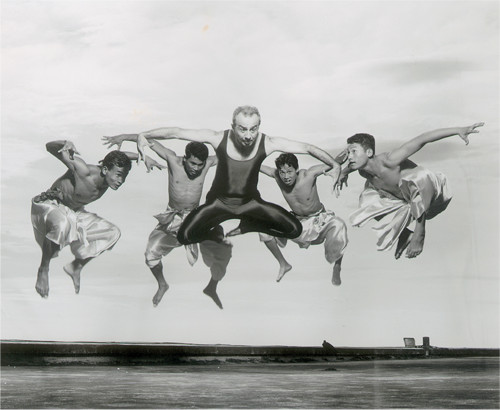
Being awarded the Padma Shri was a "total surprise,” mentions Deboo who was in Spain when he found out he was nominated. He was in fact waiting to hear "lights ready” from his technical director when instead a diplomat friend in Brussels phoned with the good news. "I’ve never hankered for awards,” says the 60-year-old dancer explaining that often the candidates themselves and others lobby for their nomination. When he was on the selection committee of a national dance academy he remembers other members calling him to lobby for candidates. But they were turned down with a firm "I have a mind of my own.” Commendations, acknowledgements, felicitation offers followed after Deboo was awarded the Padma Shri. When asked how the community responded he chuckles, "Now it’s all apro (our) Astad” with two organizations wishing to felicitate him and congratulatory messages flowing in. But community support has been scarce and by and large Deboo says he’s been regarded as "something of an odd ball.” When it comes to music/dance he broadly divides Parsis into two lots — the connoisseurs of Western classical art, usually consisting of the upper affluent class and the other that has no real interest in it or to whom it holds only entertainment value. He recalls going with his father to the office of a Parsi organization in Bombay where someone proposed, "Mr Deboo jara ma dance karine batavo ni (Mr Deboo, quickly show us some dance steps),” and more recently an international association suggesting that his felicitation be followed by a "five-10 minute demonstration.” Used to these comments and guidelines on dance he often laughs and excuses himself but states convincingly, "I don’t do five-10 minute demonstrations.”
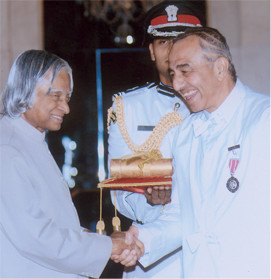
Dr Abdul Kalam with Deboo: the award was a "total surprise”
While Deboo "doesn’t owe his success to the community (trusts said their deeds did not cover the field of dance), as individuals, Parsis have been my great support,” — architect Ratan J. Batliboi, his "Rock of Gibralter,” designs many of the props for Deboo’s shows, Noshir Daruwalla who worked with Max Mueller Bhavan, theater personality Sam Kerawalla, photographer Farrokh Chothia, AFL chairman and managing director Cyrus J. Guzder amongst others. He was also lucky to have supportive parents — Roda and Aderbad — and a household where dance was not dismissed as an unviable option (the family then owned the well known Leach and Weborny laundry business). He recollects his parents sensing his initial frustration and depression as he tried to make his mark in India and regretting that they could not help better his prospects. But a happy home to return to was plenty of recompense and gave him the courage to "handle the monsters outside.” After more than three decades of pursuing dance, a Sangeet Natak Akademi Award to his credit, performances in 60 countries, including at the Great Wall of China, for the royal families of Japan and Thailand and being commissioned by Pierre Cardin to choreograph a work on the prima ballerina Maia Plisetskaia of the Bolshoi Ballet, environs have got friendlier but the "struggle is still there, nothing falls into my lap… While people say I have arrived they forget the work that goes on behind the scenes.”
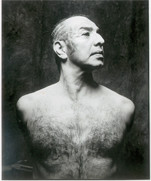
In November 2002 Deboo and a group of friends set up The Astad Deboo Dance Foundation, "the idea being to create a formal platform that would create opportunities and support for his dance work as well as focus on the deaf community…The Foundation aims to create projects, short and long term wherein the disabled could experience creative expression; to provide scholarships and aid to talented deaf performers and finally to facilitate partnerships between the deaf community and corporate worlds,” reads the Foundation’s literature. Of late Deboo has been engaged in convincing mobile phone companies to sponsor, in large numbers, cell phones for deaf students. He explains that sending an sms is one of the easiest ways students can stay in touch but their families may not be able to afford a mobile phone. Siemens donated 30 of the latest hearing aids to Deboo’s students from The Clarke School for the Deaf and he hopes that mobile phones will follow in greater numbers. Actually any donations to the Foundation will be gladly accepted (e-mail: astaddeboo@hotmail. com).
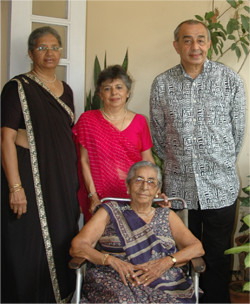
From left: Kamal Antia, Gulshan, Roda and Astad Deboo
Funds raised by the Foundation — consistent largesse of the Tata companies being their mainstay — made it possible for Deboo and his students from The Clarke School to be part of the opening ceremony and cultural festival at the 20th Deaf Olympics in Melbourne, Australia in 2005 and tour Bangalore, New Delhi, Bombay and Madras with their production Contraposition. The performances were met with "tremendous enthusiasm,” says Deboo, both by the deaf community of the concerned city (for whom they had special shows in the morning, the dancers becoming role models for their young, deaf spectators) as well as by regular audiences. Asked how he communicates with his deaf students he explains that his "signing is not all that great; like any language if you don’t practice it gets rusty.” But he manages to get by since many of the Indian students lip-read and are encouraged to speak. Abroad he is more familiar with the American Sign Language (which differs from the English) and occasionally has an interpreter if he is unsure or has a difficult child to deal with.
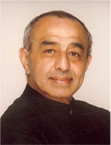
"Now it’s all apro Astad”
Deboo observes that prior to a performance his Indian students prostrate themselves before him seeking his blessing, abroad at best they would applaud after a class. "The West is astounded to see the kind of reverence here.” When Deboo wanted to work with the Manipuri martial artists of the Hula group who practiced the Thang Ta art form he had to go to Imphal and ask the permission of their Guru Devabrata Singh. Deboo enjoys developing a bond with his students that outlasts the duration of the practice sessions and the performance. His ex-students from the Action Players, the deaf company in Calcutta, keep in touch with him via sms and e-mail inviting him for their weddings or informing him of a birth in their family.
Most of Deboo’s performances are thematically universal, focusing on the life of a blue-collar worker or insomniac or drug addict accompanied occasionally with flashbacks into the character’s childhood to understand better their present condition. Deboo suddenly slaps his cheek to demonstrate — the insomniac as a child had been slapped by his parents. But stories are not always spelt out and often there may not be a story line. He’s certainly "not going to spoon-feed the audience.” Drawing the analogy of an art exhibition, Deboo notes that the audience doesn’t ask the artist, "Why this and that?… You look at the work and appreciate it.” He mentions that despite being initially trained in the Indian classical dance tradition that relies heavily on mythology as a thematic source, he avoids drawing from it and instead finds his inspiration and subject from current social issues.
Does Deboo play a Parsi in his work? No, he says, when he is choreographing "I have to be inspired, motivated.” While he is "proud of his roots and religion,” he clarifies that "I’m not a Bombay Parsi… I’m a Parsi brought up with Parsi values in Jamshedpur.” He observes that Parsis in other parts of India have a different concept of community life. Born in Navsari since his mother went to her maternal home for all her three deliveries, raised in Jamshedpur (his father worked for Tata Steel), family life was "Indian in all aspects,” as compared to the Anglophilia from which most Bombay Parsis suffered. His mother, Roda, also learned Indian classical dance and played the veena. At 90, she sits at the balcony of their flat in Shapur Baug weaving kustis, still enjoys making pickles and till some years ago the intricate torans that adorn their doors. Deboo’s older sister Kamal Antia resides in Jamshedpur with her husband Jamshed and two sons Xerxes and Danesh, while another sibling Gulshan is a tourist guide and stays with him and their mother in Bombay. Theirs is a "very religious” family, says Deboo, who follow the Bahman mah, visit the seaside every Avan mah, Avan roz with sugar and dal ni pori in hand and have monthly prayers said for their father, Aderbad, who passed away some years ago.
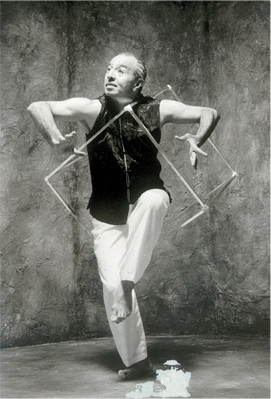
Deboo inspired by current social issues
Photo: Farrokh Chothia
Deboo stresses that "Change has to come from within the community,” in relation to the recent Doongerwadi controversy. If the situation inside the dakhmas resembles "visions of holocaust,” cremation or other alternatives should be considered. He observes that 90 percent of the funeral services he has attended for Parsis recently have been at crematoriums. The "well-educated, well traveled trustees” of community organizations who are yet "so cranky and petty with no desire to better living conditions” are another anomaly. "So what,” he exasperates if "our Parsi girls marry out and want to bring up their children following their faith…men have the right.” Disappointed with the Parsi couples he sees of late who despite knowing Gujarati prefer to speak English, he encourages them to revert to their mother tongue, or if one partner knows the language well, to teach it to the other. But the younger generation of Parsis he is happy with: "They want to better their living conditions… they are dynamic.” Perhaps in them he sees something of himself. When a bank manager recently asked him when he will retire he said to himself: "What retire… I can still do a 90-minute performance without a problem!”
◆ ◆ ◆
From the archive