
Business
Bountiful bodies
Wadia Body Builders special purpose vehicles are in demand all over India
It was a difference of opinion between father and son that resulted in the establishment of Wadia Body Builders (WBB), one of the country’s leading manufacturers of special purpose vehicles (SPV).
Founded by Sam Faramroz Wadia in 1969 with 10 employees, the 40-year-old company today has a strength of 120 skilled workers and can churn out up to 20 SPVs in a month, notes the company’s brochure. Situated on the outskirts of Ahmedabad, on a 15,000 square yard plot, the company has an all-India market for their products.
They recently received "a very large order from the Surat Fire Brigade” for vehicles and two speed boats, valued between six to eight crores, says Farida Wadia, proprietor of WBB. Her husband, Sam, died on June 27, 2002 and she took over the reins.
At the time of the phone interview on March 14, 2008, her son, Naushad, the firm’s chief executive officer was in New Delhi negotiating a sizable contract. Farida intends to launch an initial public offering (IPO) for her firm in another two years. WBB has a sister concern, Wadia Engineering Private Limited, of which Farida is chairperson and managing director. This company owns most of the assets, says Farida.
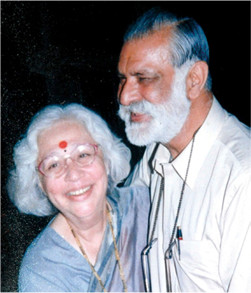
Above: Farida and Sam Wadia.
Orders arrive from government bodies, local municipalities, non-governmental agencies, public and private sector units for fire fighter vehicles (over 3,000 supplied), bullet proof vans, portable fire pumps, mobile education vans, vehicles for refineries, mobile display vans, ambulances and others.
A write-up on the company notes that in 2006-2007 WBB received "an order for the development of super specialized flood rescue vehicles and air boats… a first of its kind in the country for the fire brigade.”
What distinguishes WBB from its competitors is "quality,” says her son, Naushad, the firm’s chief executive officer. The purchaser has "peace of mind” the equipment will work when required. After sales service calls are attended to within 48 hours, he states.
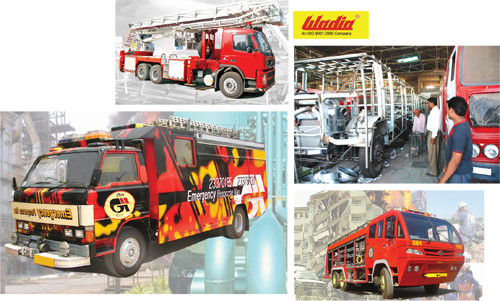
Top left: fire fighting vehicle with aerial ladder platform. Bottom: emergency responder for pipelines. Far right: Body being prepared at workshop. Below far right: portable pumps.
It takes approximately three to four months to manufacture a vehicle as per the customer’s requirements, he notes. The specifications for each vehicle differ, he adds.
Most of the materials used in manufacture are sourced locally, the factory’s foreman, Rajni Patel told Parsiana when we visited on June 2, 2007. The vehicle’s super structure is built from MS steel. Zinc sheets are then fitted. Drawings detailing the specifications and work to be done accompany each vehicle to the workshop. Aside from orders for new vehicles, old ones also come for a "full renovation,” says the foreman. The plant-in-charge is Rabrindran T. Mody.
The price of a SPV can vary from around 10 lakh rupees to five crore rupees, says Naresh Tanwar, sales-in-charge, who has been with the company for 20 years and looks after the downtown office in the absence of the Wadias. The hydraulic platforms on the fire engines are "totally imported,” says Tanwar. The ladders can rise to a height of 200 feet.
The factory builds bodies on vehicles bought from various manufacturers like Tatas, Ashok Leyland, Eicher, Swaraj Mazda and Volvo. "Tatas and Leyland” are the most popular makes, he observes. The engine and chassis can cost between five to 15 lakh rupees. The bullet proof vans were made for Checkmate, a company that provides vehicles to various banks for carrying cash. Special treatment is affected to the raw material and hardened aluminum sheets are used. The metal is between three to eight millimeters thick and the glass 35 mm, says Naushad.
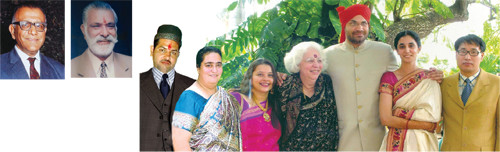
Above: Faramroz and Sam Wadia. Alongside: Rayomand and Dilshad Daruwalla, Layania, Farida and Naushad Wadia, Sanaeya Tehzeeb and KoYoungswoon
"Sam never took a single paisa from his father to set up his new business,” says Farida. He was a self educated man who worked with his hands. "He hated studies… (he learned his trade) in the school of life… He always wanted to be in manufacturing… he did not want to be a trader,” unlike his father Faramroz who had prime agencies in Gujarat including ones for Badford Trucks, Premier Automobiles and Burmah Shell. Sam and Farida spent about five years in various parts of Saurashtra servicing the agencies.
When they split from Sam’s father, they left, "literally with a fiver in our pockets,” recalls Farida. Sam worked with his maasaa (mother’s sister’s husband) ‘Bom’ (Bomanji) Gazdar in Bombay who had a fabrication workshop on Foras Road. They stayed with Sheroo and Adi C. P. Wadia at their bungalow off Nepean Sea Road contributing their share of the expenses. "We lived like kings and queens,” recalls Farida. Sam and Adi were not related but "shikar chums,” she says.
After around five years, an uncle from Porbunder convinced the young couple to return to Gujarat. To assist Sam in his new venture, Farida studied for a diploma in automobile engineering at MIMI in London.
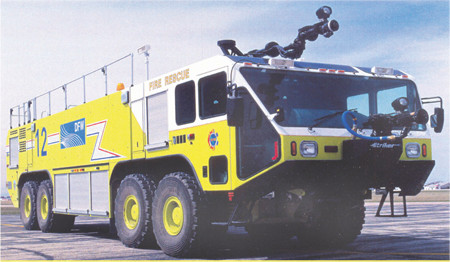
Airfield crash tender
Despite the diploma, Farida modestly states that Sam "was way ahead (compared) to what I learned… He was my inspiration.” In an e-mail to Parsiana this March she noted, "He was a tall, towering man, with a large moustache and soft brown eyes and a booming voice; menacing and endearing at the same time. He would be accompanied by the fragrance of his pipe which went everywhere with him… He was well-known in Ahmedabad society and was the face of Vimal suiting. He was a silent philanthropist, would help anyone in need and remained anonymous for his deeds towards the Parsi community.”
She had also completed a doctorate in psychology from Holland on Madame Marie Montessori. Not surprisingly WBB has a tie-up with Holmatio of Holland, manufacturers of fire rescue equipment.
Naushad completed his BCom degree and "qualified for (WBB under) his father and mother,” says Farida. Their daughters are not in the business. Dilshad (Daruwalla) is settled in Nagpur and Sanaeya Tehzeeb living in South Korea is a sculptor and artist involved with vastu and feng shui. A fourth grandchild is on the way, informs Farida.
Wadia considers herself "very much of a Zoroastrian. I don’t call myself a Parsi. I’m at heart a Zoroastrian. No other religion on earth can come as close” to ours. "My father (Ferozshah Viccaji Pestonji of Hyderabad) was a great Persian scholar.” He taught his daughter the Avesta "to such a degree that I know the meanings of the prayers I pray.”
As regards entrepreneurship in the community, Wadia wishes "more would go into business. The ones I see around are mostly ladies.”
◆ ◆ ◆
From the archive