
Books
Menus and memories of Iran
A Treasury of Persian Cuisine by Shirin Simmons. Published in 2007 by Stamford House Publishing. The book is available with the author at 49 Corringham Road, Wembley Park, London HA9 9PX, England. Pp: 270. Price: £ 19.95.
What makes the book A Treasury of Persian Cuisine fascinating are the small notes on the personal life of a young Iranian Zoroastrian; anecdotes and the author’s own experiences and encounters; the traditional customs and national holidays such as Navroos, Baman zooz (zooz means roz); the epics of Iranian history; the creation of the Persian Empire; and the history of the great kings and emperors. The book describes the geography of Iran and it would have helped had there been a map of the country.
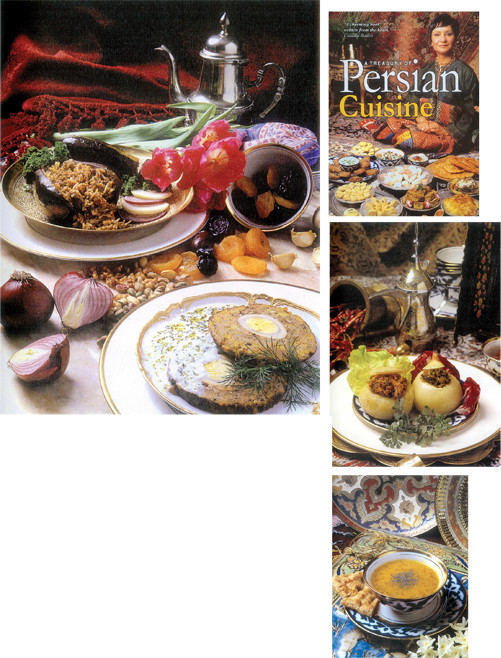
Clockwise from top left: Aubergine dish and meatball surprise; book cover; stuffed potato and onion; sweet golden soup All photos courtesy A Treasury of Persian Cuisine
Iran has several names in common with India — anar (pomegranate), golab (rose), badam (almond), nan, piaz (onion), sib (apple), shekar (sugar) and so on. Their priests are also called mobeds, and of course they celebrate the Navroz table, as the Iranians do in India. Going through the book I realize how many Parsi customs and dishes are derived from the Iranian lifestyle, though we have created our own cuisine with the addition of the spices of the west coast and adaptation of dishes from other cuisines.
They have a charity meal called Ash-e-Khirat when an affluent family would invite the entire community — rich and poor to sit together to eat — similar to our gahanbars. Those who are too poor or old to come have the food sent to their homes in large copper vessels.
I now see how the aachhoo meechhoo was derived, breaking the egg to remove the evil eye. Iranians also use the egg to ‘break the evil eye’ by drawing circles representing eyes all over the egg, until there is no more space on its surface and breaking it into a bowl of water held above the person whose nazar is to be removed.
Sarreshteh is a ceremony performed by the women when a husband gets a new job. In the author Shirin Simmons’ house, they would gather together and sit on a white sheet on the floor. After sprinkling flour on each other’s foreheads, for good luck and good jobs for their husbands, they would roll out a prepared dough into small reshteh or cookies. As these were put into the ash, to make ash-e-reshteh, everyone would make a wish. The families would then come to the house in the evening to have their share of the ash, and some would be given to the less fortunate.
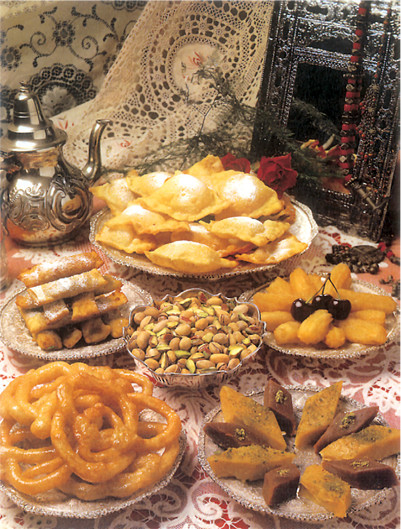
An array of Persian sweets
Another unusual event is Jashn-e-Tiragen-va-Tirmah, when the temperature soars, water is sprinkled on passers-by from balconies and behind trees, with plenty of laughter and joy. I am glad we did not carry this tradition with us to India.
These are a few of the events in the author’s life in Iran that she has sprinkled throughout the book — a few are somewhat similar to our own customs in India, and others quite different.
Iranian dishes are light and this book is replete with recipes containing fresh fruits and herbs such as dill, parsley, celery and coriander, which is their signature. Simmons also has a section on fruit healing that is practised by her physician, Dr Kaboli.
The ash is a thick broth meal and abgoosht is a thin soup. Some of the ash dishes could be a meal on its own like Ash-e-khirat (charity meal) mentioned earlier, as also the khoreshts.
There are several unusual dishes, like meatballs in yoghurt and nut sauce; turkey in peach, walnut and cinnamon sauce; roast stuffed chicken (the stuffing consists of apricots, cherries, walnut and saffron); grey mullet with chestnut, grapes and herbs; celery khoresht, which is a light summer dish. The stuffed meat and vegetable dolmeh sound delicious, especially the stuffed chicken and courgettes.
Some dishes are quick and simple to produce, such as chicken and almond hors d’oeuvres and the crispy saffron chicken.
Simmons has described beautifully how to cook perfect rice the Iranian way, to get the crisp base takdeg, and as a variation there is a recipe to provide a crisp base of potatoes.
There are some delightful crunchy sweets such as the rice crumble and pistachio munchies. She has given recipes for baklava and noghl (the origin of nougat), and toot, a delicious marzipan.
From amongst the preserves, orange blossom jam and orange and carrot marma-lade look tempting, and I am surely going to try out her recipe for pickled cherries.
Though there are a few editorial errors, and the photographs — colored as well as black and white — could have been less cluttered, I would certainly recommend this book.
◆ ◆ ◆
From the archive