
Events & Personalities
The Zoroastrian flag
Ervad Irach S. Kuka of Bombay, the 95-year-old who describes himself as a "student of Zoroastrian religion, theology and Iranian history,” has conceived and designed the Zoroastrian flag, coordinating with Ervad (Dr) Ramiyar Karanjia, principal of the Dadar Athornan Madressa of which institution Kuka is a senior trustee. He informed Parsiana through a write-up that his concept and design of the flag are based on the writings of Zoroastrian scholars, the Shahnameh and other authentic sources including the flag designs of Iran’s Pahlavi period and the reigns of Rezashah and his son, the last Shah of Iran who lost his throne in 1979.
According to Kuka’s explanatory notes, an Iranian blacksmith named Kaveh-Ahanger, having made a flag from his leather apron, revolted against the tyrannical rule of Zohak. This flag came to be known as "Drafshe-Kavyan” (Kavyani Zando in Gujarati) and was adopted as the national flag of Iran.
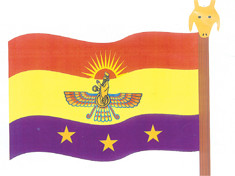
When he was an infant Shah Faredoon was brought up by a farmer who reared him on the milk of a cow. Under the Zoroastrian flag, Faredoon defeated and dethroned Zohak, fighting the latter with a specially crafted mace which had the "face” of a cow. Hence, the "cow face” depicted on top of the banner mast. Some Parsis even refer to the flag as the Gavyani Zando. The three colors of the flag — red, yellow and violet — signify sacrifice, unflinching faith in the religion and loyalty to the state respectively. The figure of the Farohar stands for the incorruptible essence of God (Ahura Mazda) in mankind. Three stars stand for the three principal teachings of Zoroastrianism –– good thoughts, good words and good deeds. Shah Faredoon and later kings of Iran decorated the flag with precious jewels. The sun and the stars, which signify the benevolent, radiant creations of God, are studded with diamonds.
When Yazdegird Shehriar, the last Zoroastrian king of Iran was defeated by the Arabs in 637 AC, the flag, whose dimensions were 22 feet in length and 15 feet in width, was taken as a trophy of war. It was so very precious that Zohra, the Arab soldier who first snatched it away was awarded 30,000 gold coins and each and every soldier in the Arab army was rewarded with a jewel, Kuka’s explanatory notes reveal.
Several years ago Jehangir R. Medora of North America had also designed a Zoroastrian flag.
◆ ◆ ◆
From the archive