
Events & Personalities
Farohar on footwear
Tipped off by a phone call that a shop in the Heera Panna shopping complex at Haji Ali was selling men’s shoes embellished with farohar pendants, activist Khorshed Meherjee went there on a recce on July 24, 2016. What she saw there made her blood boil. "I wanted to blow up,” she wrote in a WhatsApp post, "but I controlled myself and quietly clicked pics of those shoes, asked for the shop’s card and moved out.” Meherjee then mounted a sting operation. On July 27, along with Neville Broacha, president of the Bharatiya Janata Party’s south Bombay Parsi Cell, municipal corporator Sarita Patil, Patil’s husband Ajay and some members of the community, Meherjee confronted the shopkeeper Deepak Bansal. The Tardeo police was summoned to intervene. They arrested Bansal, who was subsequently produced before the Girgaum Court, and the offending footwear was confiscated.
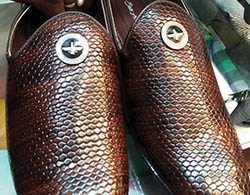
Offending shoes
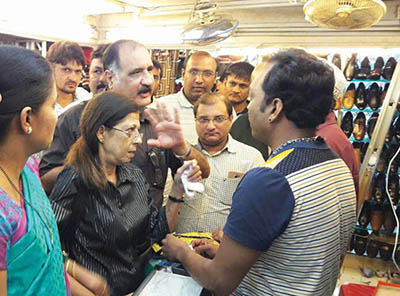
Sting operation by Khorshed Meherjee (2nd from left)
The sentiments of the Parsis, who consider the farohar their guardian angel in the spiritual world, were hurt. Almost exactly a year ago, the Parsis were outraged at the misuse of the farohar symbol in a music video on YouTube featuring Iranian singer Amitis Moghaddam and American rapper Snoop Dogg. At that time a public interest petition was filed in the Calcutta High Court by Darayas Bapooji, president of the Parsi Zoroastrian Association of Calcutta as a result of which YouTube withdrew the video (see "Fracas over farohar,” Events and Personalities, Parsiana, August 7, 2015).
But some Parsis felt the issue should have been left alone and it did not behoove Parsis to indulge in protests of such a nature.
According to Wikipedia the farohar was first seen in early Mesopotamian and Egyptian reliefs long before it was adopted and adapted by the Persians to represent the Iranian nation. Parsiana had at that time requested London based independent researcher Farrokh Vajifdar to explain the significance of the farohar, which he did at some length. According to him, a similar carving is depicted on the rock tomb of Darius the Great at Naqsh-i Rustam, where his moral qualities are presented. "There can be no doubt that the so-called farohar symbol is neither the king’s own fravashi or external guardian angel, nor his spiritual double, but the great God Ahura Mazda and none other. The fact that Ahura Mazda is altogether abstract, yet depicted in figural form should not distract one from understanding this basic truth.”
◆ ◆ ◆
From the archive