
Readers' Forum
“The challenge within”
With reference to the letter "The challenge within” (Readers’ Forum, Parsiana, March 7, 2008), I would like to comment on the observations made by E. P. Bharucha regarding Yazdegird III, the last Sasanian and Zoroastrian king of Persia. I believe that Bharucha has not been accurate or fair in his depiction of Yazdegird III.
Yazdegird III did not aspire to be king. Kingship was thrust upon him on June 16, 632 AD as he was the closest relative that the nobles could find to the last monarch Hormuzd VI. He was only 16 years old when, after only one year of his reign, the Arabs invaded Persia. In the decisive battle of Qadisiyyah in 636 AD his brave and loyal commander-in-chief of the army, Rustam, was killed and the Persian army was defeated.
Young Yazdegird III was a devout Zoroastrian. But to gain some modest support from the Persian Empire’s old rival, the Roman Empire of the East, he sought an alliance with the Emperor Heraclius’ granddaughter Manyanh even though she was a non-Zoroastrian. Yazdegird and Manyanh had many children. After the defeat at Qadisiyyah, Yazdegird and his remaining followers rallied forces once more but they again lost at the battle of Nehavand in 642 and Persia was at the feet of the Arabs. The conquerors did not waste time in occupying Ctesiphon, the Sasanian capital. The young Yazdegird fled to Media by himself, whereas his wife and daughters fled in different directions pursued by the Arab hordes. Yazdegird III then fled eastward from one district to another. He tried to get help from the Emperor of China, but to no avail.
Finally, alone and defeated, with only a few jewels and his great gem-inlaid sword by his side he landed at Merv (or Mary), one of the remotest outposts of his former Empire. There he sought shelter with an Iranian miller. After a few weeks the miller suspected that his guest was no ordinary man but the king himself. His suspicions were aroused due to two factors. Yazdegird III being religious asked the miller for some twigs of the barsum plant to perform a Zoroastrian ritual. Also, the miller had seen him cleaning his jewel-encrusted sword one day. This tempted him to kill Yazdegird while the king was asleep and rob him completely of all his few remaining belongings including the sword. He dumped the king’s body after claiming kudos for the assassination of the wanted king. Yazdegird’s body would have rotted in the stream had not the Christian Bishop of Merv intervened and made sure that the last Zoroastrian king got a decent burial. Thus ended the reign of Yazdegird III in 651 AD. He was only 35 years old. Much had been put on this young man’s shoulders. He did the best that he could.
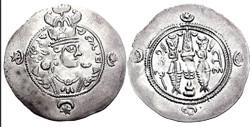
One of the last coins minted of a Zoroastrian king, Yazdegird III
The rest of the nobles who fled Yazdegird’s court settled in central Asia where they contributed greatly in spreading the Persian culture and language. Yazdegird’s son Pirooz fled to China where he unsuccessfully tried to raise an army to re-take Persia. One of Yazdegird’s daughters, Sharbanu, in order to save herself converted to Islam and married an Arab named Hussain Ibn Ali.
I am neither "orthodox” nor claim to be a scholar of Persian history. I am merely placing the facts before readers. It is incorrect to blame Yazdegird III alone for the loss of the Empire and the religion. The rot among the Sasanians had started much earlier. The young king did try his level best to fight, and when defeated could have easily embraced Islam and saved himself, a path that one of his daughters took. But he was a staunch Zarathushti and ultimately paid with his life for his devotion to Ahura Mazda, holding true to his mandate and faith even when he was all alone in the remotest part of his lost kingdom.
ARDESHIR B. DAMANIA
Davis, CA, USA
abdamania@yahoo.com
My understanding of the decline and fall of the Sasanian dynasty differs in some respects from the account given by E. P. Bharucha in "The challenge within” (Readers’ Forum, Parsiana, March 7, 2008).
Khusru Parviz (591-628 AD) was obligated to Emperor Maurice of Rome because the latter had helped him in his fight against the rebel Behram Chobin who was trying to capture the throne of Persia. Khusru Parviz had married Mariam, daughter of Emperor Maurice, and Sheroy (Kobad II) was his eldest son by her. He had also married the beautiful queen Shirin who, according to lexicographer Richardson was Irene, also a daughter of Emperor Maurice. According to Firdausi, Shirin bore 15 sons (Tabari stated 16, while Thomas of Marage made it 24).
What displeased the nobles most was Khusru Parviz’s declared intention of appointing Mardasas, the son of his favored wife Shirin as his successor, setting aside the legitimate claims of his eldest son Sheroy. Twenty-two nobles, headed by Gaudanaspa, commandant of the troops at the capital Ctesiphon, formed a conspiracy and rose in favor of Sheroy. They seized the king and confined him in a stronghold where he kept his money. On the fifth day he was deprived of his life (February 28, 628 AD). Firdausi names one Meher Hormazd, an ugly and evil looking man at whose hands the conspirators had the foul deed done.
Shortly after the accession of Sheroy (Kobad II) to the throne, the conspirators who had assassinated his father perpetrated the further outrage of murdering all the sons of Queen Shirin, to the great grief of Sheroy who was too weak to prevent the foul deed. During the very short interval of four years between the death of Khusru Parviz and Yazdegird III (632-651 AD) no less than 10 sovereigns had sat on the throne, many of whom were assassinated, poisoned or deposed, some by the soldiers and others by priests and nobles, an indication that Persian power was crumbling.
Further, the constant wars between Rome and Persia for world supremacy were wasting their manpower, exhausting material resources and enfeebling the nation by internecine dissensions and the wholesale murder of their princes cut off the royal line. During this period, Islam was rising in the East where the nomads of the deserts of Arabia were being knit into a nation by Prophet Mohammad. These nomads marched from victory to victory to the battle cry of "Allah-u-Akbar.”
Whilst Yazdegird III is generally reproached with feebleness, cowardice and effeminacy, it is worth noting that though many chieftains and kings elsewhere submitted to the Arabs and gained security and honor by embracing Islam, according to historian Benjamin, Yazdegird III disdained such a course and struggled spiritedly against his destiny to the end. Extinct for ever was that power which had achieved the unique triumph of driving away the powerful Romans from every inch of ground they had acquired in Asia.
The conclusion we can draw from these historical records is that had the fanatic nobles and priests acceded to the wishes of Khusru Parviz in appointing Mardasas to succeed him and not needlessly meddled in the succession issue, the Sasanian dynasty may have been saved.
Dr P. D. SUNAVALA
◆ ◆ ◆
From the archive