
Readers' Forum
“Around the world in...”
During the talk at the K. R. Cama Oriental Institute on February 13, 2012, there was speculation about whether the cyclists, Framroze Davar and Gustav Sztavjanik used "gears” ("Around the world in seven years,” Parsiana, June 21, 2012). The truth is there can be no cycle without any "gear” — not even the penny-farthing. All cycles have at least one gear. What is erroneously referred to as a "bicycle with gears” is one with multiple gears — like the first, second, third gears of a car. Bicycle gears perform the same job. In fact they were the first gear users, not cars.
The photos of Davar and Sztavjanik display no such mechanism on their bicycles, neither a lever on the handlebars nor on the top tube. I doubt if they had even seen one during their touring days. The rear hubs have a fine, small barrel. The chain is always in a symmetrical taper towards the axle. My guess is that they had a single fixed wheel. One sees no brake levers in some of the pictures, hence the surmise. The early riders had found a way out of this gear problem, which was used in the initial Tours de France. The rear wheel had two sprockets, one for normal riding and the other for climbing hills and carrying very heavy loads. The rider dismounted, turned the wheel over to the other side and got a new gear ratio. The difference was of course limited to chain length and frame design, yet it was a start. Davar and Sztavjanik may have used that method.
The photos of Davar and Sztavjanik display no such mechanism on their bicycles, neither a lever on the handlebars nor on the top tube. I doubt if they had even seen one during their touring days. The rear hubs have a fine, small barrel. The chain is always in a symmetrical taper towards the axle. My guess is that they had a single fixed wheel. One sees no brake levers in some of the pictures, hence the surmise. The early riders had found a way out of this gear problem, which was used in the initial Tours de France. The rear wheel had two sprockets, one for normal riding and the other for climbing hills and carrying very heavy loads. The rider dismounted, turned the wheel over to the other side and got a new gear ratio. The difference was of course limited to chain length and frame design, yet it was a start. Davar and Sztavjanik may have used that method.
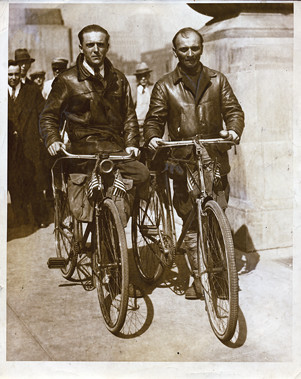
Cyclists Gustav Sztavjanik (left) and Framroze Davar
In fact, multiple gears were used in Indian racing for the first time as late as 1938, in a local race by E. G. Mills and Braddick, who had returned from Australia after the former had won the Empire Games title. A picture of them at the Oval Maidan in Bombay, after the race, shows the change lever. It must have been a hub gear, probably a Sturmey Archer (S-A), very popular on Raleigh cycles in the 1940s and ’50s in India. The S-As had a distinct ticking sound and the rear hub was large, about 100 mm in diameter. My father Malcolm Malcolm had won this race, a 10-miler, and attributed his success to riding a fixed single gear bicycle, a great advantage in the final sprint. Another Parsi, Sarosh Nariman, was third, also on a "fixed wheel.” Mills came second.
Another myth needs to be laid to rest. The usual language for multiple gears is "five-speed” or "10-speed.” This does not mean five or ten times faster. There are cycles with 21-speed set-ups! As for kids, multiple gears are a no-no as it ruins cadence. But then, a geared cycle is always more sought after than one without gears.
To end on a rather technical note, the correct definition of a "gear” on a bicycle is the diameter of the (imaginary) circle the circumference of which the bicycle travels through one revolution of the bottom bracket axle. If that’s a mouthful, I’m sorry. Just go ahead and ride your bike — safely, wearing a helmet. We’ve lost too many cyclists already. (In the simple early days the cry was, "Look, Ma. No hands!”) Finally, hats off to Davar and Sztavjanik. May their tribe increase.
BAPOO MALCOLM
bapoomalcolm@gmail.com
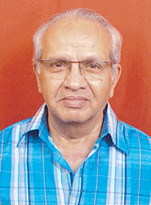
Tehemton Bharucha: inter-school cycling champ
The bicyclists, 30-year-old Parsi Framroze Davar and 16 or 17-year-old Austrian, Gustav Sztavjanik, were extraordinary in every sense ("Around the world in seven years,” Parsiana, June 21, 2012). For a pair of strangers, the latter with no knowledge of English to facilitate conversation between the "uneven pair,” as researcher Ruth Pleyer mentioned, to travel together for seven years to unknown places is both historic and remarkable.
At the K. R. Cama Oriental Institute on February 13, 2012, Bapoo Malcolm bemoaned the fact that Parsis no longer dominate cycling as before. What a pity!
As a teenager studying at St Mary’s High School in Mazgaon, it was a "must” for me to await the inter-school sports at the Vallabhbhai Patel Stadium. The annual competition involved the winning of the Tata Shield for inter-school sports in which my school had stood first for many years. For me the best event was the cycling championship trophy where two stalwart Parsi rivals made it a do-or-die issue, finishing neck to neck for three years in a row. My classmate and hero was the unconquered inter-school cycling king, Tehemton Bharucha. Losing to him for three years in a row was a formidable rival named Sarosh Nariman (now deceased) who would be so close to victory as to place second in a final burst of speed at the end of the fourth and final round. Also a St Mary’s student, Nariman would have to be content with second place.
After years I ran into Bharucha a few weeks ago, and was very happy to share nostalgia as do persons who share a lifetime’s friendship.
Malcolm’s consolation should be the excellent report on 30-year-old Australian cycling champion Nosh Mistry from New South Wales who is preparing for the world cycling event in Manchester, England in October this year. We look forward to his success.
RASHID G. KHOSRAVI
At the K. R. Cama Oriental Institute on February 13, 2012, Bapoo Malcolm bemoaned the fact that Parsis no longer dominate cycling as before. What a pity!
As a teenager studying at St Mary’s High School in Mazgaon, it was a "must” for me to await the inter-school sports at the Vallabhbhai Patel Stadium. The annual competition involved the winning of the Tata Shield for inter-school sports in which my school had stood first for many years. For me the best event was the cycling championship trophy where two stalwart Parsi rivals made it a do-or-die issue, finishing neck to neck for three years in a row. My classmate and hero was the unconquered inter-school cycling king, Tehemton Bharucha. Losing to him for three years in a row was a formidable rival named Sarosh Nariman (now deceased) who would be so close to victory as to place second in a final burst of speed at the end of the fourth and final round. Also a St Mary’s student, Nariman would have to be content with second place.
After years I ran into Bharucha a few weeks ago, and was very happy to share nostalgia as do persons who share a lifetime’s friendship.
Malcolm’s consolation should be the excellent report on 30-year-old Australian cycling champion Nosh Mistry from New South Wales who is preparing for the world cycling event in Manchester, England in October this year. We look forward to his success.
RASHID G. KHOSRAVI
◆ ◆ ◆
From the archive