
Events & Personalities
Distinction for Dadar
The Mancherji Joshi Dadar Parsi Colony won the Glory of Mumbai Award for the year 2007, adjudged the best colony in the Environmental Management Category. Instituted by The Times of India (TOI) to laud the efforts of residential societies to make Bombay a great place to live in the Award was presented on October 14, 2007, TOI reported in its issue on the following day.
The citation read: "In recognition of the passion to make Mumbai a great place to live, instilling a sense of accountability among citizens, making a difference in the neighborhood, The Times of India lauds the efforts of Dadar Parsi Colony with the Glory of Mumbai Awards 2007.”
The TOI had received over 1,400 applications from Bombay, New Bombay and Thana and had shortlisted 125 entries. The properties were divided into five categories: bungalows, apartments, societies, colonies and townships. The judges’ panel comprised members of Lakshya, Rotary Club and TOI. The event was sponsored by Life Insurance Corporation Housing Finance with Godrej Hi-Care and Dish TV as associate sponsors.
The award would have warmed the cockles of the heart of its founder, Mancherji Edulji Joshi, whose statue stands at the junction of Mancherji Joshi Road and Jame Jamshed Road, inside the Colony. "Joshi was the architect of the beautiful garden colony having about 10,000 residents,” writes community historian and writer Marzban Giara in his book Parsi Statues. "To alleviate the housing problems of the community he founded the Parsi Central Association Cooperative Housing Society in 1920 and as a result, an ideal garden colony with schools, library, gymkhana, recreation grounds, bandstand, physical culture house, stores, bungli, dar-e-meher, public hall, charitable dispensary was established,” Giara’s book records.
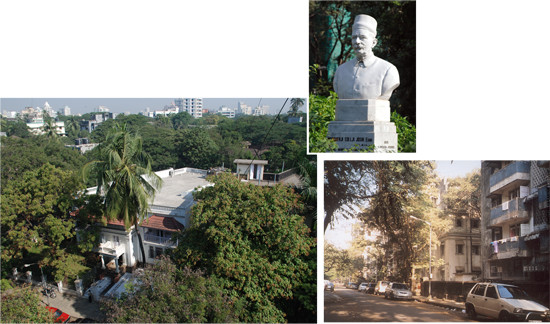
The statue of Mancherji Joshi presides over the green and clean Dadar Parsi Colony he founded
On October 27, 1951, in an introduction for a booklet published on the occasion of the Colony’s silver jubilee, J. R. B. Jeejeebhoy provides a brief but fascinating history of the area. The extract was forwarded to Parsiana by Giara. "Dadar is a name which came into vogue about eight or nine decades ago. Three hundred years (ago) the locality which now comprises Parsee Colony was known as Salvesong, a corruption of Salvacan, the Portuguese parish of ‘Our Lady of Salvation.’ A large area of those parts belonged to the Jesuits who were owners of what we now call Dadar, meaning ladder, along with Mahim, Matunga, Sion, Sewri and Parel. Dadar is so called as the area was regarded as part of a ladder leading to Bombay from the northern direction.
"The vast area encircling the Colony site was then overgrown with jungles, wild flowers and rank vegetation. Roads there were none but only small paths infested with robbers, man-eaters and poisonous reptiles. It remained in this barren state, uncultivated and undeveloped for more than two centuries….
"In 1906 the Zoroastrian Building Society was formed with an authorized capital of Rs 10 lakh. It was this and the Parsee Central Association Co-operative Housing Society which in 1919 acquired the portion of land on the Improvement Trust Area at Dadar, now known as Parsee Colony. The Dadar-Matunga Parsee Zoroastrian Association came into existence in 1925 under the able captainship of Mancherjee Joshi and his band of gallant workers…
"With the active cooperation of his able assistants, he clothed the wilderness of Dadar with the gorgeous mantle of gardens and beautiful structures now teeming with life and activity. His engineering talents found their full sphere of action and ability, and year after year houses began to be erected by private enterprise through the indefatigable labors and philanthropy of persons like Lady Dhanbai Cowasji Jehangir, Sir Hormasjee Adenwalla and other benefactors, by bodies like the Parsi Punchayet and charitably inclined Parsis, for the middle and poorer classes of the community. In time to come, by the exertions of Mancherji Joshi and his Association, 128 plots were acquired comprising 2,50,000 square yards and about 6,000 Parsis were accommodated in up-to-date sanitary houses.”
◆ ◆ ◆
From the archive