
Professions
Favoring the flowers
Adding to the charm of roses and gladioli are the orchids and anthuriums which are popular amongst the community, say Zoroastrian florists
Some hang at the entry portals. Others are used to brighten the aisles. A good number are positioned at screens and partitions. Many serve as the backdrop for the stage. The dainty ones draw the attention as centerpieces. A select few adorn the necks. The remaining are used in benediction.
Flowers in infinite hues and shapes, prominently placed, vie for attention on festive occasions like weddings and navjotes celebrated with much fanfare at baugs. To the delight of the guests the community florists are ever willing to innovate with designs, concepts, materials to create an ambience to suit the host’s social standing. And it is always fresh natural flowers on display at community functions because imitation flowers are considered as "apsugan (inauspicious)” or "disrespectful towards the religion” just as using the previous day’s flowers may not be considered propitious for the next day’s hosts. Embellishing natural flowers with gold and silver colored dried twigs is acceptable though.
"Few Parsi clients want to take risks with something different. The majority want a replica of things they have seen or a mix of two-three concepts. But there is always some innovation each season. That is what gives us excitement,” notes Kamal Kerawalla, daughter of the founder of Baimai Florists, the late Baimai J. Mehta. "Non-Parsis though who want jaasti (greater) show invariably come with a bigger budget and always want some change,” has been her experience.
Hearts with Cupid’s arrow, wedding bells, prominently displayed initials of the navjotee or the wedding couple are now considered old-fashioned and passé as stage decorations, says Sarosh Du-masia of Khushnuma Florist who has undertaken to work independently for the last 24 years, originally starting with rangoli/chalk designs that he did on order. Now the clients are on the lookout for something new, something different, even though they may have scant knowledge of flowers. Some customers are fascinated with ancient religious themes. When Dumasia shows them his book of drawing designs, asking them to make a selection, "more than 50 percent tell us ‘jé theek laagé té karo (do what you deem best)’” since they are not able to conceptualize how the design would translate into a floral decor.

Florists (from left): Shernaz and Temton Dumasia, Darius and Niloofer Irani, Neville Wadiwala, Sarosh Dumasia, Armaity and Rashid Bamanbehram
"A backdrop with a spray in the center… Different looking arrangements…” has been a priority with Havovi Ready-money of Afreen Florists who has been teaming up with decorators and event companies for nearly a decade to undertake assignments in different corners of India.
"It is the props like silver and gold net” that change the get-up of the floral arrangement, observes Temton Dumasia of Shernaaz Florist who for over two decades has been a familiar face during the wedding season with his allied catering, photography and floral services. Greater creativity and variety too is possible when the medium of cloth is mixed with flowers, he adds.
"Floral curtains, screens, different designs” is what the younger generation wants, realizes Neville Wadiwala of Wadiwala Florists. It is the youngsters now who interact with him, "with no interference from the mother or maasi (maternal aunt),” he tells us, having seen the trends from the time his father Shavaksha started the floral concern around 40 years ago.
Introducing new innovations to his floral decorations each year Darius Irani of Polad Caterers and Decorators who has been in the business for over 15 years is rising in popularity "with his live counter displays, particularly ice carving, vegetable and fruit carvings and the latest… chocolate fountain.”
"Elaborate floral arrangements and fancy designs would require proportionate investments from florists too,” points out Armaity Bamanbehram of Adil Florist. She and husband Rashid had started Adil Florist in the mid 80s when son Adil, being creative in nature, suggested they add a new dimension to their photography business. But later when Adil chose to specialize in web designing, the parents preferred to concentrate on their photography and video shooting. They do however gladly undertake small-scale floral arrangements for good friends and clients.
The rates of the floral arrangements vary from venue to venue as the costs of the transport, labor and the layout of the baug determine the end product. At Cama Baug, floral arrangements cost upwards of Rs 8,000; at Allbless Baug it starts with Rs 10,000 and at the Jeejeebhoy Dadabhoy Agiary it usually starts with Rs 20,000. There is no upper limit and customers are known to have spent lakhs to create the magical fairyland and Junglebook scenario of their choice, replete with coconuts and bananas!
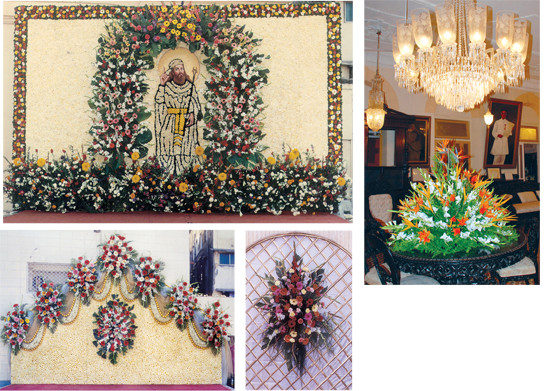
Floral arrangements executed by Khushnuma Florist (top left and far left); by Shernaaz Florist (left) and for a wedding at a private residence (above)
Some clients are so particular about their choice of flowers and colors that florists sometimes have to import them for the function. There are others though who are content with the seasonal varieties and do not mind replacing orchids with gladioli or anthuriums with gerbera, as points out Kerawalla. While carnations and roses are the other favorites, those who like their anthuriums and oriental liliums are expected to pay a higher price. The rates of flowers fluctuate depending on their supply and demand and while a bunch of roses or gerberas may sometimes be available for Rs 10, at other times may cost Rs 90.
In most cases the flowers are sourced from vendors in wholesale markets in Bhuleshwar, Parel or Dadar. While sometimes florists are required to visit the vendor they liaise with, they often place orders over the phone or indicate the choice of samples on the e-mail and can be sure of the delivery at the predetermined place and time. Assured of the loyalty of a vendor, a florist usually tends to patronize him and sometimes it is the second generation florist dealing with the second generation vendor.
In winter, when it is peak season for the florists, bad weather can occasionally throw plans out of gear when trains and flights are delayed. "At such times we have to be quick enough to switch our choice of flowers,” says Kerawalla. The trust reposed in them by their clients makes them feel obliged to pursue the next best course of action. "We are not working only for the money. Whether we make five percent or 10 percent profit is not important. The client’s function must go off well,” she adds. She vividly recalls the function for a Cusrow Baug client when due to extraneous reasons there was not a single white flower in the Bombay market…
Storage of flowers is generally not deemed necessary since vendors are willing to make the delivery on the morning at the venue itself. However some like Wadiwala Florists are fortunate to have a shop in Dadar which being open throughout the year they are able to store and sell flowers. Others may store them at their residence as does Readymoney who refers to creating airconditioned facilities at home to look after them. Some flowers are sent for two days in advance, trimmed and readied for the occasion so that they are in full bloom on the day of the function. "It is like nurturing a baby,” we learn.
The work the florists and their hired laborers have to put in varies from function to function. Usually it starts in the morning and ends before the hosts arrive at the venue. The florists are not required to supervise throughout the day because usually one of the experienced, senior workers or mukadam manages to execute the order. However, in case of bigger functions, the owners may be required to work overnight at the venue to ensure that there is no confusion in executing the nittygritties. For outstation assignments too the owners prefer to go with their trusted workers because customer satisfaction cannot be undermined.
While giving preference and good deals to customers from the Zoroastrian community, florists do undertake work for others too. A couple of them however regretfully observed that some Parsis have started patronizing non-Parsi florists who were earlier working as managers to the main florists, thinking they will get a better deal from them. When the non-Parsi florists quote cheaper rates and tell the prospective customers that they get the flowers from the villages "people sway towards them.” Actually they too get their flowers from the wholesale markets in Bombay, we are told.
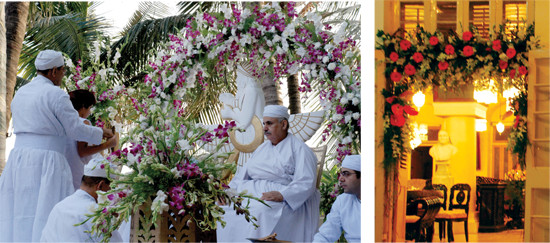
Flowers adorn the Avari navjote function in Karachi (left) and at the portals of a residence. (Below) Stage decoration by Afreen Florists
Florists like Kerawalla and her sister Soona Patel are happy with the lean period during monsoons when they get to spend time with their children which otherwise becomes difficult during the peak wedding season from November to February. Others are not happy with the lull in business. They feel the duration of the peak season which earlier would extend to April-May has now been curtailed with board and University exams starting in March. The excessive heat and vacationing abroad in summer are also the reasons frequently cited for avoiding the months of April-May.
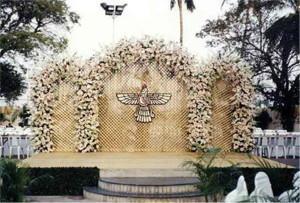
All florists are emphatic that every customer, irrespective of his/her budget, is deemed important.
Rather than cause confusion, "We always show them the sample — on the laptop,” reveals Nazneen Gamadia of Classic Concepts. They have employed seven-eight youngsters from an Event Management College for client servicing. Classic Concepts has an understanding with some five star hotels and restaurants which provide the names of organizations/individuals who have done bookings there. Their assistants then approach the clients, understand their needs, discuss the project with the three partners – Nazneen, her husband Faridoon and mother Perine Irani – and after working out the costing offer them an attractive package.
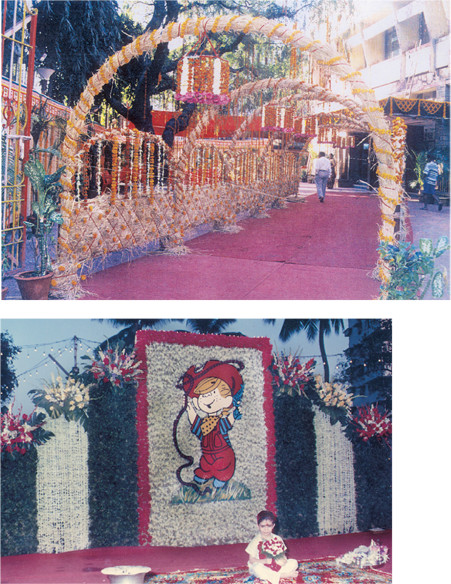
Floral decorations by Polad Caterers and Decorators (left) and by Adil Florist (below)
Irani remembers the time before she accepted assignments for weddings and theme parties when she would decorate show windows. In the mid-1960s in Calcutta the window that she did for Bombay Dyeing earned her Rs 30 every fortnight! Gradually she progressed to Christmas and Diwali decorations for big hotels like the Oberoi, Marine Plaza and the mushrooming malls, and when posters and banners took over show windows, she moved on to functions. When Nazneen too showed an inclination to join her mother they decided that exposure overseas would broaden their horizons. So after Nazneen completed her MCom she did a two-year course at the Fashion Institute of Design and Merchandizing in Los Angeles, worked there for nearly 18 months and then returned to India. Besides the décor, they were also asked to do lights, sounds, sets which became unmanageable for the two ladies until Faridoon joined them. Floral arrangements must be constituting barely 20 percent of their business, stresses Faridoon. Whether it is the launch of Dada Vaswani’s book at the Nehru Centre or a big wedding celebration in Aurangabad by the owners of the Lok Satta group, or the upcoming function at the NCPA where they will be creating an enchanted garden with gilded golden bird cages, Creative Concepts is much in demand. Since Jains are not happy using natural flowers, Creative Concepts use imitation flowers or make their own flowers with specially imported fabrics. "We do things differently,” stresses Irani.
Equally enterprising was the late Baimai J. Mehta who, at the age of 14, worked for Pushpa Milan as a salesgirl. Enjoying her work with flowers she undertook to set up a separate shop in partnership at Kemp’s Corner. Her confidence to handle independent assignments followed the floral arrangements she made for her own sister’s wedding nearly 50 years ago. Her daughters remember their adolescent years when they were compelled to go to the baugs with her on weekends during the season because she was determined that they learn the ropes of the business.
Baimai was from the generation of florists who considered it their duty that the flowers discarded after the function "né dariyé vadhtu karé (offer them to the sea),” as recalls Kerawalla. Today, florists are happiest when no flowers remain at the end of the day because it makes their job easier when they have to carry their props back for otherwise they would perforce have to dispose them in the bin.
At the start of every function the photographers vigilantly ensure that no one messes around with the decorations, but on their way home some guests have no qualms about helping themselves to the flowers. Usually, the hosts being too tired do not want the additional responsibility of carrying home the flowers and caring for them. On some rare occasions though some thoughtful hosts hire the florist’s men and entrust them with the task of carrying their flowers to their residence or some institution where they would be appreciated, reveals Kerawalla.
While some members of the community consider this ‘flower-lifting’ trait as disturbing the floral arrangements and "peekhvanu (shredding)” others question, "Why waste?” As Gamadia observes, "At functions in five star hotels, no one plucks.” But when she sees guests at restaurants like Joss hesitating to take home the center piece arrangements, she convinces them, "Please do take the flowers but not the containers!”
◆ ◆ ◆
From the archive