
Cover Story
Words worth
The fledgling Next Gen Publishing launches its seventh magazine and plans Forbes Yellow Pages in more cities
Their portfolio is glossy and goodlooking and covers everything you wanted to know but were afraid to ask about cars, bikes, commercial vehicles, homes, gardens, photography and computers! Their newest print publication is FHM (For Him Magazine) India, unveiled at a celebrity studded bash on October 19, 2007, with India’s top models presenting a designer beachwear show choreographed by ex Miss India and well-known model Mehr Jesia-Rampal. "We are happy to bring a men’s magazine like FHM to India. The FHM reader is a man who is intelligent, stylish, techno savvy, socially aware and sporty,” states Hoshang Billimoria, chief executive officer (CEO) of Next Gen Publishing Limited (Next Gen).
Owned by the Forbes Group (part of the renowned Shapoorji Pallonji Group), HDFC (Housing Development Finance Corporation Limited which is one of India’s most progressive, growth-oriented financial institutions) and UK’s Emap (among Europe’s largest publishing companies with extensive interests in radio, television and digital media), Next Gen commenced business in January 2005. "We already have 14 properties or products. We are going to grow very fast. That is our stated intent,” asserts Billimoria.
Besides their seven magazines, the all-color Forbes Yellow Pages (Ahmedabad, Mumbai and New Delhi editions) are available in print, CD and online [www.fyp.in and on any WAP (wireless application protocol) enabled phone] "Our phone Yellow Pages called Hello 45 (phone 45454545) provide information around the clock,” says Next Gen publisher Khushroo Bhadha. "In the next three years we will cover 25 cities for Yellow Pages. The emphasis will be on digital format.” The response time (for phone enquiry) is 20 seconds, but you must provide the right keyword, for example Chinese restaurant, and not just restaurant, explains Billimoria. "If we don’t know we will find out and ring you back.” For Forbes Yellow Pages, mobile phone users can type, for example, fypmum travel agency Mahim (to find a travel agency in Bombay in that area) and send an SMS to 56161 to receive the information.
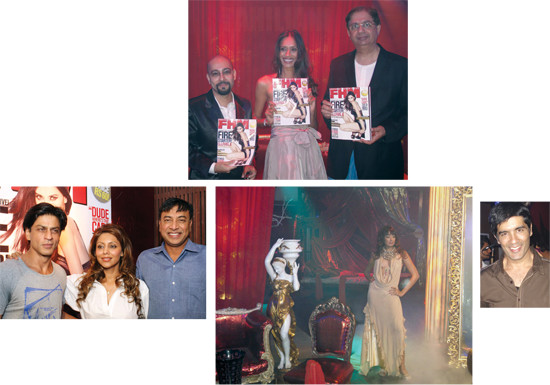
FHM's celebrity launch: (top) Hoshang Billimoria (ext right) with supermodel Ujjwala Raut (center) and Farhad Dadyburjor; above: Bollywood's Shahrukh Khan and wife Gauri with Lakshmi Mittal ; The fashion show, designer Manish Malhotra
Next Gen is also an authorized Google Adwords reseller (enabling small and medium enterprises to display their advertisements to Google users), one of just three such resellers in the country. The NDTV Profit-Car India and Bike India Awards, the Uniross Smart Photography Awards and the DIT (Digital Imaging and Technology) exposition at Pragati Maidan in New Delhi catch the public eye. Next Gen also has two BPO operations (call centers) in north India, as per its website www.nextgenpublishing.in
"Publishing is the buzzword today. With the level of literacy and education increasing in India, special interest magazines have a great future,” believes Billimoria. Newspapers and general interest magazines you read on the run, but you pick up a special interest magazine when you are relaxed so the potential to get absorbed is greater, he notes. With photography one of his passions (keeping exquisite and rare fish in an aquarium at home is another!), Billimoria is also the editor of Smart Photography which he says is India’s No.1 photo magazine. "Computer active (under license from VNU Business Publications, with Sridhar Raman as editor) is the only magazine for beginners and computer enthusiasts from age 17 to 70. It is not for software experts.”
With credible competitors like Autocar and Overdrive having a headstart on them, is it a struggle for subscriptions and sales? we query. Not at all, smiles the CEO. "Our USP (unique selling point) is production quality, content and reader interaction. We have contests, quizzes, problem solving, workshops. We were the first to separate the four-wheeler, two-wheeler and heavy vehicle segment.”
With the experienced Adil Jal Darukhanawala as editor, Aspi Bhathena as road test editor and Navroze Contractor as editor at large/contributor of the vehicular magazines, Car India (a licencee product of Emap), Bike India and CV (Commercial Vehicle) seek to make sense out of the motoring mayhem seen on Indian roads! Authoritative articles emphasize how a family of five is not fun on a stuttering scooter, or how important it is to be revved but restrained in steel and chrome monsters and not to cut corners, though rally drivers may do so! International pictorial features, technical tips, or the history and heritage of a Harley or a Hayabusa, a Dodge or a Datsun spark reader interest.
"This is a super cerebral place (to work),” enthuses Ronitaa Dubash, the young editor of The Ideal Home and Garden. "You have the creative freedom to do your own thing – from content to production to targets. Ideal Home has created its own niche, somewhere between Inside Outside and Good Housekeeping. When it comes to weddings and homes Indians spend lavishly. If you tap that correctly, there is much potential. We get letters from places as far as Assam and Kerala. It’s super cool!”
For Farhad Dadyburjor, FHM is his first job as editor. "FHM is the world’s leading men’s magazine brand and Emap’s biggest product, published in 31 editions across 43 countries,” he elaborates. "They have repositioned the magazine in UK itself. It is not just a sexy magazine. We have articles on men’s fashion, food, travel, the coolest car, the coolest suit, the coolest gizmo and of course plenty of eye candy! But there is a difference between crass and class. Ours will be a stylish men’s magazine.”
"Our people are our assets. We run a very transparent management style. Our staff (most of whom are below 40) are happy coming to work here,” Billimoria observes. Chairing the Next Gen board is Nawshir Khurody, a Cambridge alumnus who was with Tata Administrative Services, then stewarded the pharmaceutical interests of the Tata Group and retired as managing director (MD) of Voltas Limited. Among the other directors are Keki Mistry, MD of giant HDFC and a director of HDFC Bank, Infrastructure Leasing and Financial Services Limited, etc, and Jimmy Parekh who is also on the board of Shapoorji Pallonji and Company Limited.
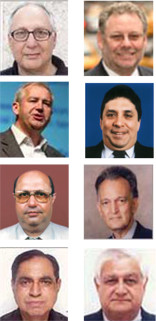
The board : (clockwise from top left): Nawshir Khurody, Chris Llewellyn, Keki Mistry, Humayun Dhanrajgir, K.C. Mehra, R.N. Jha, Jimmy Parekh, Paul Keenan
Billimoria himself has had a long stint with the Tatas. A Fellow of the Institute of Chartered Accountants (England and Wales), he worked in London in the mid 1970s with Whinney Murray and Company (now Ernst and Young). "It was during my student days in England that I took to photography in a big way,” he narrates. Returning to India, he joined S. B. Billimoria and Company ("no relative at all,” he quips) as an audit principal and was a partner in the firm from 1979-’88. He then joined Tata Sons Limited (the holding company of the Tata Group) as deputy CEO and was MD of Tata Infomedia Limited (formerly Tata Press/Tata Donnelley) from 1990.
"When I joined, the company was on the verge of becoming a sick unit and had posted a substantial loss in the previous year,” he recalls. "From 1990-2004, turnover increased from Rs 20 crore to Rs 149 crore and from a loss of Rs 56 lakhs we posted a profit of over Rs 20 crore.” When the Tatas decided to sell the company, "we (Billimoria and a few others) bid for it as a management team. But a venture capital company outbid us and around 150 of us left the company.” The idea of forming a new publishing company was broached to the Shapoorji Pallonji Group. "With his vision and stature, it took just two minutes for Pallonji Mistry (the head of the Group) to approve the idea! He is a very noble person, very low profile and he cares deeply about the Parsi community. His sons Shapoor and Cyrus are also very sweet. They are a super aristocratic family. I have the greatest respect for the Group,” Billimoria asserts.
"Many of us left Tata Infomedia together, as the new management’s style was not acceptable to us. We had posted profits year after year. We knew publishing very well. People believed in us. We got a good welcome from the Forbes Group. It gave us both freedom and opportunity,” Bhadha voices his opinion. "And we have fulfilled the shareholders’ dream. They wanted three new magazines a year. We have given them seven in two-and-a-half years! And there are more in the pipeline.”
"We have done lots of things right. In the beginning it took a while, for example, for the market to accept the new concept of separate magazines for cars and bikes. But individuals, products, mindsets change! Though we are slightly more expensive, there definitely is room to grow,” says Marzban Jasoomani, marketing manager of the automotive magazines. "I don’t work,” Rohinton Mehta looks at Parsiana with a very straight face and chuckles at our astonishment! "This is my hobby, my enjoyment. I hate sitting at home!” Mehta is the technical editor of Smart Photography with 30 years’ experience in the field, whose column "Ask Uncle Ronnie” elicits good reader response.
How does he see the future for the publishing industry in India? we ask Billimoria. Things are much better now than the horrific days of the 1990s, he maintains. "The media sector needs to be liberalized further, but there has to be a filter. The big media houses need to be controlled like in the UK, where domination in different branches (e.g. print, TV) by the same house is not allowed. This will facilitate the free and frank flow of information without any vested interest.”
The Parsis have lost out in many areas because "by and large we are straight. As for the community’s future, individually I see it as bright, as a community, diffused. It’s tough to predict. There have been remarkable success stories and that should give hope to young Parsis. Even in the current system you can win, but the struggle is great. I have had 16 very successful years with the Tatas. Their Group integrity is light years ahead of other groups and I hope it remains that way.”
Aiming to satisfy critics and commerce, Next Gen’s vision is to stand out as a leading – what’s the good word — "content generation” company across media platforms.
Award for Aava
Aava from India won the silver at the 2007 Bottled Water World Awards presented at a function under a huge stained glass multidomed ceiling at the famous Heritage Grand Hotel overlooking the Central Cathedral Square in Mexico City in September 2007. Overcoming competition from 168 multinational participants like Danone, Nestle, Coca Cola, Pepsi, Volvic, Masafi, etc from 32 nations, the first ever Indian brand to win this award despite attempts in the past was Aava, notes a write-up by Ahmedabad based Behram Mehta who with his wife Tina had promoted this venture (see "Water wonder,” Parsiana, October 21, 2006). The preliminary judging took place in London after which the awardees were announced at the Global Bottled Water Congress convened by Zenith International (reportedly Europe’s most respected consultancy in the field of technology and marketing of food, beverage and water) and Bottled Water World. This year the Congress was held in Mexico from September 12-14, 2007.
Having fortified Aava’s presence in Gujarat with a market share believed to be 50 percent, Behram Mehta is planning to make the brand national, exploring tie-ups with distribution firms, and attracting global beverage companies like Danone for equity investments. "My business is growing at 40 percent per year and it’s the right time to go ahead with opportunities,” Mehta was quoted in The Economic Times (ET) of August 27, 2007. "The Rs 100-crore natural mineral water business in India is estimated to increase five-fold to Rs 500 crore by 2011 and Mehta aims to grow (his concern) Sheelpe Enterprises to a Rs 100-crore company in the next four years from the current seven crores,” adds the ET write-up.
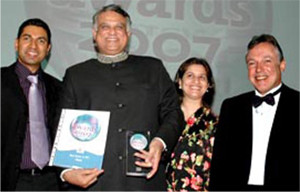
From left: Nayl D'Souza, Behram and Tina Mehta, and Bill Bruce at the Global Bottled Water Congress
Sheelpe was co-founded by Mehta in 1984 for stone quarrying and trading in chemicals and other allied products. A couple of years ago he chose to diversify by tapping the natural water resources from the Taranga Hills of the Aravalli ranges in Gujarat. Sheelpe will soon inherit technology and methods from Mexico to launch flavored water in elaichi, lime, cinnamon and other flavors.

Of the 10 companies licensed to sell natural mineral water in the country, Aava is the only one from western, central and southern India, the others being based in the north. This gives Aava the distinct advantage of serving "the entire country with equal elan. My logistics costs, especially for markets in west and south India will always be less than my competitor,” reported Mehta. Thus while Aava one liter bottles are pegged at Rs 15 in Gujarat, competitor Himalayan is priced at Rs 18 a bottle. After the Tatas bought over the Himalayan brand, its price has been upped to Rs 25. With an impressive list of reputed clients, Aava has entered into contracts with Air India, Spice Jet, Le Meridien and reportedly Air India’s first direct flight to New York carried Aava water.
Its environment friendly practices have earned Aava accreditation from the Hazard Analysis and Critical Control Point which seeks to eliminate or minimize potential biological, chemical and physical hazards to the safety and quality of foods and beverages beyond the mandatory norms set by the Bureau of Indian Standards certification. It also adheres to the International Environment Quality Standards specified by the ISO 14001-2004. Aava was the presenting sponsor at the Global Gujarat Power Summit organized by The Economic Times this year. According to the press release of October 17, 2007, "For the first time Aava will be seen on television as the co-sponsor of Sabse Bada Gujarati recording by Rajdeep Sardesai with his panel and candidates on 18 channels like IBN, CNBC, CNN, etc.” The main show was to be telecast on the evening of Sunday, October 21, 2007 on IBN7.
Parinaz M Gandhi
◆ ◆ ◆
From the archive