
Professions
Driving to success
He has driven virtually everything on four wheels from a Dodge Kingsway to a Formula One car in six continents and 35 countries, with an average of 80 to 90 cars a year. As editor of the nearly five-year-old monthly Autocar India Hormazd Sorabjee has been able to nurture his fascination for four-wheelers whilst endeavoring to make road travel easy for car owners.
Believing that there can be no adventure without the willingness to take risks, Sorabjee maintains, "Highways on India’s road network are barely two or three percent, but they account for 40 percent of the accidents! The hazards are other drivers on the road. One needs an expert team to drive. In different parts of the country, people drive differently. In the South, people are courteous in giving way, whereas in the North, the truck drivers are more aggressive; one has to leave a safety margin to accommodate the way they drive. In the hills it can be quite tiring as the progress is very slow. Road surfaces are very bad at high altitudes; they are frost-filled. Damaged, broken roads can wreck the suspension of the car!”
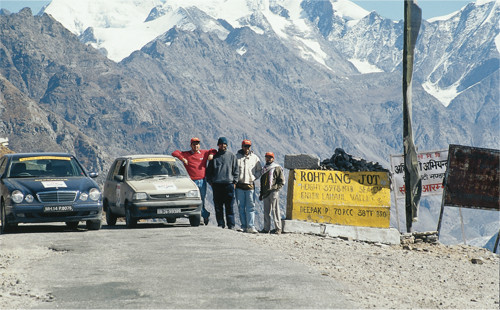
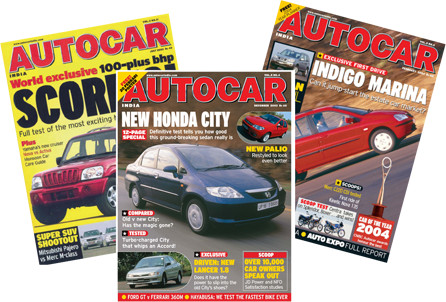
Autocar India’s forte is its road tests which are "the best in the business,” and the way the magazine analyzes cars. The team sets out on expeditions. Its first expedition called K2K from Kargil to Kanyakumari was undertaken in a bid to map the country’s road conditions from the northernmost point to the southernmost point. Says Sorabjee: "Our expeditions are based on different themes; we select cars which are relevant to the markets. For K2K we selected the Mercedes Benz and the Maruti 800, which represented the two extremes of the car market.”
Atop Rohtang Pass during the K2K expedition
K2K’s overwhelming success led the team to go on another expedition, K2K2, from Koteshwar in Kutch (Gujarat), the westernmost point of the country, to Kivithoo in Arunachal Pradesh, the eastern tip, with the objective of mapping the entire route, kilometer by kilometer. "In this expedition we took our Indian heroes, the Ambassador, a car synonymous with motoring in India for the past half century and the Indica, an indigenous car made to rival foreign automobiles — modern India at its best.” Global Positioning System (GPS) supplied by Nexgen Logistix Limited, the state-of-the-art technology for mapping roads, was mounted in the Indica: "The GPS uses satellite tracking to provide data on vehicles. As the car moves, the GPS throws up a beam, a signal, through several satellites and those satellites calculate the position and speed of the car very accurately. Auto Car U.K. was the first magazine in the world to use this latest technology. We followed this in India.” Another objective of the expedition was to determine the effectiveness of tubeless tyres which are "much safer than the conventional tube-type tyres.”
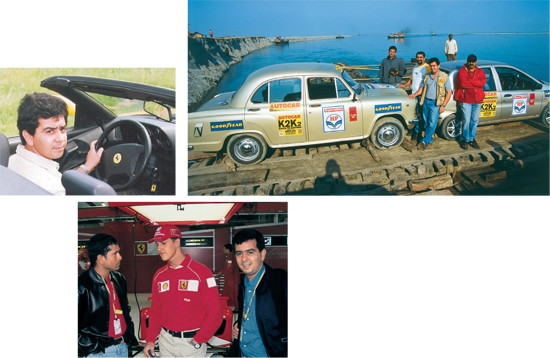
Clockwise from top left: Sorabjee in a Ferrari F355 Spyder; on the K2K2 drive; and with Sachin Tendulkar and ace driver Michael Schumacher
Each expedition lasting for approximately three weeks costs the sponsors nearly six lakh rupees. But it takes about a month’s time to plan the logistics, the fuel, the itinerary, liaising with local support, if any, informing the dealership and service centers of whichever cars the team uses, etc. The team drives from morning to evening. They avoid driving at night lest they miss out on photography, says Sorabjee, an avid lensman. These expeditions also result in higher circulation of the magazine which currently stands at 86,000, notes Sorabjee.
"Our magazine is so consumer-focused that we help people if they have any problems with the manufacturer. We tell them about the best deals in the market and give them a lot of solid, valuable information... Future Tech is a series, which is now running for 12 issues. We have also published a book explaining all the technical terms used in cars and have brought out a CD for consumers in a bid to simplify and explain technology,” states the car enthusiast.
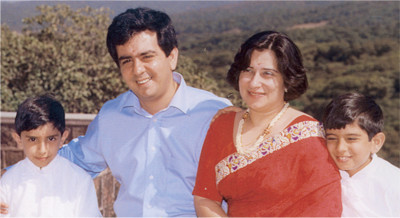
From left: Ardeshir, Hormazd, Naheed and Niki Sorabjee
Autocar India is fully owned by So-rabjee. "I was fortunate to get a license from Autocar U.K. to bring out Autocar India. Quite a few of my team members — Ajit Dalvi, Shapur Kotwal, Ellared D’Souza, John Fernandes — who were with me since the Indian Auto Journal days, joined me. We are a very dedicated and loyal team without which it would have been impossible to bring out Autocar India,” acknowledges the editor. Before he pursued his all-consuming interest, Sorabjee had wanted to make photography his career and profession. "From 1985 to 1991 I went all out for commercial photography (except fashion photography), working for advertising agencies and some clients, directly. I didn’t have any qualification and picked up the ropes on my own.” In 1986 he joined the Indian Auto Journal as a freelance journalist. A year later, after getting the feel of the subject, he became a "semi-full-time” journalist for the same Journal. Sorabjee continues: "In 1993 we started a magazine called Auto India, a part of the Business India Group. I left Auto India in 1999 when I was editor of the magazine. The same year I started my own publication...
"It was like a religion for the team to break stories way in advance of the other media. The very first issue of Autocar India showed the Ford Ikon on the cover. The car’s international launch was, after all, in India.” Both the readers and the industry supported the publication.
"We have a tie-up with Maruti to do a travel destination every month. We have also done a story on 50 best driving roads in India... Our readers, who comprise travel enthusiasts fond of cars, people connected to the automobile industry and people who want advice and tips on car buying, write to us (you can also dial 24152727 and speak to Rishad Mehta) for advice on driving destinations, for example, Bombay to Goa. We advice them on everything, to the nearest 100 m: nasty speed breakers, availability of good petrol, places where mobile phones work. This is very essential and we have gone a long way,” says Sorabjee.
Autocar India lays tremendous stress on road safety. According to the editor "there are 80,000 deaths a year on India’s roads and it’s getting from bad to worse.” In October 2003 Autocar India conducted a safe driving program in Bombay for approximately 300 students, targeting collegians and young drivers to imbibe good driving habits from an early age. Castrol promoted it and Maruti supported it by providing the cars.
Sorabjee has also been a member of the Central Asia Cultural Expedition, across Asia on the Silk Route, and has participated in many car rallies.
The adventure lover goes back to 1987 when he drove from Manali to Leh. "It was a dirt road with no facilities along the way. We were supposed to have been met by an official of Jammu and Kashmir to escort us to Leh. The official didn’t show up. We pressed on. By nightfall, we were quite disoriented. We were driving through open plains in a general direction with just the headlights to follow. We decided to stop. It was one of the coldest nights ever spent in a tin shed, sleeping at a place named Sarchu. That tin shed was certainly not enough at 14,000 ft; the temperature was below zero. I was feeling the effects of high altitude sickness: breathlessness, severe headache and nausea. There were no provisions for water and food. We couldn’t stay in that shed for long and got into the car at the crack of dawn to go to Leh where we finally met up with the concerned person. That was a bad drive. Now, of course it is a common route and there are facilities along the way. But at that time it was completely deserted.”
"Our unfriendly neighbors make it very difficult for us to get out of the country. It is impossible for Indians to drive through Pakistan in their own car,” rues Sorabjee who has always dreamt of going for long-distance drives from, say, Bombay to London.
The standing committee of Parliament on industry, chaired by P. C. Alexander, has made recommendations to the government that "no new auto players should be allowed into the country, especially in the passenger car segment and import of secondhand cars should be completely banned” as this is converting the country into a dumping ground, it was reported in The Indian Express dated October 30, 2003. But Sorabjee who is a big BMW fan, finding the car very "driver-focused” has different views: "The fact is that we produce cars, which are 20 and 50 years old! They don’t have objection to that! You can have a level playing field by levying additional taxes. But you are denying consumers access to efficient, reliable and safe cars by such anti-consumer policies...”
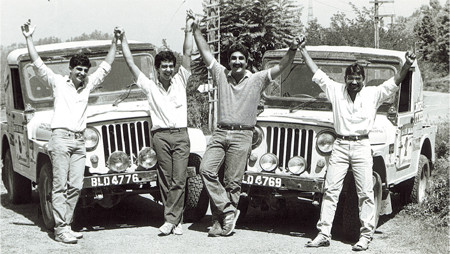
Winners of the Great Desert Himala-ya in ’88: Sorabjee (2nd from left) with Farad Bhathena (3rd from left)
Sorabjee, in fact, learnt to drive on a Dodge Kingsway and on an old Fiat at Polo Ground, Mahableshwar, when he was 12! The youngest son of Soli Sorabjee, the attorney general of India and Zena who is a member of the Continental Board of Counsellors of the Baha’is in Asia (Hormazd too follows the Baha’i faith), was born on November 4, 1963. He was a student of St Mary’s School and, later, Campion School, Bombay but when Soli got posted in Delhi as additional solicitor general in 1977, Hormazd moved with his parents and finished schooling from St Columbus. He was a mischievous child and an average student, not inclined towards academics. Towards the end of his schooling days, he developed an interest in cars and photography. He returned to Bombay in 1980 to stay with his siblings: two brothers and a sister. Sister Zia Mody is a lawyer and runs her own firm in Bombay called CZB and Partners. Brother Jehangir is a doctor, specializing in infectious diseases and is attached to the Bom-bay Hospital. Second brother Jamsheed is mentally challenged and attends a special school.
After studying for some years at Bombay’s St Xavier’s College, Sorabjee opted to drop out when he was not allowed to sit for the final BA examination due to poor attendance. He found photography more rewarding.
Wife Naheed (née Lalkaka) is a trustee of the Concern India Foundation and an assistant to her husband in managing Autocar India’s finances. She was his neighbor when he used to stay with his siblings at the Napean Sea Road house in Bombay. They had a love marriage in 1989. Elder son Niki born in the same year was named so after his dad’s hero, the three-time Formula One Champion, Niki Lauda. Younger son Ardeshir was born in 1991. Both are students of Cathedral and John Connon School, studying in Standards IX and VIII, respectively. The father does not intend to mold their interests in any particular direction. Yet, he observes: "Niki is fond of cars, but not Ardeshir who is good at debates and is very convincing, so, I guess, he may choose his grandfather’s path and take up law.”
Hormazd and Naheed didn’t have a traditional Parsi wedding. It was a wedding devoid of rituals, with the "simple and quick” Baha’i marriage prayers. Says Hormazd: "I was influenced by my mom, but it’s quite logical. I find the Baha’i faith very appropriate for modern times. Its fundamental teaching is unity of mankind. It does away with caste, creed, race and color. Baha’is believe that earth is just one country. This philosophy can really be a solution to most of the world’s problems... Dad is very accommodating and ‘cool’ about these matters.” Naheed, being a Parsi Zoroastrian, a tandarosti was also prayed. The marriage was also a registered one.
Sorabjee is all for interfaith marriages. He believes that "uniting mankind has nothing to do with religion. My siblings, too, have married non-Parsis. In fact I would even encourage my children to marry outside the community. We have to assimilate and be one homogenous society.”
Aware of the raging dakhmenashini controversy dogging the Parsi community, he maintains: "As far as the diminishing vulture population is concerned, I believe that one has to live with the times. Baha’is believe in burial because it is considered a natural process as the body dissolves back to dust. Cremation is extreme to the body and the soul.”
Hormazd is very proud of his father: "My dad has imbibed in us certain ethics and values. He is passionate about his work. There is no greed element at all. His lifestyle is very basic.” In that sense, father and son are similar. He continues: "Dad is not mechanical or technical-minded at all. He likes poetry and the arts. He is very fond of jazz, I’m more fond of rock music.”
Several cups and trophies won in rallies adorn his house. What has driven him to achieve these heights of success is the "love, understanding and moral support of my parents,” acknowledges the son.
◆ ◆ ◆
From the archive