
Zoroastrians Abroad
“Middle of the road is undefined territory”
Old ideals tempered by pragmatism is driving the Zoroastrian community in Britain
"Extremism of the right or left is dangerous. We believe in the middle path,” says Noshir Avari, trustee of the London based Zoroastrian Trust Funds of Europe (ZTFE).
A chartered accountant who hails from East Africa, Avari speaks for the large number of Zoroastrians from Zanzibar, Mombassa, Kenya, etc who migrated to the United Kingdom when those lands wrested their independence from Britain, bringing their religiosity and community cohesiveness with them. Their roots lay in the small towns of Gujarat; their fervor for India had never died. "Despite fights in the AGMs, love, understanding, regard for each other bonded the Zoroastrians of East Africa…The same attitude prevails in London…In 21st century UK we want to recreate the feeling that prevailed in the gahanbars of Navsari,” he adds.
Avari is one of ZTFE’s three trustees, the others being anesthetist Dr Firoze Munshi, and consulting engineer, former president and longtime managing committee member Rusi Dalal. Elected for seven-year terms, they hold the liquid assets of the ZTFE, bearing complete responsibility for the trust funds under the Trusteeship Act, Dalal informs Parsiana. On the other hand, the immovable property rests in the name of the association. A finance committee, comprising the trustees, the ZTFE president and treasurer and a couple of community members co-opted for their financial acumen, decides on investments, liaising with a professional broker. According to the system of checks and balances that has been established by the association the trustees do not interfere with the budgeting done by the managing committee but the ZTFE constitution ensures that the trustees and the managing committee meet at least twice a year. That’s when the committee informs trustees of the financial implications of their plans. Since the last few years however they have started attending committee meetings. "Though they can’t vote, they can attend and deliberate,” states Dalal. There was a time when trustees were appointed for life. The system changed to elected office for seven years at a time under an amendment introduced by trustee Faridoon Madon, adds Munshi. And all cheques are cosigned by any one trustee and one of the three members of the managing committee authorized to do so — the president, treasurer and honorary secretary, currently Paurush Jila, Dorab Mistry and Malcolm Deboo, respectively – Dalal describes the nitty-gritties of ZTFE functioning. Being registered under the Companies Act, the association needs to submit its accounts every year and under the Act all members of the managing committee and the trustees are said to be directors, all equally liable if anything goes wrong. "It’s never happened. We’ve never been in a position where this clause has been evoked…We’ve never faced embarrassment for misuse or mistrust,” Dalal notes with pride.
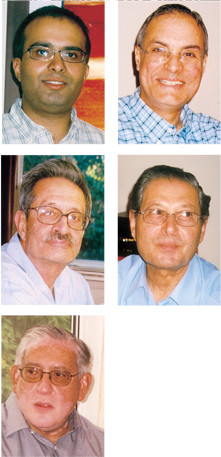
Clockwise from bottom left: Noshir Avari, Rusi Dalal, Paurush Jila, Dorab Mistry and Firoze Munshi
It is an accepted convention that no one can be a member of the managing committee and a trustee simultaneously, though there is nothing in the constitution that says a committee member or president can’t be trustee. Dalal, who was a member of the managing committee when he was elected trustee on November 26, 2006 when Kersey Jasavala chose to retire, has relinquished his position as committee member. "The question arose when Shahpur Captain had wanted to be both. As committee members we had objected. We consider that a precedent. So I’d be the last person to continue as committee member if elected trustee,” says Dalal. It does not prevent him however from sustaining all the tasks he had undertaken as member of the managing committee, attests Avari, prompting Jila to remark, "That’s the beauty of the team that my predecessors developed. Everyone is doing their bit.”
When these East Africans reached British shores in the 1960s and 70s, they were dismayed to find that the association had drifted away from the religion as they understood it. "When the association started, it had high aspirations, great leaders,” notes Avari, referring to the 40-year presidency of Dadabhai Naoroji, 28 years of Muncherjee Bhownaggree. "Before World War II when we enjoyed a privileged position in India, we came here to study, trade, establish businesses. The first meeting of the Parsis in the area was called to establish the religion. Its principal raison d’être was to promulgate the Zoroastrian faith. Yet, since the end of the War, we have failed to make a mark on the nation. The failure reached the point where Britons couldn’t pronounce the word ‘Zoroastrian.’ Hindus, Sikhs, Muslims came much later. They have built mosques, temples to the point where they have proliferated, but we became impactless. The significance of the community declined. But since 1985-86 we have become more assertive. We are not involved with community politics in India, but Khojeste Mistree changed the youth here in England with his powerful speeches. He took them to India; he lit the torch. We East African Parsis respect him for this.”
Endorsed the London born Jila: "Even when I was young, there were hardly 50 people attending functions. Now we have a toddler group of under fives, the Extra Young Zoroastrians (XYZ) aged five to 15 years who have five to six functions a year, and the Young Zoroastrians (YZ) aged 15 to 25, about 60 odd individuals, who hold superb functions with an attendance of 55-60. We are trying to rekindle the community spirit from toddler-hood because we didn’t have it when we were young, create a partnership from grandchild to grandparent with sports for the community. We had nine events last year. The activities have increased exponentially.”
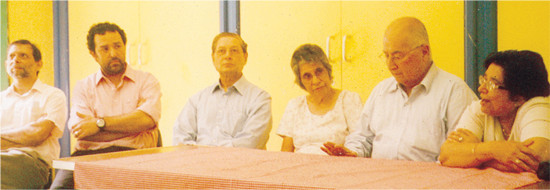
Optician Mahiyar Godrej, osteopath Daraius Cooper, consultant anaesthetist Firoze Munshi, retired social worker and vice president of the Harrow Zoroastrian Group Hilloo Daruwala, retired accident and emergency consultant Sapal Tachakra and physician Dolat Dinshaw respond to community queries on health related issues on a Sunday morning
Viewing historical events in perspective, Avari says, "Each president since 1985 has marched towards cohesiveness. Now we’ve almost come to the point where the old East African feeling is coming back. The names of ill people are being taken in the tandurasti prayers; the directory is bringing the community together. Until Rusi (Dalal) published the first directory in 1991, there was no directory of the Zoroastrians of UK.” Dalal notes that what began with 400 names has now burgeoned to 1,200.
Avari further notes that when he became a trustee in 1992, when Dalal was president, the balance sheet recorded "£ 350,000 in the kitty. Now we have 6.5 million.” He attributed the rise to donations and bequests, stating it registered "a new mindset, a change of opinion. If that continues, there are no dark clouds…It is a pity that Freddie Mercury died early. If he had lived, we would have revived his Zoroastrian faith. His kaka (paternal uncle) had been commissioner of customs in Zanzibar in British times. He was also from Zanzibar.”
"There was this feeling among Parsis in India in the past. It is now gone. But it has revived in England,” adds Dalal. Jila and Mistry are however quick to note that the current healthy balance sheet is also largely due to the generosity of Mehraban and the late Faridoon Zartoshty who boosted the collection of the local Zarathushtis to enable them to acquire the new premises at Rayners Lane, Harrow. Thereafter, the ZTFE was able to dispose of its old property at Compayne Gardens at a time when real estate prices were riding high, netting an invaluable surplus to enable the refurbishment of the new property and earmark corpus funds for its running and maintenance.
A monument in Regents Park bears testimony to Zoroastrian largesse in the heyday of Parsis during the Raj. A drinking water fountain and watering trough, it was "the gift of Sir Cowasjee Jehangir, Companion of the Star of India, a wealthy Parsi gentleman of Bombay, as a token of gratitude to the people of England for the protection enjoyed by him and his Parsi fellow countrymen under the British rule in India,” notes the inscription on the monument. Inaugurated by Princess Mary, Duchess of Teck in 1869, it is stated that the edifice was restored in 1999-2000 thanks to funding from the Heritage Lottery Fund.
Jila further notes that the old Zoroastrian House was registered for conducting marriages. "We have reapplied for the registration but because of the current (socio-political) climate, they are being selective about giving permission.”
"Is there greater cohesion, greater vitality? The answer is ‘yes!’ This is the story of the evolution of the community in London. Successive presidents have put in their best for the betterment and togetherness of the community.” People are thinking of setting up old peoples’ homes, Avari adds and cites the setting up of an Interfaith Panel in the ZTFE.
Jila is more cautious: "It is a challenge. We can’t be complacent. It is a harder task to instill (the faith) in the younger group.” He acknowledges however that participation in Interfaith has helped young people acquire a better knowledge of their own faith: "not in a huge academic sense but it can be an opportunity to go out in the larger community and say ‘We are Zoroastrians’ and that is what we want them to do.” It also helps them widen their interests and friendships, he notes, emphasizing that the ZTFE is after all, "a European association.”
The normally reticent Munshi points out to the greater priestly involvement today, a product of two decades of priestly activity that has been enormously supported and advertised by the association, as compared to the "undermining of the priesthood and its relevance after the passing of Dastur (Dr) Sorab Kutar” according to Avari. Kutar had established the Setayesh Gah at Zoroastrian House — a facility that is dear to Zoroastrian Londoners as the nearest they can get to an agiary. Avari tells us that Ervad Rusi Bhedwar, the ZTFE’s vice president and most devoted mobed, has been going all over the UK and Europe, has been invited by the Pope and recently made a trip to Brazil. More Zoroastrians are having jashans performed in their homes. "Every parab there is a jashan at the ZTFE. It is not always sponsored by the anjuman. It is the community that has got the fervor to break bread and wine with the community…The credit goes to everyone working in unison. (The Zoroastrian Centre) is not a consecrated building or fire, but it rouses that feeling when 150 Parsis pray the Yatha together.”
Avari says that in his 14 years as trustee (he is now into his third term) he has served seven presidents. "It was Noshir’s document at the end of his first term that sparked off the New Premises Project. Over that period our work load has increased so much, thanks to e-mail and Interfaith,” says Jila. "The Department of Parliamentary Affairs often calls us for discussions,” adds Dalal, explaining that the government seeks the reaction of all sections of society before introducing new social legislation; and he and Mistry have gone on record during the Eighth World Zoroastrian Congress (8WZC) in London in 2005 that they have often been summoned by the authorities in connection with asylum seekers claiming to be Zoroastrians. "Other communities have a full-time employed executive. We need one too, but we are not ready for it; maybe we’ll have one in the next 15 to 20 years… In the meantime we are proud that we have a continuous trickle of new talent,” states Jila.
Apart from these formal duties, the committee members and trustees of the ZTFE often take on responsibilities on humanitarian grounds. Immediately after the 8WZC in London, Ervad Yezdi Panthaky, a delegate from India, got a massive heart attack at Heathrow Airport just before boarding the flight home. The airport authorities and the police rushed him off to hospital where an angiography was performed even before his wife and son who were with him knew where he had been taken. On hearing about it, the ZTFE swung into action, providing immediate financial relief and provisions and Dalal and his wife Roshan, a physician, housed the family in their property while a host of others helped with transportation and commuting between the hospital and the residence. Panthaky tells the tale.
A more recent case Parsiana became aware of was when a Parsi gentleman attending a conference in London was felled by a major heart attack. The ZTFE had a week long job not only piloting the Zoroastrian body through police and legal formalities and arranging for the funeral, but working towards visas for the shell-shocked family members from Bombay and helping them cope with UK requirements.
The ZTFE committee today has three members in their thirties — Jila, an IT specialist, youth coordinator Javid Canteenwala and Mondana Mondavet, the only Iranian and a woman to boot, who is pursuing an academic career at School of Oriental and African Studies (SOAS). The ZTFE has supported her studies there from the Zartoshty Brothers Fund. The late Mary Boyce’s endowment of £1.6 million to SOAS to ensure the continuation of Zoroastrian studies together with Mehraban Zartoshty’s half a million pounds donation will ensure that there will be a permanent chair for Zoroastrian study at the School, ensure that academic interest in Zoroastrianism continues, Dalal shares the information, adding, "That’s why we have a picture (of Boyce) in Zoroastrian House.”
Though the first three Asian members of the British House of Commons had been Parsis, the community has lost political momentum. Zerbanoo Gifford, a former local councilor from the Liberal Party, had aspired to a seat in Parliament in the mid 1990s but has since withdrawn from politics. "The number of Zoroastrians even in local government has declined,” notes Mistry, adding that mayor of Brighton Tehmton Framroze, the first Zoroastrian to be elected mayor, has opted to retire. A former university librarian, Framroze did not stand for reelection even though the state had funded his entire political career, added Mistry. Filly Marawalla continues as a councilor in opposition as his Labor Party lost control of Redbridge in the local government says Mistry. "He is personally very popular. Although Labor lost, he was reelected with an increased majority,” notes Dalal who maintains a link in local politics as member of the Liberal Party. Marawalla had lost the ZTFE managing committee election in 2003. "Marawalla belongs to the extreme right. We are too liberal for him. He considers The World Alliance of Parsi Irani Zarthoshtis (WAPIZ) as too liberal!” adds Mistry. Marawalla does not consider any outmarried Zoroastrian to be a member of the community, they note. Could an outmarried Zoroastrian aspire to be president of the ZTFE now? "That would depend on the popularity of the person married out,” say Avari and Mistry.
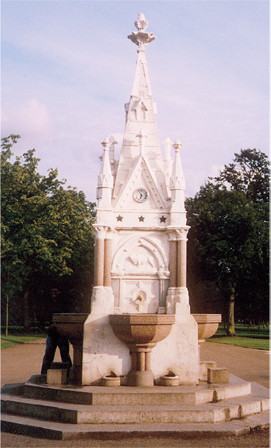
Sir Cowasjee Jehangir’s water fountain in Regents Park
The association had seriously considered putting up a consecrated fire temple since 1991. "At the end of 10 years we realized that we wouldn’t be able to maintain it because of lack of infrastructure,” admits Avari. Though they had spent a lot of money, had an architect design an agiary in the Centre’s parking lot and had formally applied for permission, they had to withdraw their application on the advice of the local council, notes Mistry, adding, "Because of the agiary, the rest of our renovation project couldn’t go through… Also, how would we explain the concept of a consecrated fire to the police (in case of an emergency)? It was impossible. It would create an unimaginable situation.”
Both the project and its abandonment had raised hackles in the community. There were those who had questioned their ability to do so. Others such as architect Kersey Moddie who pursued "a personal odyssey” felt that "their (ZTFE) efforts lacked vision and their subsequent purchase of a derelict cinema (was) ill conceived.” It may be noted here that while the Odeon Cinema when purchased had reached the nadir of its existence, it has been classified as a grade II heritage structure as a fine example of art deco architecture in London. The ZTFE, in its refurbishment, has had to work around the requirements of the local heritage committee. That the successful restoration work supervised by ZTFE architect Shahrokh Shahrokh has met with official approval was evinced on April 28, 2007 when Alderman Keith Toms unveiled the commemorative plaque in the presence of Harrow Heritage Trust (HHT) Chairman Martin Verden and other HHT members, members of the Harrow Council and other dignitaries.
"Nobody wanted the consecrated fire more than I,” notes Avari with a sigh. "But when Dorab and I had talks with the authorities, we realized it would be impractical in the UK. Jévo désh tévo vésh. Thoru ghanu bee thai tau bus (one needs to realize the limitations of the environment. One must do what one can)…Middle of the road is not a defined course. It is undefined territory…”
◆ ◆ ◆
From the archive