
Zoroastrians Abroad
ZTFE’s friends
Three outstanding academics who have helped reposition Zoroastrianism in contemporary consciousness were presented by the association with the title of "Honored Friend” on May 20, 2007. Professors David Bivar and John Hinnells were introduced by their equally exalted peers, Dr Oric Basirov and Dr Almut Hintze respectively. The late Dr Mary Boyce, outstanding teacher and researcher who lived over a spell of time in Yazd to understand the beliefs and customs of living Zarathushtis in the land of the religion’s birth, not only taught all the others but changed the academic perception of the religion. After a commemoration of Boyce’s work by Prof Sarah Stewart, her picture was unveiled at the Zoroastrian Centre by Prof John Webley, director and principal of SOAS.
Fittingly, the event followed the ritual commemoration of the late Rusi Bahadurji who passed away in January 2005. A World War II fighter pilot and war hero, Bahadurji had been seconded to the Royal Air Force by the Indian Air Force, and had taken part in over 1,000 bomber raids over Germany. Towards the end of the War, he also flew with the Occupation Force over Japan and Malaysia. After the War he had helped propel the nascent Air India under J. R. D. Tata in the international aviation world, noted former ZTFE president Dorab Mistry in his tribute.
"Stationed in London in the late 1950s, he finally settled in Richmond, southwest London in 1957 where he was to later marry and raise a family. In 1966, he joined Britannia Airways, then a pioneer in the holiday charter business, flying all over Europe. Rusi retired from flying in 1979 and spent his remaining years in more contemplative activities: photography, reading, study and prayer and the Daily Telegraph crossword. His love of flying never lessened and he attended UK air shows as often as possible and was always keen to share and explain any aspect of flying in great detail to anyone,” recounted Mistry.
A regular attendee at events organized by the ZTFE, he was said to be a keen supporter of the ZTFE’s New Premises Project. "In September 2000, when we were frantically raising money for the purchase of the new Zoroastrian Centre in Harrow, Rusi came to me and whispered in my ear, ‘I can’t help you very much at present, but I have remembered you in my will. Be sure you will receive something from my estate,’” recalled Mistry.
A saddened ZTFE learnt of Bahadurji’s bequest after he passed away on January 4, 2005 — a quiet and instantaneous death. He had allowed for a sum of £ 141,000 in his will towards the New Premises Project for the community centre and place of worship.
To remember Bahadurji on this occasion, Hinnells, who had been invited as guest lecturer, began his talk by "adding my voice of respect for Captain Rusi Bahadurji…When I was asked to give this lecture I thought something on ‘Change and continuity among British Zoroastrians’ would be appropriate in a lecture in his honor.”
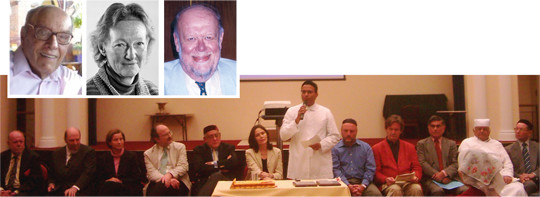
L to R: Late Rusi Bahadurji, Mary Boyce and John Hinnells. Below Porus Jila welcoming ‘Honored Friends’
Hinnells recalled the history of the Zoroastrian association in London, picking on memorable vignettes:
"The first priority was a burial ground, since Zoroastrians could not be buried in Christian cemeteries. (Thereafter it was) the study of religion with three trusts dedicated to that, something which has continued to this day. Many of the early Parsi settlers in Britain were students pursuing postgraduate studies, once the University of Bombay had been founded. When the third president, Sir Muncherji Bhownaggree started his splendid dinners or banquets and invited the rich and famous, he also invited the academic from Oxford, Prof L. H. Mills. Whereas some of our colleagues specializing in Sikh and Islamic studies have received death threats, I and other academics specializing in your history, have received nothing but support. It is a matter of great pride that with the support of the Zartoshty brothers, funds have been raised to establish a full-time post in Zoroastrian studies at SOAS, the first such dedicated post in the world…This collaboration shows what can be done when academics work with community members and is a testimony to the continuity of tradition in the ZTFE…
"Another feature of early history to have continued is the London base’s European perspective so that any Zoroastrian stranded anywhere in Europe was helped to return to India and Parsis who died in Europe were brought to Brookwood for burial. The London based leaders at the end of the 19th and early 20th century also petitioned the Shah on his European visits on behalf of their coreligionists in Iran. That continued with petitions to the Ayatollah after the 1979 revolution and with ZTFE having Rusi Dalal as international officer, organizing ceremonies in Europe. The vision is international now as it was at the outset…
"The purity laws remain strong among British Zoroastrians…One consequence of the adherence to those laws is the disputes over the presence of non-Zoroastrians at Zoroastrian funerals. This was first raised at the AGM on Septem-ber 14, 1891. From the chair Dadabhai Naoroji proposed that the correspondence should be discussed at the end of the meeting and hoped that ‘once for all it will be necessary to decide whether any persons not Zoroastrian should be admitted in our chapel at the time of funeral or not.’ It was raised again at the AGM in 1892 when it was decided that non Zoroastrians would be so admitted. But it is a debate which has continued. Another frequent focus of debate has concerned the purchase of a property. Each one has been contentious, from the first in Cromwell Road in 1919, again with the purchase of Russell Road in 1929, with Compayne Gardens in 1969 and even with the purchase of this splendid property (in Harrow in 2000). Some debates seem to keep rumbling on…”
In a way, Hinnells’ findings bear out what trustees Avari and Dalal had remarked in the course of the interview: "We are promoting change in a subtle and peaceful manner in the last 10 years. We are very focused towards the concept of peaceful co-existence. Some difference of opinion, yes, but avoiding hatred,” noted Avari. Added Dalal, "The Americans want to throw everything away, to change. We’ve preserved everything and yet brought in change…”
◆ ◆ ◆
From the archive