
Zoroastrians Abroad
An accent on youth
The new president of the Zoroastrian Trust Funds of Europe (ZTFE) Paurushasp Jila believes in inculcating community concerns from earliest youth
Paurushasp Jila, the youngest ever and first UK born president of the Zoroastrian Trust Funds of Europe (ZTFE), is out to catch members at a younger age than ever before. To supplement the Young Zoroastrians (YZ) who has been an active support group in all ZTFE activities with regular programs of its own, he is promoting the Extra Young Zoroastrians (XYZ), less than 15 years old, to attend a children’s fun club meeting one Sunday every month. It was flagged off with a separate party on December 31, 2005 when 30 children under five and 53 YZs, between 11 and 19, were active participants.
The soft-spoken young computer and finance professional was in Bombay recently with his family – his wife Marzbeen (née Todywalla), their three-year-old daughter Vahishta and son Vishtasp – to celebrate the latter’s first birthday. The celebration at Allbless Baug seemed designed to familiarize Jila with the young and old of the community in Bombay.
The 30-year-old already has 12 years of community service behind him. A member of the ZTFE house committee for six years in the footsteps of his parents, Jila has been on the managing committee over the past six years, serving with zeal as joint secretary, secretary and treasurer until elected to the presidency by fellow members of the managing committee when the popular Dorab Mistry stepped down after eight years.
Jila’s family antecedents are truly international. He tells us that dad Bomi was born in Mombasa and worked there for the Standard Chartered bank. His mother Sheru (née Sepai) had been born in Navsari but moved with her family to Tanzania. They were married in Mombasa and their daughter Bapsi was born there. After Kenya’s independence Bomi felt the need to move to a more stable environment and the family migrated to the UK where Paurushasp was born. With a totally British background and education – he graduated in computer science from King’s College, London – Paurushasp accepted the offer from investment bankers Merrill Lynch (one of 10 selected from the UK in 1997) and moved to New York to participate in their six-month training program, he says, "because they gave information technology graduates the same training as banking traders; we had to sit for the same exams.” In the upshot he missed a major ZTFE event when it hosted the Second World Zoroastrian Youth Congress. Since then he has set up his own software company and executed contracts for famous investment banks such as Goldman Sachs and Nomura and is currently under contract with the Royal Bank of Scotland.
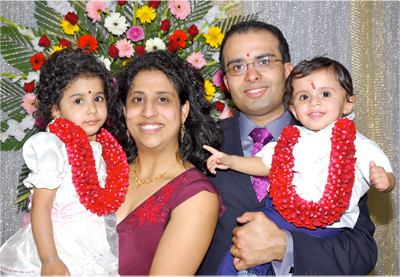
The Jilas: celebrating life
Marzbeen, with a masters degree in archeology, ancient Indian history and culture from Poona University’s Deccan College, had come to London for an apprenticeship with the British Museum when she met Paurushasp. The courtship continued at the Seventh World Zoroastrian Congress in Houston which they both attended. "I experienced my first patru (traditional feast off the banana leaf) at my own wedding!” recalls Jila. Marzbeen now runs a gallery with Indian art works and antiques for display and sale – an extension of her family’s business.
Attending Farvardian prayers at the Brookewood Cemetery since 1993, Jila says he joined the ZTFE managing committee in 1999. When he first heard of the New Premises Fund the amount was less than £ 200,000. With land appreciating much faster than the Fund, there was hardly any hope for a new building, he recalls. Yet fortune smiled when they heard of the Rayners Lane property in Harrow. The grade two heritage structure, a former cinema hall built in the art deco style, was acquired for £ 1.35 million when philanthropists Mobed Faridoon and Mobed Mehraban Zartoshty agreed to bankroll the deficit. "We were a lean, mean team,” exults Jila at the effort put in by the managing committee under Mistry to streamline the once seedy structure into the beautiful, welcoming Zoroastrian Centre that greeted delegates to the Eighth World Zoroastrian Congress. It was generally agreed, in the words of Bombay Parsi Punchayet chairman Minoo Shroff, "It is the very best I’ve seen anywhere in the world.”
Speaking of the simultaneous work on hosting the Congress Jila, then treasurer on the team, says, "We had to make it totally self-funding. We asked for previous budgets but nothing came. Also, people tend to register very late.” What saved the day for the ZTFE was that they were able to sell off their old property while real estate prices were high. The sale price helped cover the cost of renovations at Rayners Lane and as these were completed in record time, preempted much of the cost of hosting the Congress at a hired venue.
A conservative in religious matters, Jila notes happily that "most weddings are within the community, especially those active in the ZTFE.” His aim in bringing children of the community together from their earliest years will perhaps enhance this goal.
The ZTFE has also started Farsi classes this year, holding them twice a month. The earlier generation of YZs are handing over to the younger generation. Interfaith is gaining strength: "More and more schools are contacting us,” he says, wanting to learn about Zoroastrianism in Britain’s multifaith environment. "We were invited for the Diversity Week in the Home Office when representatives from all departments came to learn about Zoroastrians,” notes Jila, adding, "In July the schools inspectorate is implementing education on all faiths.”
For the first time two coach loads from the UK will go to Paris for three days in September. On the cards is an anjuman jashan and a visit to the Tata mausoleum in the Père Lachaise Cemetery. Greater interaction with Europe was what Jila had proposed in his acceptance speech at the ZTFE annual general meeting when elected to the office of president last November. The cavalcade is being organized by ZTFE vice president Ervad Rustom Bhedwar and European coordinator (and former president) Rusi Dalal.
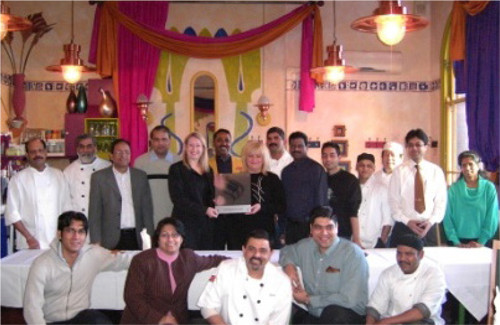
Todiwala (seated, center) with wild life enthusiasts
In response to a query on his position vis-à-vis the World Zoroastrian Organisation (WZO) Jila points to the family interconnections — "(WZO committee member) Darayus Motiwala is my fua (married to his father’s sister); (former WZO chairperson) Ruby Contractor’s son is married to my cousin!” — adding, "I’m a WZO member like Dorab (Mistry).” Jila is equally accommodative regarding the world body which Mistry had hoped to see born at the Congress: "India has to educate its people, get a view on it. We are open to discussion. If things progress, we’d be happy to facilitate, talk positively about it.”
Vulture culture
"Can you do something to help the vultures? We need £ 25,000 by the end of this year. Can you help us? The money you raise will go towards running safe breeding centers for the vultures.”
The plea, addressed to bird lovers and sympathizers around the world and more specifically the UK, features on the website — www.rspb.org.uk/vultures — of the Royal Society for Protection of Birds (RSPB).
Three species of vultures – the white-rumped, the slender and the long-billed — have declined by over 95 percent of their once estimated population of between 20 and 40 million in the subcontinental sky. Diclofenac — a painkiller benign for mammals but lethal for vultures who consume animal carcasses — was identified as the culprit by the Peregrine Fund study in Pakistan in 2003. The drug’s increasing veterinary use in the treatment of cattle and buffaloes over the past 15 years has led to the decimation.
The RSPB, working with the Bombay Natural History Society (BNHS), its BirdLife International partner in India, and a number of other researchers from South Africa and Australia, has formulated a plan to save these magnificent birds, writes Tim Webb of RSPB in an e-mail to London restaurateur Cyrus Todiwala of The Parsee and Café Spice Namaste. Todiwala has agreed to endorse the campaign noting, "These birds are perceived as scavengers but they play a vital role in environmental health by disposing of carcasses and reducing the risk of disease. For Parsis, the demise of the vulture would end a long established world faith custom.”
The RSPB has urged the Indian government to ban the drug and support the use of an alternative, meloxicam, which does not harm vultures but is equally effective in treating livestock.
Chris Bowden, who heads the RSPB’s vulture conservation program said: "Diclofenac is still widely used in India and it could be many years before vultures are safe, even if the government were to ban it tomorrow. The creation of a captive population of India’s three vulture species is crucial to make sure each one continues to exist. We have two breeding centers now and hope to establish four more very quickly to secure the future of all three species. Protecting vultures in the centers is as vital as persuading ministers to ban diclofenac.”
The breeding centers have been established in Pinjore, Haryana (funded by the UK government’s Darwin Initiative), and at the Buxa Tiger Reserve in West Bengal. Each can house 150 vultures. When the country is clear of diclofenac they, and their offspring, will be released back to the wild, notes Webb. However, vultures produce "just one offspring a year, so it will be a long haul…We may not see the same numbers again in our lifetime,” vulture program director Nita Shah told The Times of India (TOI - April 9, 2006). Adds Bowen, "Even if diclofenac is banned tomorrow, the speed of decline is so fast that the one percent left is declining at 40 percent per year.”
Dr Vibhu Prakash, senior scientist at the BNHS, runs the center in West Bengal which is housing four rare slender-billed vultures. According to him, "The slender-billed vulture is already the rarest of the species affected and nobody before us has ever attempted captive breeding of these vultures anywhere in the world.”
The initiative was given a boost in India with the premiere of renowned wildlife filmmaker Mike Pandey’s inspirational film The Vanishing Vultures, screened at the British Council Theatre in Delhi on March 16, 2006. The film is part of a nation wide campaign by the BNHS supported by Earth Matters Foundation, the British High Commission, RSPB and other international groups to raise public awareness on the vulture crisis. The film will be screened on Doordarshan in 15 languages to reach rural farmers and veterinarians, notes the TOI. The publication hopes that enough public pressure builds up to influence the National Wildlife Board, headed by the Prime Minister Manmohan Singh, when it meets on April 28.
Getting the Indian government to ban diclofenac is the immediate goal of the campaign. Though Singh directed on March 16, 2005 that diclofenac be withdrawn from the market in six months’ time, nothing has been done by the drug controller or the animal husbandry department of the ministry of agriculture, rued Shah. Meloxicam is presently only produced by two Indian companies but the drug is out of patent so Webb hopes others will soon start production, bringing the cost down. According to the TOI Nepal’s major diclofenac producer has already voluntarily switched to meloxicam.
"Today, there are hardly any vultures left. In their place, packs of stray dogs eat the dead animals. These dogs carry deadly diseases such as rabies. Both people and other wild creatures are at risk from this,” notes the RSPB website. Quoting Pandey TOI notes, "The vultures are nature’s free cleaning service. When the service vanishes, the consequences can be more far-reaching than we think. Pandey recounts how when he travelled to Gujarat, he found one village where 18 children had died from rabies due to increased dog numbers and aggression.”
The understanding of how a drug is responsible for the near loss of a once vast species of birds leads Pandey to comment, "It shows how just one chemical intrusion by man has almost wiped out one of nature’s most resilient scavengers.”
◆ ◆ ◆
From the archive