
Cover Story
A second home
A chance conversation resulted in California based millionaire real estate developer Behram Baxter financing a second senior citizens center in Navsari
When Behram Baxter of California inquired if there was place at the Bai Maneckbai P. B. Jeejeebhoy Senior Citizens Centre in Navsari for his ageing mother he was informed there was a waiting list of applicants. "Why wait?” he queried, "build a new center.”
"If you finance it, we’ll do it,” retorted Bachi Tamboly, trustee of the World Zoroastrian Organisation (WZO) Trust Funds which runs the Centre.
The brash San Diego based mill-ionaire agreed. "Once I shot my mouth off I couldn’t back out,” he says jovially.
That was in February 2003. By December 15, 2005 Baxter and his American wife Rena were in the South Gujarat town and onetime Parsi bastion to inaugurate the three-storey, 15-room center named after his parents, the Dolat and Hormusji Vandrewala Senior Citizens Centre on Pinjar Street, Malesar, two buildings away from the first center which became operational in 1998 (the two are interconnected at the rear, the first center being L shaped).
The Rs 75 lakh project (60 lakhs for the land and construction of the center and 15 lakhs towards the maintenance fund) took 18 months to complete, once the land was acquired.
"All our projects are within a time frame of 18 months,” says WZO Trust Funds managing trustee Dinshaw Tamboly. Thus all the houses constructed from donations raised by the WZO to house lower and middle income Parsis in Navsari are also completed in the same time span. Their architect is Jayant Mehta and contractor Yazdi Kasad.
"Our forte is bringing people together,” says Dinshaw Tamboly. Thus one of the conditions for residing at the center is that everyone has their meals together in the dining room. A staff of three cooks under the able supervision of the matronly Khorshed Variava dishes out Parsi delicacies to suit all palates. A daily menu is prepared and residents may write their comments on the dishes selected. The variety includes spicy, non-spicy, vegetarian (fish only), pure vegetarian (no eggs) and diabetic diets.
The staff under the able guidance of resident manager Soli Vandrewala and administrator Sharmin Tamboly are assisted by a maid on each floor (the old center has five floors with seven rooms per floor) and four maids (two for the day and two for the night). The center also arranges private domestic help for patients who can afford it and want it.
The center is for mobile individuals, state the Tambolys. If residents become bedridden they are shifted to the Abuwalla Parsi Infirmary run by the Navsari Samast Anjuman in a quaint period house with a modern extension at the rear. Two plaster lions on either side of the Infirmary gate guard the entrance.
The Infirmary’s extension was built by the WZO through funds donated by the Bai Maneckbai P. B. Jeejeebhoy Deed of Settlement Fund on condition that the center’s inmates who are unable to fend for themselves be housed there. The Infirmary, with its substantial grounds, can accommodate 80 inmates but at present has only 30 occupants. The Nariman Old People’s Home in Su-rat reportedly also has spare capacity.
Genesis
The idea for a senior citizens center (the Tambolys refuse to use the term ‘home’ as they believe it has a negative connotation) germinated when a Parsi working in The Central Bank in Bombay kept talking about buying a small cottage in Navsari after retirement.
Dinshaw Tamboly mulled over the idea and "saw merit in it…We didn’t want to create another infirmary.” This would be a place for senior citizens who would opt for the confines of a small town like Navsari to "avoid Bombay’s congestion… We wanted a mobile, vibrant home,” says the trustee. Bachi and he approached Scylla Vatcha of the Jeejeebhoy trust who had the funds at her disposal and favored the idea.
Vatcha laid down three conditions. The center must be in a Parsi moholla (locality), near a fire temple and a bazaar. A home belonging to the Bhote family who had migrated to the UK met the requirements. As their ancestral place was being used for a "good cause,” they agreed to sell. The deal was finalized in 1996 and the center came into being in 1998.
The fees are levied depending upon the resident’s capacity to pay, say the Tambolys. The Jeejeebhoy trust provides a subsidy. At first the fee was Rs 1,000 a month but this was "not viable,” says Dinshaw Tamboly.
It was raised to a maximum of Rs 3,000 but even at that rate, each and every resident is subsidized, he adds. The cost works out to Rs 3,500 to Rs 4,000 a month. Deanna Jeejeebhoy, then with the Sir Ratan Tata Trust, visited the center and was sufficiently impressed with its functioning to recommend the Tata trust give a grant of Rs 2,000 a month per resident which they have been doing over the past five years.
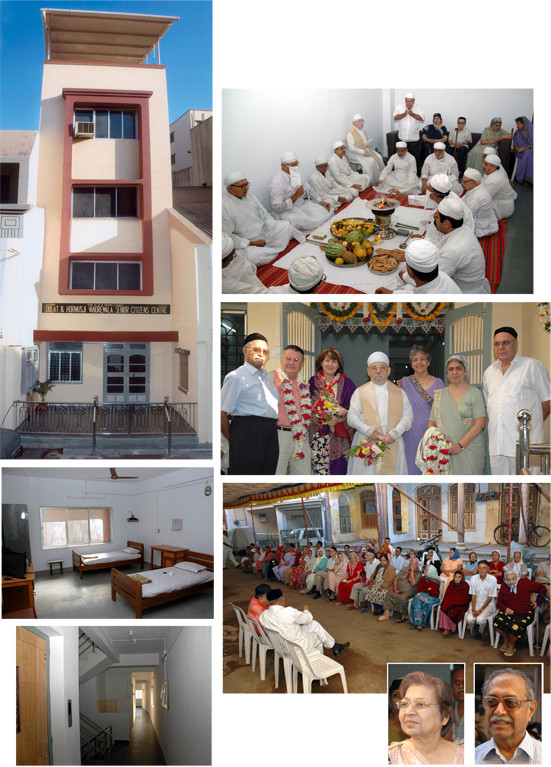
Top left column: New Centre: furnished room and landing Right column: Jashan (standing, Farrokh Kasad, seated on sofa holding stick Firoj Panthaky), Dastur and Mehrbai MeherjiRana ( in sari holding flowers) flanked by the Baxters, Tambolys and Captain
Photos courtesy Sarosh Daruwalla, Mazda Audio Video Labs ; Above: Centre residents and others at the inauguration
Bottom right: Former WZO (London) chairpersons Ruby Contractor (left) and Shahpur Captain
This largesse has enabled the center to do more for the occupants, say the Tambolys. The residents are taken to Udvada twice a year with a one week stopover at the WZO sanatorium at Sanjan as well as outings to the beaches at Ubhrat and Dandi. Yoga classes have proved exceedingly popular, with an instructor, Deepa Patel attending thrice a week. The residents do whatever asanas they can. A physiotherapist also teaches them exercises. People come from Bombay to deliver talks and columnist Ruby Lilaowalla lectured and sang songs for them. "We want the residents to feel they are part of an extended family,” says Dinshaw Tamboly, "not as though they were commercial residents.” The Tambolys who reside in Bombay make it a point to visit the center once a fortnight for three to four days. First cousins, Bachi was brought up and educated in Navsari and the couple has an apartment in the town.
Amongst the other senior citizens homes, Dinshaw Tamboly says the one at Deolali financed by businessman billionaire Pallon Mistry is "very beautiful.” The residents are housed in separate cottages. The Parukh Dharamshala in Bombay run by the Bombay Parsi Punchayet (BPP), of which Tamboly is a trustee, has a capacity of 100 residents, some of whom are bedridden, he mentions. The residents are also discouraged from going out of the premises to safeguard their existence. (In Navsari the BPP has two high rise residential cum-commercial buildings plus a large plot of land, given by Ratanbai Bamji sister of Jamsetji Tata to the BPP.)
Despite some of the senior citizen centers not functioning at full capacity, Tamboly believes more centers will be required "purely from the demography angle.” Around 31 percent of the Parsis in India are over 60 years. The Cama Convalescent Home in Bandra is also contemplating setting up such a center, while Pallon Mistry is financing a senior citizens’ home on the B. D. Petit Parsi General Hospital grounds, the construction of which is well under way.
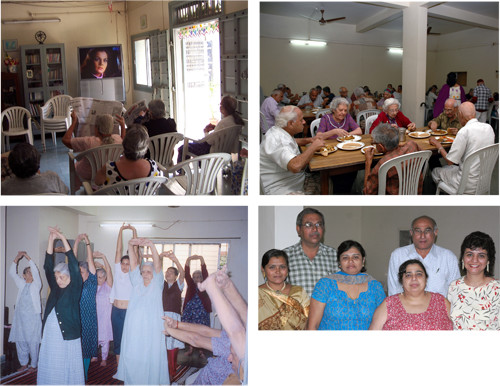
Clockwise from top left: Recreation hall at Jeejeebhoy Centre; dining room; Centre staff (L to R) Sarosh Guzder and Soli Vandrewala (behind), Nirmala Dhimmar, Bapsy Daruwalla, Khorshed Variava and Sharmin Tamboly; yoga session in progress
Will the Bombay centers draw people away from Navsari? wonders Bachi Tamboly. Compared to Navsari, Bombay is more impersonal with a hectic pace of life. Navsari, depite its chaotic unplanned growth, crowded narrow streets and diesel fumes, still has an old-world charm. But quaint old structures that should be valued and treasured are ruthlessly pulled down. (Dadabhai Naoroji’s home lies in disrepair with the Hindu family occupying it complaining about the leakage and the lack of funds to repair the structure. Tamboly is trying to interest some Parsi trusts to acquire the home which is for sale and turn it into a museum.) Much of the new construction is stated to be illegal.
Most of the 4,000-strong Parsi population in Navsari is "elderly,” says Dinshaw Tamboly. Mills and factories have shut down and many residents commute to nearby Vapi or Surat to work. But Navsari serves as a shopping center for the surrounding villages, says Bachi. Thus the streets are lined with countless shops that gave the city a certain vibrance.
With no public transport except auto rickshaws whose meters are dysfunctional, many locals opt for two wheelers, adding to the pollution, states Sarosh Guzder, assistant manager of the Centre.
The WZO Trust Funds have financed around 40 auto rickshaws for Parsis in addition to chemists’ shops, a motor garage and a foundry. Bad debts are less than five percent, says Dinshaw Tamboly.
The active trustees of the WZO Trust Funds, the WZO Trust and the WZO Women and Children Trust are the two Tambolys, Firoj Panthaky, a former conservator of forests in Gujarat and affluent agriculturist Farrokh Kasad.
Baxter’s backing
It was when visiting his friend Rumi Sethna, former president of the WZO, that Behram Bax-ter first came to know about the senior citizens center in Navsari. His 93-year-old mother who resides in Canada wanted to return to India in order to have her body consigned to a tower of silence when she died. Baxter who had migrated from Bombay to the West in 1967at the age of 24, moved from Toronto, Canada to San Diego, California after almost 18 years on account of the weather and because he believed the "grass was greener” in the US.
A "mischievous” and "very independent guy,” Baxter "hated” Navsari, the town where he was born and raised. His father, an agriculturist who also owned a flour mill in Bombay, could not monetarily afford to send his rebellious son to college in Bombay so instead Baxter did a technical course in air conditioning and refrigeration at the Victoria Jubilee Technical Institute (VJTI). The family’s surname is Vandrewala but Baxter disliked the name as his school mates mocked it. Since he had started his working career in Bombay with a man named Dadi Baxter he decided to expropriate the name once he had migrated to Canada. He started his own air conditioning and refrigerator business in Colaba taking some of Baxter’s clients with him. "He hated my guts,” says the congenial entrepreneur, laughing.
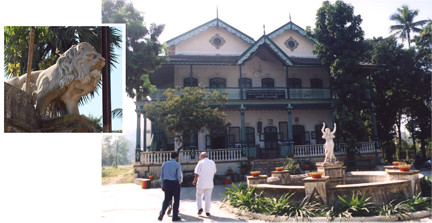
The Abuwalla Parsi Infirmary (top) with lion at gate (inset)
But Bombay could not hold the young businessman. In India in those days the waiting list for a telephone or a car was 10 years. A flat would not be affordable in a lifetime. He migrated to Canada believing, as always, "the sky was the limit.”
"I was a very good salesman. I’m good at getting business,” he says. And he always wanted to travel. Life in Canada was tough initially. Baxter faced discrimination. "Everywhere I went for a job interview they said they wanted some Canadian experience. How the hell can you get that” when you are a fresh migrant? he queried.
He finally landed a job with Westinghouse. But the entrepreneurial bug was strong in him and when he observed another Parsi in the real estate business he decided to take the plunge. "I said if he can do it, why not me? I’m a risk taker.”
In the first eight months he was unable to close a sale. If there were legal or technical hitches a business acquaintance recommended he keep aloof. That was a mistake, recalls Baxter. "I had to figure out how to solve the problem – work with the buyer and the lawyers.” Almost penniless, with no money to pay the rent, he lived on his credit card borrowings. His first break came when an Italian buyer, Roy Vespi, dithered over buying a plot because it abutted the highway. He thought the noise of the traffic would be a deterrent to finding customers. Plus there was a $ 50,000 gap between the price he offered and what the sellers wanted. The Canadian tax laws were to change on January 1, 1972. If the sale didn’t go through, Vespi would lose out on the existing tax breaks.
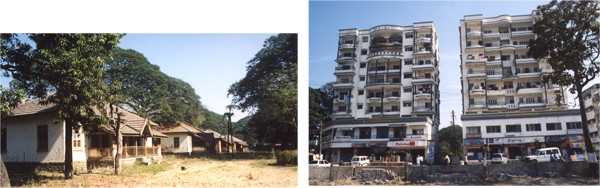
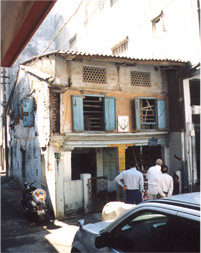
Above: Dadabhai Naoroji’s home. (Right and below) BPP buildings and cottages on land donated by Ratanbai Bamji
When he didn’t hear from him, towards the end of December Baxter phoned saying he had been in the shower and had Vespi called? ‘No,’ replied the prospective buyer. His bluff called, Baxter said alright and was about to hang up when Vespi asked, "So we can’t make a deal?” Baxter jumped at the opportunity. He foresook $ 15,000 of his commission, convinced the seller to accept $ 15,000 less and the buyer to shell out $ 15,000 more, and closed the deal on December 29. He earned a commission of $ 15,000. At that time a year’s salary was $ 6,000 to $ 8,000, he recalls.
Baxter made a million dollars in commissions the next year and never looked back. From brokering deals, he started to invest in property. First came a car wash, then a motel and by the time he left Canada after around 18 years, he owned 500 apartments!
His latest deal is a $ 400 million joint venture to develop and sell condominiums. But success comes at a price. With a fluctuating real estate market, timing is crucial. Baxter went through a divorce and suffered two heart attacks.
Does his family worry about the risks? "I never tell them. They give you advice without having any experience in the business,” he replies.
Baxter who has a 21-year-old daughter, Farah, from his first marriage to Zarine, studying at Boston University, says there are around 200 Parsis in the San Diego area but no association. He feels the community should invest in property only if a portion of the property can generate an income.
He believes the new community center coming up in Toronto is "not splitting up the community.” People can go to both centers he says noting that it can take up to one-and-a-half-hours for some to reach the existing center. The Baxters find the Parsis in North America more reserved and aloof than their counterparts in India.
His wife Rena, "loves Navsari and loves India.” She finds the Parsis in Navsari "more humble, more genuine.” She refers to one of the residents, Dhun Patel who loaned her a scarf for the 8 a.m. inaugural jashan presided over by Navsari High Priest Meherji Kekobad MeherjiRana. "When I went to return the scarf she said it was for me to keep… when you have nothing, this is literally like giving the shirt off your back.”
◆ ◆ ◆
From the archive