
Poonawalla at the pinnacle
With a fillip from chairman Zavaray Poonawalla, the Royal Western India Turf Club will introduce night racing and host the Asian Racing Conference in January 2016
 "I want to see the world recognize an Indian horse,” emphasizes Zavaray Poonawalla, managing director of the Poonawalla Stud Farms (PSF) and current chairman of the Royal Western India Turf Club (RWITC). For him, horses are not merely "a passion, but an obsession,” he smiles indulgently during the Parsiana interview at his imposing manor in Poona on November 5, 2015. The only time the publicity shy businessman likes to be in the limelight is "when my horses do well, particularly internationally,” he admits.
"Over the decades I have actively and financially taken upon myself many essential and progressive initiatives at the Bombay and Poona Race Courses such as tracks, railings, stabling, grand stands, paddock areas, gardens, photo finish camera… Introduced/constructed and financially supported projects like the All Weather Race Track in Bombay and the All Weather Working Track and the Monsoon Race Track in Poona,” he lists his little known contributions. "I believe I’m relatively simple and don’t necessarily need to hold a chair to show what I am,” says Poonawalla who is content to work behind the scenes. His elder brother Dr Cyrus was RWITC chairman in 1995 and 2006.
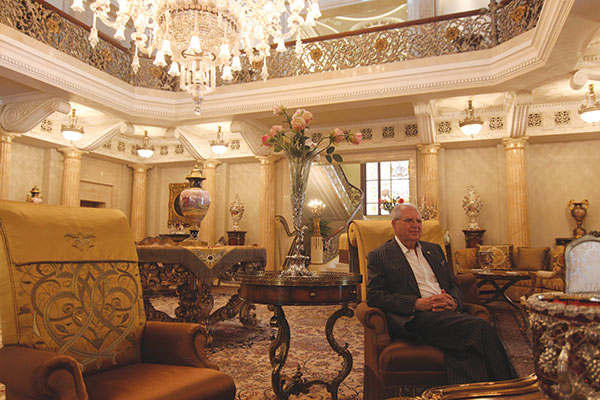
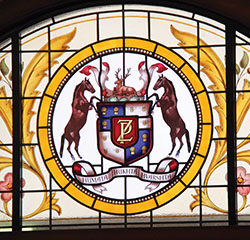
Zavaray Poonawalla at his residence; (above) crest
Photos: Jasmine D. Driver
Persuaded for the last several years that the "Poonawalla passion” for the sport should translate into a proactive role at the RWITC, Zavaray finally "took the jump reluctantly” and was elected chairman in September 2015. Among the dreams he would like to set in motion before his 12-month term draws to a close are "to clean up racing as far as possible so that the confidence of the public is gained and the sport can flourish.” He realizes that whenever any sport has money tied up with victory it cannot be absolutely clean but so long as there "is no personal agenda” it can run a smooth course.
"To see the racecourse look prettier” is also among his priorities although he is aware that he has had "the misfortune of becoming chairman when the anticipated annual losses of the Club could be Rs 20 crores.” Housekeeping and cleanliness will be given due attention with the support of his wife Behroze. Whilst they survive by hiring out their grounds for weddings, the committee realizes the need for "new, innovative ideas” to augment their income.
Yet another project Zavaray is keen to pursue is "night racing in India …to bring in a completely new dimension and crowd since racing under floodlights will be a new scenario.” He hopes this event which will commence next month will be "a game changer” to attract young couples seeking fun and frolic. Realizing the need to "put in money where my mouth is,” for the project costing Rs 10-15 crores, "as a measure of encouragement my personal contribution will be between one crore to one-and-a-half crore rupees.” This will reportedly be the biggest personal contribution to racing in India. Zavaray is excited that the monogram for night racing will feature PSF’s Mystical whom he considers "the pride of India… the real brand ambassador…” Horse of the Year 2005-06, Mystical had created an international sensation when he won at the Dubai International Carnival in 2007.
Zavaray looks forward to the five-day Asian Racing Conference from January 24 to 29, 2016, more so since it was last hosted by RWITC 21 years ago when Cyrus was chairman. The Asian Racing Federation being the apex body of racing and breeding in Asia, the Conference will see attendance from 500 to 700 delegates. After full day educative sessions on the management of horse breeding, training, medicine, and exposure to Indian racing, the gala evening programs will include a Bollywood night, western entertainment and even Parsi bhonu. On the last day the delegates will be treated to luncheon and a visit to the PSF, Zavaray gives an overview.
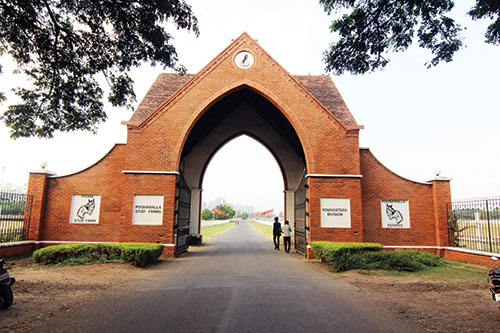
Entrance to the Poonawalla Stud Farms in Hadapsar Photo: Jasmine D. Driver
With the lease renewal for the Turf Club property awaiting clearance from the Bombay Municipal Corporation, Zavaray is set to "approach the government and give it a best shot.” He would also like the government to reduce taxation on the rationale "if they understood what racing and betting is all about, it would bring huge funds to the exchequer.” As he further explains, although Indians are known to be gamblers, official gambling is extremely low due to high government taxes. Currently RWITC has 1,927 Club members with voting rights and 4,489 Life members.
The chairmanship of RWITC is consuming a major chunk of his time presently "from morning to night, neglecting my own business and my family. Now that I have taken it up, I have to finish it. Taking people with you on the nine-member committee” is a challenge with every item that comes up for discussion dragging indefinitely.
Introducing a Code of Conduct for the RWITC "was a necessity because elections should be based on pure merits of the individuals and not parties and gifts. This is something I felt perturbed about and the reason why I didn’t stand for elections in the past,” mentions Zavaray to whom soliciting votes was anathema. His contribution to the world of racing being well known, he felt he "should be requested” to join the committee. His friends convinced him to realize the futility of his idealistic approach, saying, "You are being too much of a bawaji and in this present world you cannot have your way.” Ultimately Zavaray penned a letter to the members stating, "If I am worthy in your eyes you can support my cause…”
Whether voting rights should be restricted to those who attend a certain percentage of races in a year is another "very ticklish and extremely debatable” issue vexing the committee. "Legally it is not possible but I would like to see members who vote take direct interest in racing,” commented the chairman.
Security and vigilance is strict at the Turf Club. Yet, an accident to a race horse invariably gets highlighted in the media, more so if it has to be put to sleep as happened recently after the Poona Derby in October 2015 when Continental, collapsed just 50 m from the winning post, fractured a leg and had to be put down. The winner Bull Run too almost collapsed. "Whether a horse or a sportsman trips or collapses, these are rare accidents that happen in all sports,” points out Zavaray. Whilst factors like high temperature, intense competition and long races may cause injuries to horses, the treatment and comfort options have to be weighed keeping in mind that a horse stands on its feet for 24 hours, whether awake or sleeping. If a horse fractures its leg severely, the veterinarian examines whether painkillers or surgery would cure its injury permanently, or whether humane euthanasia is a better option. They also have to guard against conditions like laminitis, a tenderness of the tissues around the hoof, which can be a crippling disease prompting doctors to recommend a merciful death.
Officiating as chairman of the Stud Book Authority of India, Zavaray explains that this institution which functions with "the highest level of integrity” maintains a meticulous record of every horse born in India and can trace equine lineage from 1734.
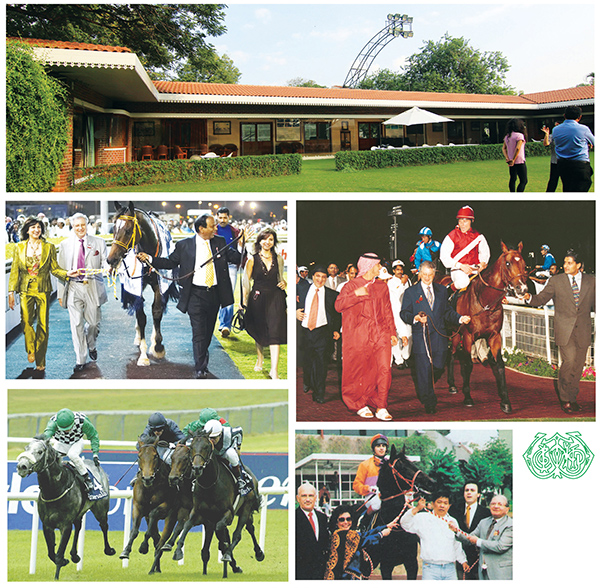
Before Independence, "it was only the British, the Maharajas and the Parsis in India” who took an interest in racing, says Zavaray. His father Soli started The Poona Stud Farm in 1946 with approximately a dozen mares and one stallion. Although Zavaray and Cyrus had been taking an interest in the Stud Farm from the 1960s, "it took over 40 years for the Farm to win its first Indian Derby in 1987-88.” The Horse of the Year Cordon Bleu who won the race has been immortalized with an etching on his tombstone at the PSF in Hadapsar on the outskirts of Poona. Exhilaration and Astonish are the two other Indian Derby winners from PSF to be given the same privilege.
Astonish, in fact, even has a room at the Equine Viewing Gallery in Hadapsar dedicated to the thoroughbred’s memory. To Astonish goes the credit for blazing a new trail as "India’s first post-Independence commercial export.” Owned by Hong Kong based Rusy and Purviz Shroff, at his international debut, the Indian Triple Crown winner and Horse of the Year 1991-92 won the first place through a Class I field at Sha Tin, Hong Kong.
Twelve times recipient of the Indian Champion Breeders Award, Zavaray has also been conferred the Hall of Fame award, the Rajiv Gandhi Excellence Award and the Vijay Shree for his contribution to equine breeding, animal husbandry, family planning, welfare and socioeconomic activities. The reticent Zavaray may not elaborate on his personal accomplishments or his many unknown deeds of philanthropy. He does though take pride in declaring how their Stud Farm was able "to open the floodgates for Indian thoroughbreds and show the world that we are there. That’s my most cherished achievement…”
When Mystical won in Dubai in 2007, the Prime Minister of UAE Sheikh Mohammad Bin Rashid Al Maktoum had commented, "For a horse to come and win in the International Carnival it is good. But for a horse to win two in a row is quite something.” As recalled Zavaray, "He took the defeat so sportingly and even offered me a memento” — to mate a Poonawalla mare with any of his stallions across the globe, free of cost. Mystical’s win had also been reported in The Irish Field, Dublin: "If anyone suffered from the illusion that European horses were better than those bred elsewhere, the Dubai Carnival must have been a rude awakening. The latest affirmation came when Indian champion Mystical won…”
The Trophy Room at the Poonawalla Manor bears testimony to the toil and triumphs experienced by the breeders. Winners of nine Indian Derbies and 68 Indian Classics, PSF is the highest stakes earning establishment in the country with over 537 home breds earning stakes in excess of one million rupees, states their website. Introducing us to his treasure trove, Zavaray shares with us the legends associated with some of the cups and memorabilia that he lovingly and respectfully handles. Also given pride of place in this room is the saddle on which jockey Ryan Moore rode Mystical to victory.
At the PSF in Hadapsar which houses the youngstock division, Mystical continues to enjoy a privileged position as do other horses who are assured acres of natural grazing grounds with additional inputs in the form of lucerne grass, oats, feed balancers. They have 140 broodmares and three stallions who contribute to the breeding section at their second farm in Theur, near Poona. The paddocks segregate the youngstock depending on their age (weanlings/yearlings) and sex. Whilst the paddocks give the horses ample space to frolic, a specially laid out track familiarizes them with racing conditions. They are permitted to race on the tracks only once a week for at each race a two-year-old horse weighing around 450-500 kg may lose eight-10 kg of weight, mentions one of the veterinarians Dr Amit Patil when showing us around their Farm at Hadapsar. Specially erected walkers accommodate 12 horses at a time to give them regular exercise. Every week each horse goes on a weighing scale to ensure his/her weight is in check. A special stack of grass, known as bedding, permits horses to stretch their ligaments when they feel the need.
Once a month the dung sample of every horse is tested in the laboratory at the Equine Clinic on their premises. Sonography, endoscopy and x-ray machines help diagnose medical problems instantly. Horses are taken to the colic boxes at the first hint of any discomfort to help the veterinarian on duty give immediate medical attention before it can lead to any major complication. Those sick and injured are kept in stables for separate medical attention. Shaping of hooves is undertaken at the farrier room. There is auxiliary training equipment to discipline horses. And attending to this brood day and night are a band of committed and vigilant carers. No wonder, a horse that bespeaks Poonawalla pedigree carries a premium and their Equine Gallery continues to draw the best names in the world of racing to their sales arena every year.
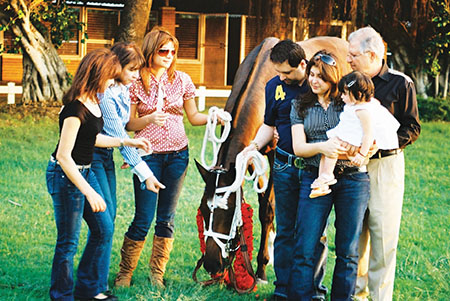
Poonawalla family (from left) Simone, Behroze, Michelle, Yohan, Delna, Tania and Zavaray with Mystical
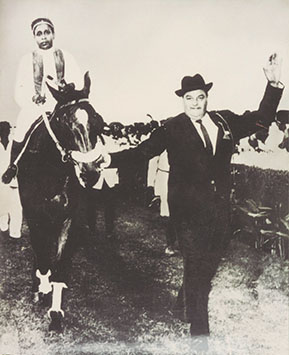
Soli Poonawalla
Beyond the steeds
As president of the Poonawalla Group, Zavaray takes an interest in all the other companies managed by the Group. Besides being co-founder and director of the Serum Institute of India Limited, one of the largest manufacturers of vaccines and other immuno-biologicals in the world, he is director of Intervalve (India) Ltd, manufacturing butterfly, ball and check valves, El-o-Matic (India) Pvt Ltd, manufacturing pneumatic actuators, and Poonawalla Financials Pvt Ltd. He takes keen interest in real estate with a sizable land bank and commercial establishments that he has acquired over the years in Poona, Bombay and London.
His son Yohan looks after the engineering, estates and finance businesses in the Group. Under Yohan, the Poonawalla Group has diversified into the hospitality business by acquiring a stake in a UK-based hotel, Grayshott, promoted as a luxury spa in Surrey, as notes the Group website. One of his twin daughters Simone is manager, Youngstock General Administration at PSF, having studied equine management in Australia and Ireland. Her twin sister Delna is an independent fashion designer. "Behroze is our backbone. I don’t think we would have been able to achieve anything without her,” acknowledges Zavaray.
An alumnus of The Bishop’s School and Wadia College in Poona from where he graduated in commerce, Zavaray says he wanted to be a veterinarian but his father dissuaded him. Music and gliding, which once used to preoccupy him greatly, have now taken a backseat although strains of fluted music greet every visitor to their home.
The community’s zeal to produce more children does not find favor with him. He actively propagates that youngsters should marry and procreate when they are ready and not succumb to social pressure. What is the point in producing more children if you have to stay in a one bedroom flat and cannot ensure quality of life? he wonders.
Proud to belong to this "grand community,” he admires "the Parsi stalwarts” who created a reputation for "the minuscule minority existing in India. It is pleasing that all communities still look up to us.” He does though express his "extreme disappointment that in the last 100 years it has been continuously deteriorating. Our youngsters should be more ingenious and should not be disappointed with the present atmosphere or we’ll continue to go downward.” Sad to see "the fighting in the community… and the acrimony everywhere,” Poonawalla observes, "We only argue and fight.”
Happy to unwind in the company of "nice, simple, genuine friends,” Zavaray states, "The rest are acquaintances.” When asked whether his intimate group constitutes Parsis, he responded, "Nearly all. Birds of a feather flock together. We equate with each other. Everywhere in the world you see that happen.”
Fulfilment for Zavaray does not come with "material things,” but the family’s many acts of charity like the Zavaray Poonawalla Cancer Building at the Ruby Hall Clinic, The Gool Poonawalla Jogging Park in Salisbury Park named after their mother and The Soli A. Poonawalla Memorial School as the New Modern Education Society’s primary school is known. Another deed for which Zavaray continues to be associated is his spontaneous gesture to fly back from Bombay when his long-serving faithful driver suddenly collapsed at the wheel in Poona. Zavaray decided that the funeral bier be carried in a Poonawalla car and insisted on steering the vehicle on its final journey to the crematorium.
In favor of cremation for Parsis too, Zavaray feels that prayers should be permitted for those opting for this mode of disposal and non-Parsi friends should be allowed to attend the obsequies. "So long as the sanctity and cleanliness of a shrine is not violated, there should be no restrictions” on praying at one another’s temples, he believes.
"Religion has only caused bloodshed. I hardly believe in religion. In fact I discourage it,” he asserts. Whilst he goes to the fire temple once a year on New Year, he is convinced that "Depending on God will get you nowhere. Hard work and goodness help more than prayers.”