
Comment
Pause and applause effect
“Please explain,” pleads a confused clapper
Maestro Zubin Mehta may squirm but can any erudite Parsiana reader please explain to me the proper code of conduct at western classical music concerts — especially the pause and applause riddle?
Be it Bombay or Sydney, I am always out of sync. When I clap after a superb musical movement, every one stares at me as if I am an unenlightened soul who should be locked up. When I don’t, I am labeled a subhuman species who cannot appreciate good music.
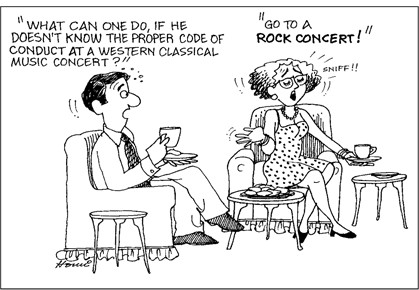
I remember when the famous Parsi pianist Zenobia Vakil-Patel was in Sydney in March 1987, she was disgusted with audience clapping during pauses. When she mentioned this during a reception held in her honor by the Australian Zoroastrian Association, I could not look at her in the face. But how would anyone but a classical music scholar know for sure whether it is the end of a movement or of the symphony? Is a music lover expected to be a music aficionado? Or adopt a follow-the-leader policy which takes enjoyment out of the concert?
I have classified music as eastern classical, western classical, the oxymoronic modern classical, jazz, rock, pop, blues, reggae, devotional, film, Bollywood, Japanese…
Call me an ignoramus but to me there are only two categories, good music and bad music. Go east or west, sitar or violin, classical music is always good — nay divine. Jazz, rock, Bollywood and pop could be uplifting or annoying depending on your taste while modern classical is mostly metallic noise.
Melodic harmony is good, noise bad — as simple as that. Now to some ignorant questions:
Why does clapping offend during a pause but coughing does not?
Have there been instances — heavens forbid — when a conductor or the first violinist had an uncontrollable bout of coughing in the middle of a concert or the wig of a pianist came off when bowing over-enthusiastically for the third encore?
Has a conductor ever rushed to a compulsive and out-of-tune clapper, brandishing his baton in fury?
In my defence, how would I know when the music stops after a heart-stopping climax that it is the end of the symphony or the dreaded pause? Should there be play cards held prominently by a timpanist (who has little to do anyway) to indicate what the break in music is for — one signaling "Pause, you may cough;” the other, "Finished, now applaud?”
In sports, spectators stand up and cheer spontaneously after Roger Federer hits a scorching smash at Wimbledon or Sachin Tendulkar skies a towering six into the Members’ Stand at the Wankhede Stadium. No one waits until the set is over or till lunch break to cheer.
A comedian would be offended if the audience would not laugh instantaneously at his/her jokes but wait until he finishes his routine and then break into hysterical laughter and guffaws. Even worse, he’ll get suicidal if after a deliberate pause following a terrific double entendre, the crowd would clear their throats or sneeze and not chuckle or chortle.
Let’s enjoy and appreciate classical music, respect its glorious traditions but not be slaves to its outdated conventions.
Readers, do I hear applause or a cough, a deafening "Bravo” or an infectious aaah-chhooo?
Parsis have produced world famous conductors, violinists, concert pianists… What we need now is a cosmic physicist to explain to confused clappers like me the pause and applause phenomenon.

Born in Bombay and settled in Sydney since 1970, Kersi Meher-Homji is a Master of Science in virology. He has many research publications in international journals on poliomyelitis, smallpox and HIV-AIDS. He also writes cricket columns in mainstream newspapers (including the elite Sydney Morning Herald) and magazines in Australia and in The Wisden Cricketer in South Africa. He has written 11 books on cricket including the best-selling The Waugh Twins, Out for a Duck and Six Appeal. P. G. Wodehouse and Adi Marzban are his heroes.
◆ ◆ ◆
From the archive