
Religion
Novel approaches
Group prayers for the dead and humbandagi are some of the features resorted to attract the flock to the fire temples
The Zarathushti community of Secunderabad and Hyderabad with a population of 1,250 members is very fortunate in having three places of worship, two dakhmas, a dharamshala, a Zoroastrian Club and a Parsi School.
The places of worship are Seth Viccaji and Seth Pestonji Meherji Parsi Fire Temple popularly known as the old Parsi Fire Temple managed by a private trust; The Bai Maneckbai Nusserwanji Chinoy (BMNC) Fire Temple better known as the Hyderabad Agi-ary, also managed by a private trust; and The Khan Bahadur Seth Edulji Sohrabjee Chenai Dar-e-Me-her known as the Anjuman Dar-e-Meher or the New Parsi Fire Temple. The Anjuman Dar-e-Meher is operated by a trust known as the Parsi Zoroastrian Anjuman of Secunderabad and Hyderabad and its affairs are overseen by a managing committee consisting of five trustees and seven managing committee members with a president as its head. All the three fire temples have been in their present location since their inception.
The role of an agiary is firstly a place where the members of the community come to worship and offer their devotion to Ahura Mazda and his holy Prophet Zarathushtra. It is also a place where all liturgical services (outer or inner) are held. All the three fire temples are situated on fairly large sized areas bounded by residential quarters meant exclusively for Zoroastrians. While the residential quarters provide some income to the trust, income is also generated from shops leased to commercial tenants.
The Anjuman Dar-e-Meher is managed by two mobeds: the vada mobed and a junior mobed. A chasnidaan is also employed and should the need arise, the chasnidaan can ask for help which is given by the caretaker of the dakhma. While the day-to-day affairs of the fire temple are managed by the vada mobed, the management of the fire temple is handled by the managing committee.
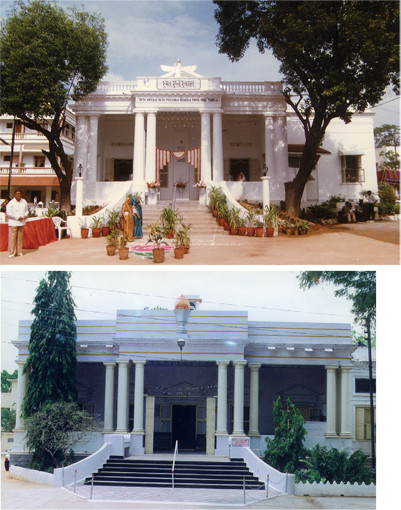
Seth Viccaji and Seth Pestonji Meherji Parsi Fire Temple (above) and The Bai Maneckbai Nusserwanji Chinoy Fire Temple (above)
Kathi (baval wood) is obtained from the local market through an arrangement which has been in existence for over two decades. The funds for kathi are provided by the Anjuman and occasionally augumented through donations.
In the present arrangement, the charges for undertaking various kriyas are fixed by the managing committee of the Anjuman. Procurement of fruits, flowers, vegetables, groceries are handled by the vada mobed and the amount for such purchases are reimbursed by the Anjuman. The rates fixed by the Anjuman are extremely reasonable and the behdins are in a position to perform the kriyas at affordable rates.
During the muktad period it becomes extremely difficult to handle the prayers by the two mobeds of the Anjuman Dar-e-Meher and every year the services of two outstation mobeds are requisitioned by the Anjuman. The muktad ceremonies are performed in two slots of group prayers in the Anjuman Dar-e-Meher. This novel concept of group prayers was introduced over a decade ago due to paucity of mobeds and constraints of time. Separate prayer ceremonies are held for only those Zoroastrians who have passed away during the year. The Anjuman has been unsuccessful in employing a third mobed for which post advertisements were given in various newspapers.
In the past, religious institutions originated through the fervor and deep devotion of the community members and were maintained with great dedication. At present many improvements have been instituted in our religious institutions and the upkeep and the maintenance of our Dar-e-Meher has been continuously praised by outstation members, particularly its cleanliness, its order, and the clockwise efficiency of the committed teams of both the mobeds and the managing committee.
To enable our glorious religion to continue to survive even in future, we have instituted many ways by which worshippers would be attracted to our Dar-e-Meher. One such recent form of worship is the introduction of the humbandagi which is held on every Tuesday at the Anjuman Dar-e-Meher and on all Mondays at the BMNC Fire Temple. The humbandagi at both the agiaries are normally led by the vada mobed.
All our jashan ceremonies are very well attended and it is gratifying to know that the ceremonies conducted at the dakhma are also well attended by the young and older members of the community. Daily attendance at the Dar-e-Meher is fairly good with at least 20 worshippers offering prayers and ‘baj’ ceremonies are frequently performed at the request of family members.
Religious classes are conducted by the Zoroastrian Stree Mandal as well as in the Parsi School to impart religious education to the children. Hence it is felt that the Anjuman Dar-e-Meher serves its purpose of giving spiritual satisfaction to its worshippers and encouraging ethical conduct among its members.
Gulbanoo Chenoy is the president of the Parsi Zoroastrian Anjuman of Secunderabad and Hyderabad.
◆ ◆ ◆
From the archive