
Religion
Birds of passage
After being served by three generations of the Rao family, Indore has struggled to find and retain priests
Our forebears were enterprising and ventured into parts of what is now Madhya Pradesh. They fostered the religion and that would explain why places like Indore, Mhow and Neemuch have agiaries as well as dakhmas which are still functional. Some settled at important towns like Bhopal, Jabalpur and Ratlam.
As was expected of small communities living in strange lands, the Parsis settled in clusters and thus in Indore one such cluster came to be known as Parsi Mohalla. The name and locality still survives though it does not boast of more than a couple of families today. That is also the story of the Parsi population. In the absence of any reliable record it would be difficult to say but the general view was that there were initially more than 500 Parsis which number has today declined to about 170 or so.
It went to the credit of the late Hormusji Maneckji Bhamgara to build an agiary and dharamshala as far back as 1878. The Bhamgara Dar-e-Meher in Indore was maintained and looked after by Sir Dinshaw Maneckji Petit. The Parsi Anjuman of that time decided on December 27, 1888 that the moneys so collected by Petit be transferred to the Bombay Parsi Punchayet to an account called Shri Indore Zarthosti Anjuman Dharam Fund on certain conditions. The interest was to be used to maintain the agiary and dharamshala and to pay the priests.
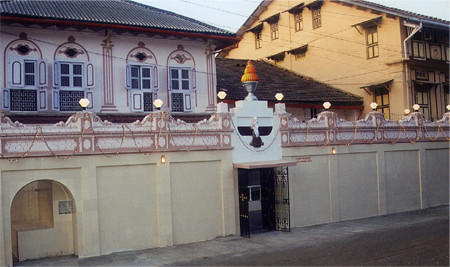
Indore;
The agiary was rebuilt in 1920 thanks to the personal effort and munificence of the late Mr Plumber. There have been some repairs and renovation but the agiary is in the same place. This is the only Dar-e-Meher in Indore. The closest other agiary is located in Mhow, about 25 km away.
Ever since the agiary was established in Indore, the community had the good fortune to be served by three generations of the Rao family who were the original panthaks. They were wise, religious and kind people, deeply loved and respected by the community. Even in public, they occupied a pride of place. Ervad Nariman Rao was the last from that lineage and when he left Indore we were served by a few mobeds ending with the late Ervad Behramshah Kapadia. After his demise, mobeds have come and gone. Indeed, they were difficult to come by. Some turned up as birds of passage and left us in the lurch. Either the remuneration and perks did not satisfy them or the place was not attractive, especially to the spouses! At last we have been able to find one and have appointed Ervad Dhunjishah Karanjia as panthaky and hope that he will continue.
In the present circumstances, the agiary is not self-sustaining and has to be subsidized by the Anjuman. The Anjuman gets no income from the temple. By tradition and practice, the priest collects money on sukhad and divo and jashans and other prayers in the agiary. A good mobed can generate a fair amount of extra income and this possibly acts as an incentive to be here.
Muktad prayers are conducted every year and the proceeds go entirely to the priest and here again the Anjuman earns nothing. Thus the muktad prayers are a big attraction to the priest. It has been our experience that where the mobed is sincere and can articulate well, the muktad prayers have been successful. Another success factor is the availability of additional mobeds. This has proved difficult on some occasions because at this time they are in demand and cannot forsake their commitments. Fortunately we have been able to hold these prayers every year. Generally, there have been six to eight tables with 16 to 18 vases.
It must be remembered that the Anjuman maintains the dakhma. This requires a whole-time chowkidar. There is also a part-time security in the agiary complex. Salaries, cost of kathi, electricity, water, municipal charges and insurance are the main items of expenditure. The cost of keeping the fire burning is on the increase. There are some old structures like priest’s quarters (over 100 years old) which require constant attention.
The Anjuman depends on subscription, earnings from the dharamshala and two halls, and interest on investments. Subscription is more or less static. Sadly all the Parsis staying here are not members of the Anjuman. Their argument is that if they can visit the agiary and avail of its benefits, what is the need to be a member? The community does not understand that each one has a commitment to the temple and its surroundings. Hence, with our limited and dwindling resources, perforce we have to depend on donations and contributions. Although a large number of our members are well-to-do there is an unusual reluctance on their part to donate to the Anjuman. For many years, we have been trying to obtain sanction under section 80G of the Income Tax Act. Perhaps if this comes through, there may be a change of heart towards the Anjuman.
The original settlors of the Indore Parsi Anjuman were Seth Hormusji Maneckji Bhamgara; Seth Mancherji Maneckji Edibam; Seth Hormusji Navroji Cooper and Seth Jamasji Dadabhai Navroji.
The Indore Anjuman could boast of setting up a school which was called J. N. Petit’s Zoroastrian Elementary School. It was established on September 11, 1866. The building to house the School was completed in 1893 thanks to the generosity of the late Bai Avabai Nusserwanji Petit and she presented it to the community to perpetuate the memory of her late son Jamshedji N. Petit. An annual grant of Rs 120 was paid to the School for the English education of Parsi children. Upto 1875, the priest was employed to teach the children but when it was found that he could not spare time, a full-time separate teacher was appointed. Eventually the School closed down many years ago, possibly for want of students.
Another interesting sidelight of that time was that a few Parsis who had settled in Indore (which was then the princely state of Holkars) were mostly employed as clerks in the service of the British agents/governors and gained their favor to such a great extent that one of them, Mancherji Edibam, was taken to England. He had the coveted honor of being one of the first Parsis to visit England.
Presently the affairs of the Anjuman are managed by the board of trustees. Notwithstanding our difficulties and problems, the trustees, individually and collectively, have a deep commitment to keep the flame alive and serve the community. This is our abiding faith.
Bomi Heerjee is the president of the Indore Parsi Zoroastrian Anjuman.
◆ ◆ ◆
From the archive