
Zoroastrians Abroad
FJ's new team
The retirement of Roshan Rivetna after 15 years as editor-in-chief of the FEZANA Journal (FJ) — the mouthpiece of the Federation of Zoroastrian Anjumans of North America (FEZANA) — marks a watershed in the development of a publication that has taken pride of place among community journals around the world under her leadership. The gutsy yet gentle Rivetna provided news of happenings in the Zoroastrian world while creating issues dedicated to major sectors of community involvement guest edited by persons best acquainted with the topic, ensuring all the while that all shades of opinion were represented. With the passing of the baton to former FEZANA president Dr Dolly Dastoor, a new chapter opens in the life of the publication.
Current president of the Zoroastrian Association of Quebec, Dastoor’s involvement with the community in North America is legion. "Dynamic and hard-working” is how Rivetna and Khorshed Jungalwala, chair of the FEZANA publications committee, describe the lady who in the course of the years has functioned as FEZANA’s first secretary, produced the first strategic plan for the North American community during her four years as president, chairs its Academic Scholarship Program and co-chaired the thumpingly successful Seventh World Zoroastrian Congress (7WZC) in Houston in 2000. Her journalistic credentials include the years as associate editor of Gavashni (now defunct), the scholarly quarterly launched by Ervad (Dr) Jehan Bagli and, thereafter, as guest editor of several FJ editions, as note Rivetna and Jungalwala.
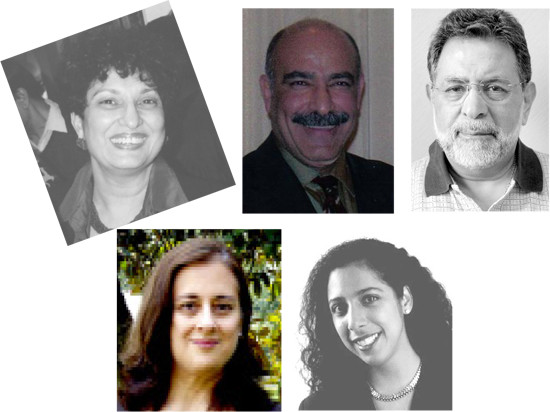
Clockwise from top left: Dastoor, Khanizadeh, Byramjee, Alphonse and Fitch
Always in the thick of things, Dastoor has presented thought provoking papers at North American and World Congresses as well as at the Parliament of World Religions. The outspoken grandmother of four is a geriatric neuropsychologist, the clinical-administrative head of the Program in Dementia with Psychiatric Co-morbidity and assistant professor in psychiatry at Montreal’s McGill University.
A new team of volunteers takes over the responsibilities of the FJ under Dastoor. An editor at the Boston Globe and freelance writer, Lylah Alphonse is consultant editor. Assistant professor of biology at Laval and McGill Universities of Montreal, Dr Shahrokh Khani-zadeh is in charge of graphics and layout. Graphics designer Feroza Fitch of Bethesda, Maryland, an active member of the Zoroastrian Association of Metropolitan Washington (ZAMWI) who functions as secretary of the Fali Chothia Charitable Trust, has undertaken to design the FJ’s cover pages. Coomi Gazdar is Dastoor’s technical assistant.
Owner of Toronto’s Regal Press Canada, Marzi Byramjee, will now print the Journal at a discounted rate. Hitherto the Whitehall Printing Company in Florida had printed the Journal. The mailing and distribution function, once a quarterly event at the Rivetna household in Chicago where area volunteers gathered to "sort, stamp, paste, bundle… and load two wagons with mailbags for the post office,” has now been split up with former FEZANA secretary Arnavaz Sethna and her husband Hoshang and volunteers from the Zoroastrian Association of Houston ensuring the postal delivery to US subscribers while Byram-jee along with founder president Kobad Zarolia and volunteers from the Ontario Zoroastrian Community Foundation do likewise for the Canadians. Dilnavaz Shroff and Shazneen Rabadi Gandhi come in as contributors of special interest and children’s stories respectively. An interfaith section is in charge of ZAMWI’s Behram Pastakia. Between the covers is Hoshang Shroff’s territory. Houston’s Homi Davier of Capricorn Travels and Dastoor’s co-chair for the 7WZC takes on the business portfolio while Rusi Gandhi continues as business manager.
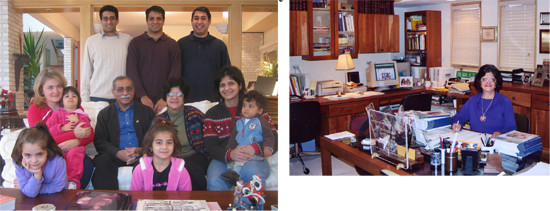
Roshan Rivetna at her ‘Journal’ desk and (left) with the family
Many other members of the old team also continue with their assignments. Thus Farobag Cooper, Jamshed Udvadia and Dolly Malva continue as copy editors; Kershaw Khumbatta and Arnavaz Sethna as subscription manager and assistant subscription manager respectively; Nikan Khatibi and Ushtavaity Davar for Youthfully Speaking; Mahrukh Motafram and Fereshteh Khatibi for the Milestones and Farsi components respectively.
Providing a glimpse of what is likely to come, Dastoor notes in her first editorial (Spring 2006), "We are living in challenging and changing times from when the Journal started. We are bombarded with information from cyber-space almost every hour from all over the world. What is news today is history tomorrow. So the challenge for the print media, like the Journal is how to present information and news which is already known, and at the same time sustain the interest of the reader. You have spoken in the survey which was circulated and we have listened. Future issues will reflect the changes you have suggested as to the frequency of publication and content…
"Starting with this issue every effort will be made to broaden our pool of contributors and a whole new generation has stepped forward, as scholarship winners and as contributors to the featured articles of Generation Why.” Indeed, the whole Spring issue of the Journal is replete with the voices of youth expressing their joy in being Zarathushti and what the religion means to them, how it needs to be practiced and what goals to set for themselves.
The Rivetna touch
Roshan Rivetna’s retirement after 15 hectic years as editor-in-chief of the FEZANA Journal (FJ) has unleashed a tide of tributes to her devotion and zeal, her commitment and composure, her penchant for organization and sheer intellectual ability. The messages hail not only from all over North America but from the UK, India and Australia as well. They provide an idea of how many lives she has touched.
Rustom Kevala, current FEZANA president who was the chair of the publications committee in 1991, recalls how the Journal was then a simple provider of news about FEZANA activities and those of the community in North America, published in tandem with the Quebec based more scholarly Gavashni. "But,” he notes, "when Gavashni ceased publication, the Journal had to fill the gap somehow.” That was when FJ began to include articles about religious matters written by knowledgeable Zarthoshtis. "This idea was a success and the Journal just took off and had a life of its own.” Kevala stresses that during the time Roshan had a "responsible full-time technical position at Lucent. She was also the silent voice behind husband Rohinton, working together during those early formative years of FEZANA. And on top of that she was a full-time mom to her three growing children. I marvel at how she managed all these activities without ever complaining, without uttering a cross word (at least in public), never refusing to listen and make last-minute changes.” There was an off-side however: the need to allow for the sensitivity of the authors when their articles had to be shortened or edited. Kevala says, "It needed the height of diplomacy to get them to agree to changes. Through all this the tone of the Journal had to be kept neutral. With Roshan as the editor-in-chief, typesetter, layout person and everything in-between, my job as the committee chair was easy.”
The Journal "educated us Zara-thushtis, elevated and enthused us for well over a decade…making us prouder of who we are,” notes former FEZANA congress chair Bella Tata of Vancouver.
Writes Behram Pastakia of Washington DC: "One of Roshan’s constant laments has been the inability to find articles in past issues of the FJ and make the contents easily accessible to youth members who are comfortable in cyberspace. Her constant pleas of making the published pieces available on an easily searchable web page have been ignored. In her usual style of responding to such indifference, she has decided to put all the past 60 issues she birthed on the internet, herself!” Pastakia makes a plea to readers who may be willing to sponsor costs or aid the task in other ways.
Bombay based author and publisher Marzban Giara attributes two of his successful activities to Rivetna. In 1998 she requested her niece in Bombay to send her a list of Parsi statues. This inspired Giara to bring out his book on Parsi statues. "Until then nobody had ever made even a list of Parsi statues,” he notes. It was again Roshan’s suggestion to start a service by which people all over the world could order books on the Zarathushti religion, Parsi history, etc by e-mail, paying by credit card, which led to the birth of the Parsiana Book Club three years ago, writes Giara.
"Writers and caterers have common problems. Both find it difficult to cater to all tastes. Editors and official tasters of the prepared food seem to carry even a bigger burden. During medieval times the ‘Royal tasters’ and the ‘Official organizers’ of ecclesiastical manuscripts found themselves at great risk. But Roshan, born of a different grit, weathered graciously many irascible storms in her stride, first as editor, then as editor-in-chief. She looked forward, in a most compulsive and incorrigible way, (to) the organization of the next edition,” writes surgeon and amateur historian Dr Sam Kerr of Sydney, Australia.
"As coordinator of articles from all persuasions…an editor plays many roles as an educator, historian, researcher and advocate for social awareness. Roshan Rivetna excelled in rising above the community’s internal politics by keeping a respectful balance,” notes Shahrokh Mehta of Syracuse, New York.
But to know what went on behind the scenes we turn to the testimony of her son Cyrus, a professional architect:
"If millions of years of evolution could occur in just 15 years, I’m certain that I have witnessed the transformation of my mother, Roshan Rivetna, into a unique organism found only in Hinsdale, a suburb of Chicago. Chair, keyboard and body have fused to create the Journalosaurus Rex – the ideal organism for producing and mailing FEZANA Journals every three months.
"My mom’s transformation began with a frantic month of cutting and pasting, after work and on weekends, to create a short and informative pamphlet. Fifteen years later the pamphlet has grown into a 160 page journal and the Journalosaurus had evolved and is optimized to allow for production 12 hours a day (minimum), 7 days a week, 51 weeks a year (the missing week is explained in the following paragraph). The journal cycle is continuous and overlaps; when one ends, the next is already being produced.
"The Journalosaurus has two rituals. The first and more frequent is the ‘Mailing Day.’ Once every three months the Journalosaurus will induce a minor metamorphosis to allow for the distribution of the journals. She slightly alters her domain with folding tables and chairs to accommodate the flock of friends who gather to tape, insert, label, stamp, bind and bag the thousands of FEZANA Journals that have filled the garage. For their efforts the flock is rewarded with laughter, gossip and a delicious meal effortlessly prepared by the Journalo-saurus. The second ritual is the FEZANA annual general meeting. For that week, she sheds chair and keyboard, and fills her suitcases with spare journals, files and notes. She flies to the host city to meet with other FEZANA members to discuss the next year’s journals. Then she returns to Hinsdale and quickly regenerates chair and keyboard and continues with the regular journal cycle.
"The Journalosaurus has a mate that she relies on and can’t live without. She fearlessly guards it, and politely asks that nobody touch it. So effective is her simple plea that her cohabitants instinctively avoid that corner of the dwelling, for fear of accidentally causing a ‘disastrous’ malfunction to her faithful Macintosh G4.
"Like many unique organisms, the Journalosaurus has a few mysteries. The most perplexing question is – Why? Community devotion? Religious devotion? Lack of anything else to do? Voice her opinions? For the challenge? As one of her three offspring, I can tell you that none of these apply. I suspect that the Journalosaurus does what she does because she does.
"However, showing extreme intelligence, the Journalosaurus has decided to stop doing what she does. With the completion of the winter 2005 journal, the Journalosaurus sheds her keyboard and chair a final time, and steps aside to allow a new and equally qualified team to take over her duties. As a proud and curious son, I look forward to seeing what my mom (the now extinct Journalosaurus) will evolve into and perfect next.”
Compiled by Arnavaz S. Mama
◆ ◆ ◆
From the archive