
Events & Personalities
Indo-Iranian initiative
"There is a lot of Indian investment in Iran," stated Minoo Shroff, president of the Inda-
Iranian Friendship Society (IIFS) and chairman of the Bombay Parsi Punchayet (BPP) addressing a gathering of invitees and Iranian consular corps officials on June 27, 2006 at the Kilachand Conference Hall at the Indian Merchants' Chamber building. "Trade is ample" but industrial ties, joint venture projects "are not so many," he noted.
Shroff was part of a 17-member delegation of Indian office bearers of the IIFS who visited Iran at the invitation of the Iranian government in May this year. Other invitees included BPP chief executive officer and vice president of IIFS Behram Dastur, Mehli Colah, chief financial officer of the BPP, and Havovi and Godrej Dotivala, the latter being the public relations officer of the BPP.
Shroff, who has visited Iran four times over the last 30 or so years described Tehran during the Pahlavi dynasty as "very glitzy," akin to "any mid sized European city." At that time Iran produced around six 'million barrels of oil a day at eight US $ a barrel.
Today Iran produces four million barrels, of which 2.8 is exported at US $ 70 a barrel! They want to "conserve this valuable" irreplaceable resource, said Shroff explaining the reason for the cutback in production. Saudi Arabia in contrast produces 10 million barrels of oil per day. Iran expects to earn $ 380 billion in oil revenue in the next five years (caviar, carpets and nuts are the other major exports).
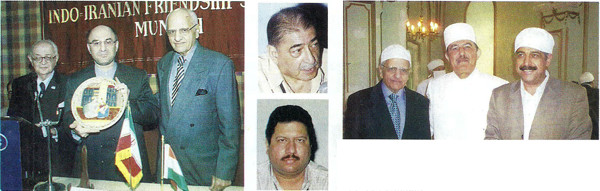
From left: Dotivala, Shokrani Shroff; Dastur (above) and Colah; in the foyer of Tehran's Bhikha Behram Agiary: Shroff, Dr Ardishir Khorshidi and Koorosh Niknam
Petrol in Iran is priced at Rs 3.60 per litre as versus around Rs 50 in India. Diesel is one rupee a litre in Iran. 'Their per capita income is twice ours," said Shroff. Iran is half the size ofJndia with a population of70 million, he noted.
Describing Iran as "a confident nation on the move," Shroff opined people were "well groomed, disciplined and self restrained ... one hardly saw any policemen." The government wants to "open up" the economy. "They want to liberalize and downsize government. .. 65 percent of women go to university. They are educated out of choice." He described the women as "attractive and beautiful" and "not shy to talk with a stranger."
The bazaars had an oriental ambience and one had to bargain as in India, noted Shroff. "The US dollar is the most preferred currency ... air connectivity within the country is good." Referring to Iran's great cultural heritage Shroff said the Iranians took pride in maintaining their monuments.
A similar ·sentiment was expressed by Dastur who observed that unlike in India, the Iranians knew how to preserve their heritage. "The mosques are truly worth seeing ... In India, the holier the place, the dirtier it is." Many Zoroastrian artifacts were on sale, he noted and many of the "buyers are Muslims."
Dastur bemoaned Iran's policy of not accepting credit or debit cards, thus throwing a dampener on tourism. He noted more English speaking guides were required and that the shopkeepers "hardly speak English." Encouraging Indians to visit Iran, the consul general Mohammed Shokrani noted that all the four seasons existed in Iran at the same time. Iran ranked seventh in UNESCO' s list of countries that preserved their historic monuments, museums and fostered cultural activities.
Dotivala who compered the event and also presented an interesting slide show said that India was the motherland of Parsis and Iran, the fatherland.
◆ ◆ ◆
From the archive