
Politics and Policy
Declining and defunct
The executive council of the Federation of Parsi Zoroastrian Anjumans of India discuss the twin issues of an aging community and defunct anjumans
The proposed amendments to the Federation of Parsi Zoroastrian Anjumans of India constitution and other contentious issues discussed at the Federations' executive council meet on March 25 and 26, 2006 were published in Parsiana, April 7, 2006.
This issue reports on questions of demography and defunct anjumans.
Demography
Citing facts and figures from the TISS (Tata Institute of Social Sciences) studies on the community (see "Propping up the community,” Parsiana, March 21, 2006) Bombay Parsi Punchayet (BPP) chairman and Federation president Minoo Shroff sought a "supreme collaborative effort” from the anjumans, urging them to address problems of aging, declining numbers and levels of education and income, health and familial patterns in their own jurisdiction.
Lt Gen (Retd) Adi Sethna, president of the Delhi Parsi Anjuman (Registered Trust) spoke of the Agewell Foundation, a non-governmental organization operating all over India, assisting the elderly and giving confidence to them by visiting and talking to them, providing a helpline for the 70+ membership who pay a one-time fee of Rs 5,000 per head. There is a demand for setting up an old age home in the Mengusi Dharamshala complex, he said, adding, "We have much to learn from Dinshaw and Bachi Tamboly (who run two senior citizens’ homes on behalf of the World Zoroastrian Organisation in Navsari). We are now placing demands on our children and grandchildren. Because we are aging, we keep pulling the others down,” he noted and referred to para helpers in Kerala who go to the elderly in their homes, take their temperature and blood pressure, ensure that medicines are taken.
The Calcutta Zoroastrian Community’s Religious and Charity Fund (CZCRCF) have a similar system. It’s trustee Bahadur Postwalla said the service was launched when Navaz Garda, a 50-year-old volunteer, started taking care of 14 persons. The senior citizens are happy with the attention and Garda now has an assistant, he said. Postwalla said they had set apart two rooms in their dharamshala for the use of the aged but there were no takers. "The demand for senior citizens’ homes may decline because the elderly prefer to remain at home with such caregivers,” he opined. Of course, Bombay would require professionals who would need to be recompensed heavily, he added.
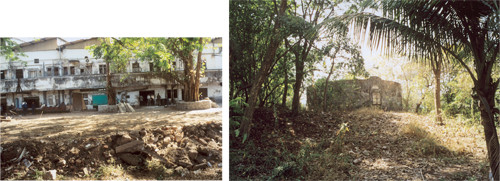
Above: Thana dakhma boundary wall levelled by a neighbouring industrial estate’s hired bulldozer. Right: Thana dakhma
An old age home (OAH) provides security, contended Federation joint-honorary secretary Keki Gandhi and Postwalla agreed that that factor did not feature in Calcutta because the small community lives in centrally located areas. The volunteer is available to take them to hospital, pay advance deposit when necessary.
The initial shift from residence to institution can be quite traumatic for the concerned individual, noted BPP trustee and managing director of the WZO Trust Funds, Dinshaw Tamboly. "The first two or three months are crucial,” he said as the new inmate becomes depressed, needs psychological care. But then the sense of security takes over. A building is better, he opined, and it needs to be close to a hospital for a quick shift in an emergency. "Four or five (inmates) at a time are often in hospital with broken bones. They also go berserk with their diet and have gastro upsets. We treat them as extended members of the WZO family,” said Tamboly adding that the second center is now full and "we are talking to donors interested in a third center…Irrespective of charges (inmates pay as able), there is no preference in the treatment of the inmates.”
BPP CEO Behram Dastur referred to their Parukh Dharamshalla which accommodates about 100 aged persons, some fully paid, some partly paid and some free, looked after by the staff supervised by a committee of lady volunteers. A medical officer and a volunteer doctor, plus day and night nurses look after them but the inmates suffer from a "sense of abandonment…There is no communication from their families.” "The elders feel they want to die,” agreed Shroff. There are already wards in the J. J. and Masina Hospitals and Pallon Mistry is building a new one at the B. D. Petit Parsee General Hospital, he informed the delegates. Tamboly agreed that the J. J. Ward and the Parukh Daharamshalla are fully patronized. Not so the facility in the Bahadurji Sanatorium in Deolali where the cottages are secluded and help in time of illness at night is difficult to get. He was in favor of more OAHs in Bombay in the next 50 years: "We are already an aging and ailing community.”
"What do you do with infirm people in the baugs?” wondered Shroff, noting that when they stay on in hospitals, they impinge on the higher utility value of hospital beds. But Tamboly reminded him that Surat and Navsari have excellent homes for the infirm. Federation honorary treasurer and CEO of the Sir J.J. Trust, Farrokh Rustomji referred to the long waiting list for the 45 beds in the J. J. Ward and noted that ex merchant mariner Adi Mistry is setting up an OAH in Poona. Thana trustee Pervez Bhesania said there were plans for building on the land around the Thana dakhma where the intention was to keep the ground floor for old people.
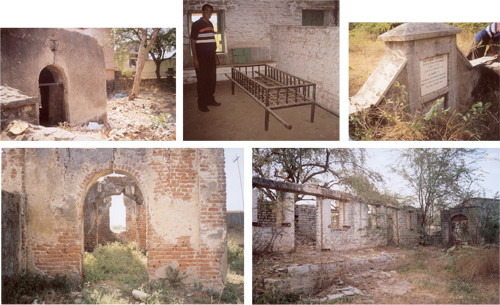
Defunct anjuman properties in variousparts of Andhra Pradesh: Clockwise from top left: Bungli at Gulbarga aramgah, a metal bier, a grave stone and room for mourners in Shahabad, Nizamabad aramgah bungli
The Poona Parsi Panchayat is building a three-storey hostel for students and working people, said its committee member Tehmasp Bharucha. They were also contemplating a new building where flats on long lease would be available to any Parsi who can afford the cost of construction. Sethna spoke of the textiles and embroidery workshops organized by Parzor to revive old skills and help the community economically and psychologically. The third in the series is scheduled for Bombay from April 24-30, 2006 at the Khareghat Hall.
The Mysore University has clear-cut instructions to provide a few seats for Parsis in undergraduate and post graduate departments, said Sethna who is trying to get a similar ruling for Bombay University from the Maharashtra Government. The Gujarat education department is prepared to do likewise, he noted, adding, "This is not reservation. The students have to get through the central entrance test. Our students fare poorly. They need lots of encouragement.”
Sethna also emphasized the need for the community to talk about itself to others, increase participation in the general welfare so as to be better known and understood. Shroff, who has been invited by Maharashtra chief minister Vilasrao Deshmukh to join the Citizens Action Group, noted, "We are not bold enough. Some effort to project the community must be made. In public life you have to answer questions…”
Dastur spoke of the BPP’s financial support for the third child and the six groups of private tuitions instituted for students facing board examinations. President of the Ahmedabad Parsi Punchayet and vice president (west zone B) of the Federation Areez Khambatta noted that the World Alliance of Parsi Irani Zarthoshtis has arranged to provide mobeds on short term to small anjumans in need of them.
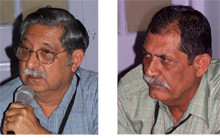
Aspi (left) and Omim Debara
Defunct anjumans
Aspi Debara of the Parsi Zoroastrian Anjuman of Secunderabad and Hyderabad spoke of defunct anjuman properties in Warangal and Nizamuddin, Gulbarga and Shahbad. According to his information, backed by photographs, the aramgah land at Warangal had been contiguous to the residence of a member of parliament but now there was no sign of it. At Nizamuddin a lone Parsi operating a transport business has preserved two acres of aramgah land on which the locals are trying to encroach. The walls have been broken and there is no one to look after the graves. At Gulbarga there are two Parsi families. Surrounded by posh homes in the upmarket area, the aramgah has become the locality’s dumping ground. Should we sell or develop the place? wondered Debara. In Shahbad the 30 acres of aramgah land is occupied by locals who have even got it transferred to their name. One Irani gentleman is trying to reopen the case, noted Debara.
Omim Debara, also of Secunderabad informed the gathering that no documents were available for any of these places. But Bardoli Zarthosty Anjuman president Jamshed Mohta advised him to put barbed wire on the land, search for the records in the city survey office and inform it that this is vacant land.
Debara’s information added a few new names to the defunct anjuman subcommittee’s long list. Its coordinator Sorab Katpitia’s litany of Parsi lands encroached, locked in litigation, often a victim of apathy or chicanery on the part of the last survivors in the area, continues to depress listeners. In Khergam, Bhusaval, Bhownagar, Disa, Nanded, Neemuch, Jalgaon, Ghadak, Cambay, Junagadh the community has been the victim of greed, lassitude, internecine fights and land sharks. Even where one round of the litigation has gone in the Federation’s favor, the defendant has gone into appeal. Where an agreement is reached, another member of the community feels he can do better, then backs out and the government presents a notice of requisition as happened in Ghadak. As Katpitia pointed out, there is a multiplicity of legislation and litigation has to be fought on many fronts. "Because of the litigation the properties are still technically in our possession. Eighty percent is legal work, 10 percent revenue work and 10 percent administrative.”
Though an assistant to help Katpitia has been on the Federation’s priority list for some time, none has been forthcoming. Katpitia spoke of a retired mamlatdar from Vapi who he had tried to send to the BPP to confer. Dastur spoke of two shortlisted candidates to whom he had given a profile of the job but so far no administrator had been appointed.
Shroff referred to three people from Khergam who had met him in regard to the dakhma property and dharamshala in the main bazaar area worth over 30 lakh rupees in Katpitia’s estimation. "Their attitude was: who says we are defunct? They did not want the Federation to involve itself, suggesting vested interest. We need people who can deal at the ground level. Some want profit sharing. Are we prepared for it?” asked Shroff.
In answer to persistent demands for a "time bound program” Gandhi noted that Shroff, Tamboly, BPP trustee and Federation joint honorary secretary Dinshaw Mehta, Katpitia and BPP trustee and solicitor Burjor Antia were members of the subcommittee meeting every month, talking to lawyers in various places. When anjumans were requested to help, the only one to offer its service was Bardoli, he added.
In his capacity as member of the National Commission for Minorities Sethna recounted that he had met the district administrator of Surat together with the Surat Parsi Panchayat, and learnt to his dismay that the SPP had not filed returns. As the meeting was on the last day of the stipulated period, Sethna’s intervention had saved the situation.
"Forget Katpitia, let a new secretary look after this work. Even 25 lakh rupees per annum for professional staff would be nothing compared to the value of the property in jeopardy,” Khambatta reverted to his anti-Katpitia stand. Countered Baroda president Jal Patel, "Katpitia is doing a great job but he needs help. Hiring professionals is a must. Areez, your point is great, but avoid deriding individuals.”
In the matter of dwindling anjumans the council appointed Mhow president Behram Masani as the Federation’s representative on the Neemuch anjuman, registered under the Madhya Pradesh Trust Act, as custodian trustee. "There is some reluctance. They are worried that the Federation will take away their properties. They may need the Federation’s consent if they are wanting to sell,” said Masani who was also requested to get hold of the revenue records for Bina and revert to the BPP. Indore president Heerjee, Masani and Ratlam’s Tehmtan Anklesaria were delegated the task of bringing the dwindling Gwalior anjuman under the custodianship of the Federation.
Masani protested that there is no representative of the Federation attending meetings of the Mhow anjuman where too it is custodian. "If you and the Federation are willing, I am ready to come once in three months,” volunteered Gandhi and Mehta proposed that he be given the authority to do so.
Though only 65 of Mhow’s 157 members continue to live there, about 75 percent of them are over the age of 70. Masani is worried about what will happen to Parsi properties there worth crores of rupees. Gandhi wondered whether the property could be bequeathed to another anjuman or trust. Rustomji believed there is a provision in law whereby an anjuman can amalgamate with a neighbor with the permission of the charity commissioner. "When the population falls below 15 the Federation will take over the administration of the anjuman. Masani’s fear is that the Federation will not be informed of that fact,” noted Gandhi.
Emphasizing the rehabilitation of members of a dwindling/defunct anjuman Khambatta said that the younger generation should be rehabilitated in larger cities with funds from the sale of their anjuman’s properties. Gandhi explained that so far only two lakhs from the sale of Khandwa property was available for use and had been credited to the Khandwa anjuman account. "If there are any residents left, the money will be used for their benefit. If former Khandwa residents are living elsewhere, they will have second claim on the money. Only thereafter will it be available for general use,” he noted. In other cases, earnest money or deposits need to be maintained in separate accounts until all litigation is over. As for private property, the Federation can involve itself only if the proprietor asks for its help, Gandhi added.
Digging out old minutes Khambatta alleged that 12 lakh rupees had been received from defunct anjuman properties. Though Shroff sought to reassure him that "nothing is amiss,” Khambatta begged "to differ,” pointedly asking for progress before and after 1996 when Rustom Anklesaria, former CEO of the BPP, resigned from the defunct anjuman subcommittee. Gandhi requested the BPP to tabulate the figures of amounts received under various heads.
"The BPP and Federation are taken to task. But how many anjumans have contributed? How do we keep asking for results every six months?” questioned Iranian Zaroastrian Anjuman (IZA) vice president Pervaz Irani adding that the achievements have been the work of volunteers. "In the IZA we haven’t been able to get our own land back. You may be be a very successful businessman,” he told Khambatta, "but you are talking of other people’s property. For 12 years you have been coming here. What have you been doing? Now you are digging up past records, records passed with your consent. You are talking under someone else’s influence!”
Whenever Khambatta was cornered he shouted, "I’m a flavorist. I don’t know land laws…”
"Bardoli is the only one from 70 anjumans who offered to help but did not have a copy of the defunct anjumans report. Col Allavali also offered help from Bhopal. But 68 other anjumans had nothing to say. Tell us what you will do to help. Take a constructive approach. Progress may be slow but let us consolidate what we can,” urged Gandhi, alluding to the part played by the Federation in buttressing the fight of the Thana anjuman to preserve a part of the Divecha Trust land and of IZA president Mehrwan Irani in preserving the Tithal property as also Sethna’s help at several junctures. Mohta acknowledged that Katpitia’s report noted achievements also.
Cursetji informed the audience that even as they enjoyed their lunch he had received a call regarding encroachment on the dakhma property. The wall between the dakhma land and the adjoining industrial estate had broken down.”Before we could do anything, bulldozers came in and encroached on 1,000 sq ft of land. We spent two hours at the police station after the Federation session ended. Acknowledging the Federation’s support Cursetji said, "Let us celebrate these victories. In Ahmedabad trustee Farokh Kavina had worked to regain the land where shops have been built by the anjuman, increasing its income.”
Gandhi recalled how land in Poona and Bardoli had been saved by volunteers from the respective anjumans. "In most encroachment cases when things begin to deteriorate, one must take timely steps, strike the iron while it’s hot,” advised Mohta, ruing crores worth of encroachment on SPP lands due to lethargy or misplaced economy. "There was no barbed wire fence. One lakh of rupees was saved at great cost,” he noted.
Mehrwan Irani wondered why anjumans do not plant bawal trees on their dakhma lands which would help their agiaries and prevent encroachment at the same time. He was told that growing bawal is a time consuming process. It also leads to deterioration of the soil and hence a fall in value if there is any intention to sell. Mohta informed the delegates that Gujarat chief minister Narendra Modi had a scheme for farmers in conjunction with pharma companies. Government assistance was available for the production of certain plants and herbs according to given norms.
To be continued...
◆ ◆ ◆
From the archive